

Polyakova: Holocene Diatom Strati graph v and Paleoceanography
621
~
Cl u
~
::E
~
...:
~/I
0
~
=:
~
'?
~
Eli
i
~
~
0
u
>1
150
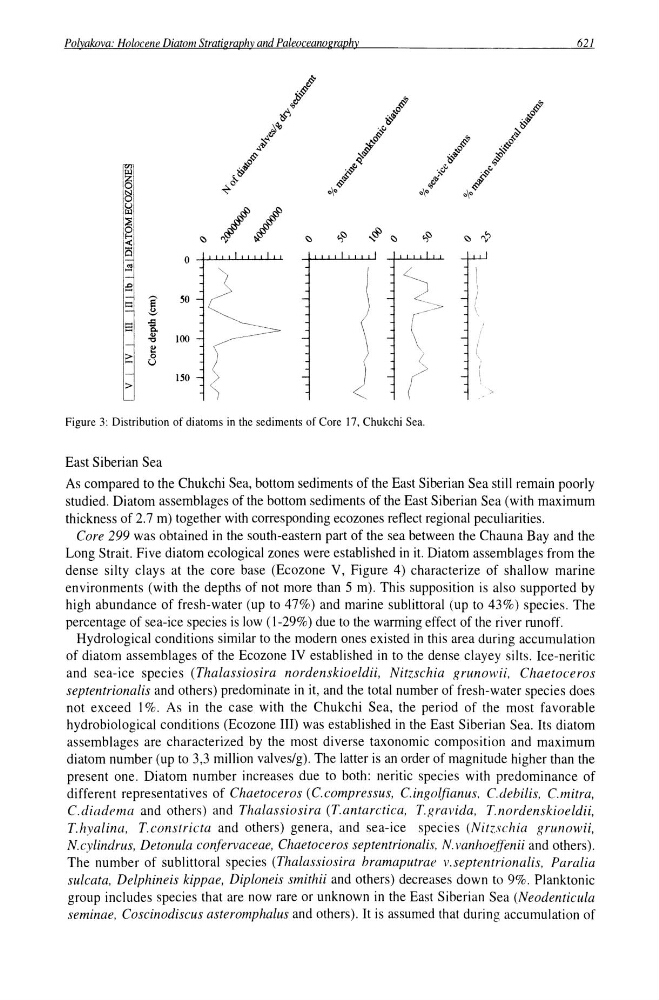
Figure 3: Distribution of diatoms in the sediments of Core 17, Chukchi Sea.
East Siberian Sea
As compared to the Chukchi Sea, bottom sediments of the East Siberian Sea still remain poorly
studied. Diatom assemblages of the bottom sediments of the East Siberian Sea (with maximum
thickness of 2.7 m) together with corresponding ecozones reflect regional peculiarities.
Core 299 was obtained in the south-eastern part of the sea between the Chauna Bay and the
Long Strait. Five diatom ecological zones were established in it. Diatom assemblages from the
dense silty clays at the core base (Ecozone V, Figure 4) characterize of shallow marine
environments (with the depths of not more than 5 m). This supposition is also supported by
high abundance of fresh-water (up to 47%) and marine sublittoral (up to 43%) species. The
percentage of sea-ice species is low (1-29%) due to the warming effect of the river runoff.
Hydrological conditions similar to the modern ones existed in this area during accumulation
of diatom assemblages of the Ecozone IV established in to the dense clayey silts. Ice-neritic
and sea-ice species (Thalassiosira nordenskioeldii, Nitzschia grunowii, Chaetoceros
septentrionalis and others) predominate in it, and the total number of fresh-water species does
not exceed I %. As in the case with the Chukchi Sea, the period of the most favorable
hydrobiologicaJ conditions (Ecozone III) was established in the East Siberian Sea. Its diatom
assemblages are characterized by the most diverse taxonomic composition and maximum
diatom number (up to 3,3 million valves/g). The latter is an order of magnitude higher than the
present one. Diatom number increases due to both: neritic species with predominance of
different representatives of Chaetoceros (C.compressus, C.ingolfianus, C.debilis, C.mitra,
C.diadema and others) and Thalassiosira (Tantarctica, T/{ravida. T.nordenskioeldii,
Thyalina, Tconstricta and others) genera, and sea-ice species (Nitzschia grunowii,
N.cylindrus, Detonula confervaceae, Chaetoceros septentrionalis, N. vanlweffenii and others).
The number of sublittoral species (Thalassiosira bramaputrae v.septentrionalis, Paralia
sulcata, Delphineis kippae, Diploneis smithii and others) decreases down to 9%. Planktonic
group includes species that are now rare or unknown in the East Siberian Sea (Neodenticula
seminae, Coscinodiscus asteromphalus and others). It is assumed that during accumulation of
621
~
Cl u
~
::E
~
...:
~/I
0
~
=:
~
'?
~
Eli
i
~
~
0
u
>1
150
Figure 3: Distribution of diatoms in the sediments of Core 17, Chukchi Sea.
East Siberian Sea
As compared to the Chukchi Sea, bottom sediments of the East Siberian Sea still remain poorly
studied. Diatom assemblages of the bottom sediments of the East Siberian Sea (with maximum
thickness of 2.7 m) together with corresponding ecozones reflect regional peculiarities.
Core 299 was obtained in the south-eastern part of the sea between the Chauna Bay and the
Long Strait. Five diatom ecological zones were established in it. Diatom assemblages from the
dense silty clays at the core base (Ecozone V, Figure 4) characterize of shallow marine
environments (with the depths of not more than 5 m). This supposition is also supported by
high abundance of fresh-water (up to 47%) and marine sublittoral (up to 43%) species. The
percentage of sea-ice species is low (1-29%) due to the warming effect of the river runoff.
Hydrological conditions similar to the modern ones existed in this area during accumulation
of diatom assemblages of the Ecozone IV established in to the dense clayey silts. Ice-neritic
and sea-ice species (Thalassiosira nordenskioeldii, Nitzschia grunowii, Chaetoceros
septentrionalis and others) predominate in it, and the total number of fresh-water species does
not exceed I %. As in the case with the Chukchi Sea, the period of the most favorable
hydrobiologicaJ conditions (Ecozone III) was established in the East Siberian Sea. Its diatom
assemblages are characterized by the most diverse taxonomic composition and maximum
diatom number (up to 3,3 million valves/g). The latter is an order of magnitude higher than the
present one. Diatom number increases due to both: neritic species with predominance of
different representatives of Chaetoceros (C.compressus, C.ingolfianus, C.debilis, C.mitra,
C.diadema and others) and Thalassiosira (Tantarctica, T/{ravida. T.nordenskioeldii,
Thyalina, Tconstricta and others) genera, and sea-ice species (Nitzschia grunowii,
N.cylindrus, Detonula confervaceae, Chaetoceros septentrionalis, N. vanlweffenii and others).
The number of sublittoral species (Thalassiosira bramaputrae v.septentrionalis, Paralia
sulcata, Delphineis kippae, Diploneis smithii and others) decreases down to 9%. Planktonic
group includes species that are now rare or unknown in the East Siberian Sea (Neodenticula
seminae, Coscinodiscus asteromphalus and others). It is assumed that during accumulation of