

Rossak et al.: Clav Mineral Distribution in Suiface Sediments of the Laptev Sea
593
In most regions kaolinite concentrations are < 15 % (Figure 7 and Table I). Only in the
western Laptev Sea concentrations are ~ 15 %. Highest values of up to 19 % were measured in
the Olenek- and the Anabar-Khatanga-Valleys (Table I).
lOS E
110"
lIS'
120"
125
130'
135'
140"
145' E
77'
76"
75
74
73
73
s
72
e
72"
I
71 ' N
110
115
120
125
140"
145' E
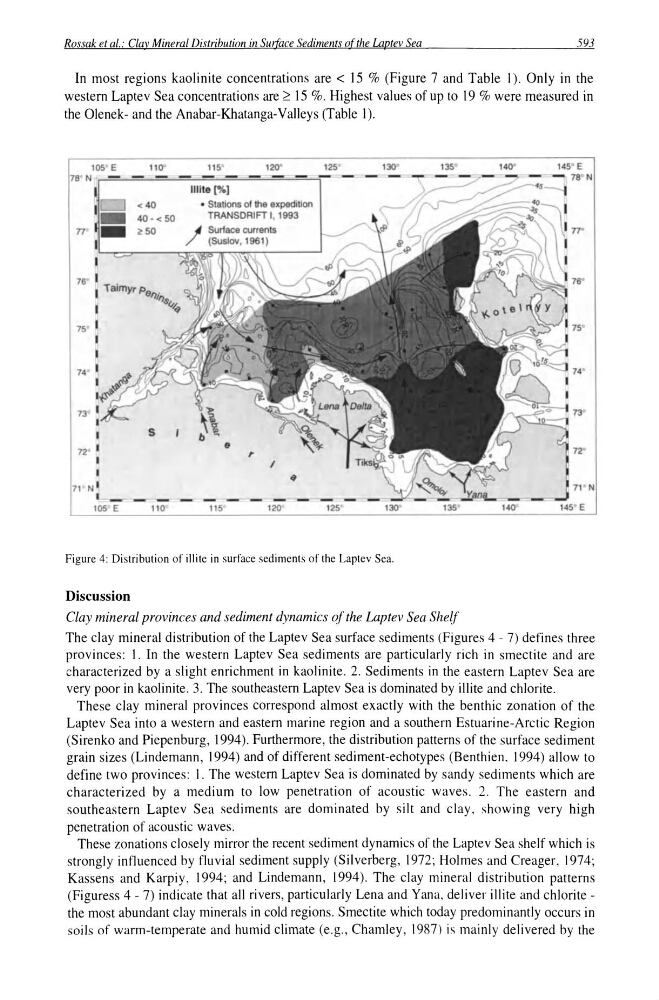
Figure 4: Distribution of illite in surface sediments of the Laptev Sea.
Discussion
Clay mineral provinces and sediment dynamics 0/ the Laptev Sea Shelf
The clay mineral distribution of the Laptev Sea surface sediments (Figures 4 - 7) defines three
provinces: I. In the western Laptev Sea sediments are particularly rich in smectite and are
characterized by a slight enrichment in kaolinite. 2. Sediments in the eastern Laptev Sea are
very poor in kaolinite. 3. The southeastern Laptev Sea is dominated by illite and chlorite.
These clay mineral provinces correspond almost exactly with the benthic zonation of the
Laptev Sea into a western and eastern marine region and a southern Estuarine-Arctic Region
(Sirenko and Piepenburg, 1994). Furthermore, the distribution patterns of the surface sediment
grain sizes (Lindemann, 1994) and of different sediment-echotypes (Benthien. 1994) allow to
define two provinces: I. The western Laptev Sea is dominated by sandy sediments which are
characterized by a medium to low penetration of acoustic waves. 2. The eastern and
southeastern Laptev Sea sediments are dominated by silt and clay, showing very high
penetration of acoustic waves.
These zonations closely mirror the recent sediment dynamics of the Laptev Sea shelf which is
strongly influenced by fluvial sediment supply (Silverberg, 1972; Holmes and Creager, 1974;
Kassens and Karpiy, 1994; and Lindemann, 1994). The clay mineral distribution patterns
(Figuress 4 - 7) indicate that all rivers, particularly Lena and Yana, deliver illite and chlorite -
the most abundant clay minerals in cold regions. Smectite which today predominantly occurs in
soils of warm-temperate and humid climate (e.g., Charnley, 1987) is mainly delivered by the
593
In most regions kaolinite concentrations are < 15 % (Figure 7 and Table I). Only in the
western Laptev Sea concentrations are ~ 15 %. Highest values of up to 19 % were measured in
the Olenek- and the Anabar-Khatanga-Valleys (Table I).
lOS E
110"
lIS'
120"
125
130'
135'
140"
145' E
77'
76"
75
74
73
73
s
72
e
72"
I
71 ' N
110
115
120
125
140"
145' E
Figure 4: Distribution of illite in surface sediments of the Laptev Sea.
Discussion
Clay mineral provinces and sediment dynamics 0/ the Laptev Sea Shelf
The clay mineral distribution of the Laptev Sea surface sediments (Figures 4 - 7) defines three
provinces: I. In the western Laptev Sea sediments are particularly rich in smectite and are
characterized by a slight enrichment in kaolinite. 2. Sediments in the eastern Laptev Sea are
very poor in kaolinite. 3. The southeastern Laptev Sea is dominated by illite and chlorite.
These clay mineral provinces correspond almost exactly with the benthic zonation of the
Laptev Sea into a western and eastern marine region and a southern Estuarine-Arctic Region
(Sirenko and Piepenburg, 1994). Furthermore, the distribution patterns of the surface sediment
grain sizes (Lindemann, 1994) and of different sediment-echotypes (Benthien. 1994) allow to
define two provinces: I. The western Laptev Sea is dominated by sandy sediments which are
characterized by a medium to low penetration of acoustic waves. 2. The eastern and
southeastern Laptev Sea sediments are dominated by silt and clay, showing very high
penetration of acoustic waves.
These zonations closely mirror the recent sediment dynamics of the Laptev Sea shelf which is
strongly influenced by fluvial sediment supply (Silverberg, 1972; Holmes and Creager, 1974;
Kassens and Karpiy, 1994; and Lindemann, 1994). The clay mineral distribution patterns
(Figuress 4 - 7) indicate that all rivers, particularly Lena and Yana, deliver illite and chlorite -
the most abundant clay minerals in cold regions. Smectite which today predominantly occurs in
soils of warm-temperate and humid climate (e.g., Charnley, 1987) is mainly delivered by the