

590
Land-Ocean Systems in the Siberian Arctic: Dynamics and History
4000 r.p.m., decanting the clear water. This washing-procedure was repeated until no more
clear water could be decanted after centrifugation. The cloudy water then was evaporated and
the coagulating clay minerals were returned to the centrifuged sample. Because of the very
small carbonate and opal concentrations, removal of these substances was not necessary.
105 E
78 N
77
76
75
74
73
72
71 N
I
105' E
110
S
110
115
120
125
130"
135
• ,.
I
•
lIS'
120'
125'
130'
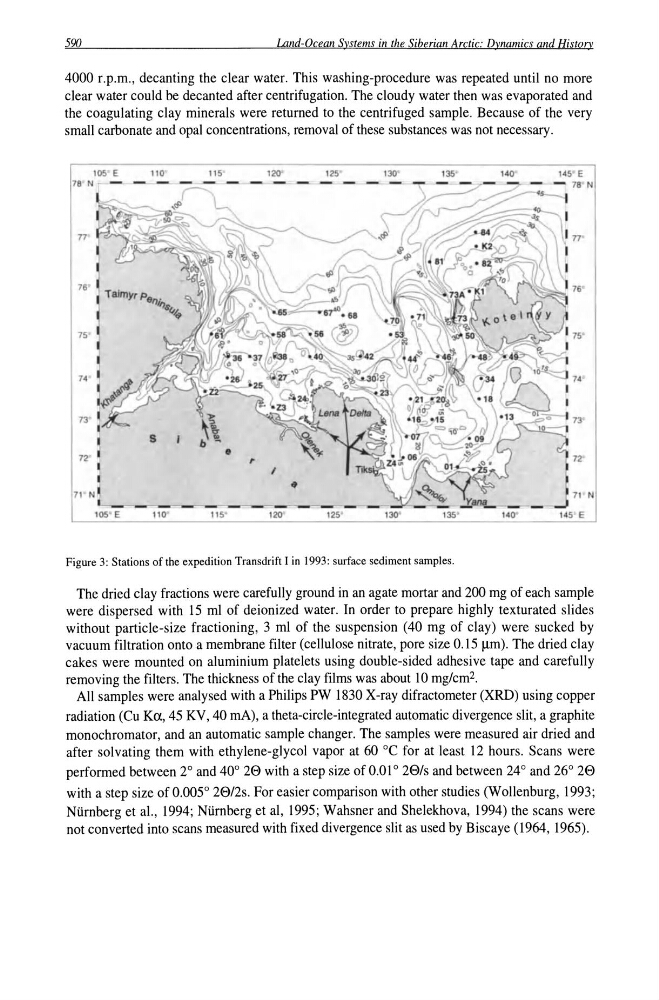
Figure 3: Stations ofthe expedition Transdrift I in 1993: surface sediment samples.
140
145 E
-
78 N
73
145 E
The dried clay fractions were carefully ground in an agate mortar and 200 mg of each sample
were dispersed with 15 ml of deionized water. In order to prepare highly texturated slides
without particle-size fractioning, 3 ml of the suspension (40 mg of clay) were sucked by
vacuum filtration onto a membrane filter (cellulose nitrate, pore size 0.15 !lm). The dried clay
cakes were mounted on aluminium platelets using double-sided adhesive tape and carefully
removing the filters. The thickness of the clay films was about 10 mg/cm 2 .
All samples were analysed with a Philips PW 1830 X-ray difractometer (XRD) using copper
radiation (Cu Ka, 45 KV, 40 rnA), a theta-circle-integrated automatic divergence slit, a graphite
monochromator, and an automatic sample changer. The samples were measured air dried and
after solvating them with ethylene-glycol vapor at 60°C for at least 12 hours. Scans were
performed between 2° and 40° 28 with a step size of 0.01 ° 28/s and between 24° and 26° 28
with a step size of 0.005° 2812s. For easier comparison with other studies (Wollenburg, 1993;
Niirnberg et a!., 1994; Niirnberg et ai, 1995; Wahsner and Shelekhova, 1994) the scans were
not converted into scans measured with fixed divergence slit as used by Biscaye (1964, 1965).
Land-Ocean Systems in the Siberian Arctic: Dynamics and History
4000 r.p.m., decanting the clear water. This washing-procedure was repeated until no more
clear water could be decanted after centrifugation. The cloudy water then was evaporated and
the coagulating clay minerals were returned to the centrifuged sample. Because of the very
small carbonate and opal concentrations, removal of these substances was not necessary.
105 E
78 N
77
76
75
74
73
72
71 N
I
105' E
110
S
110
115
120
125
130"
135
• ,.
I
•
lIS'
120'
125'
130'
Figure 3: Stations ofthe expedition Transdrift I in 1993: surface sediment samples.
140
145 E
-
78 N
73
145 E
The dried clay fractions were carefully ground in an agate mortar and 200 mg of each sample
were dispersed with 15 ml of deionized water. In order to prepare highly texturated slides
without particle-size fractioning, 3 ml of the suspension (40 mg of clay) were sucked by
vacuum filtration onto a membrane filter (cellulose nitrate, pore size 0.15 !lm). The dried clay
cakes were mounted on aluminium platelets using double-sided adhesive tape and carefully
removing the filters. The thickness of the clay films was about 10 mg/cm 2 .
All samples were analysed with a Philips PW 1830 X-ray difractometer (XRD) using copper
radiation (Cu Ka, 45 KV, 40 rnA), a theta-circle-integrated automatic divergence slit, a graphite
monochromator, and an automatic sample changer. The samples were measured air dried and
after solvating them with ethylene-glycol vapor at 60°C for at least 12 hours. Scans were
performed between 2° and 40° 28 with a step size of 0.01 ° 28/s and between 24° and 26° 28
with a step size of 0.005° 2812s. For easier comparison with other studies (Wollenburg, 1993;
Niirnberg et a!., 1994; Niirnberg et ai, 1995; Wahsner and Shelekhova, 1994) the scans were
not converted into scans measured with fixed divergence slit as used by Biscaye (1964, 1965).