

Cremer: Svatial Distribution of Diatom Surface Sediment Assemblages
541
Fossula arctica is a marine, planktic diatom but also is a typical sea-ice species.
Fragilariopsis group: this group consists of the species Fragilariopsis cylindrus (synonym
Nitzschia cylindrus) and Fragilariopsis oceanica (synonym Nitzschia grunowii). Both species
are cold water diatoms in circumarctic waters (Hasle and Syvertsen, 1996). F. cylindrus is
bipolar and thrives in circumantarctic waters too and its biogeographic distribution extends to
50 0 N and 50 0 S respectively, whereas F. oceanica appears down to 45°N (Hasle, 1976). Both
species occur in large quantities in sea-ice and are often the predominating diatoms in this
environment (Hasle, 1976; Poulin, 1990). The relative abundance pattern of the
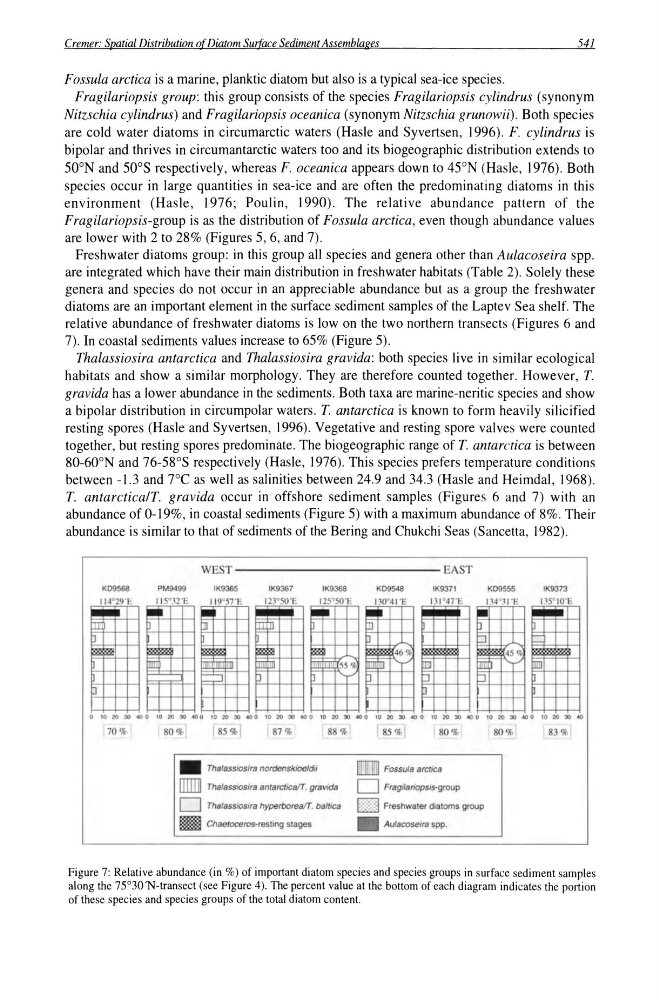
Fragilariopsis-group is as the distribution of Fossula arctica, even though abundance values
are lower with 2 to 28% (Figures 5, 6, and 7).
Freshwater diatoms group: in this group all species and genera other than Aulacoseira spp.
are integrated which have their main distribution in freshwater habitats (Table 2). Solely these
genera and species do not occur in an appreciable abundance but as a group the freshwater
diatoms are an important element in the surface sediment samples of the Laptev Sea shelf. The
relative abundance of freshwater diatoms is low on the two northern transects (Figures 6 and
7). In coastal sediments values increase to 65% (Figure 5).
Thalassiosira antarctica and Thalassiosira gravida: both species live in similar ecological
habitats and show a similar morphology. They are therefore counted together. However, T.
gravida has a lower abundance in the sediments. Both taxa are marine-neritic species and show
a bipolar distribution in circumpolar waters. T. antarctica is known to form heavily silicified
resting spores (Hasle and Syvertsen, 1996). Vegetative and resting spore valves were counted
together, but resting spores predominate. The biogeographic range of T. antarctica is between
80-60 o N and 76-58°S respectively (Hasle, 1976). This species prefers temperature conditions
between -1.3 and 7°C as well as salinities between 24.9 and 34.3 (Hasle and Heimdal, 1968).
T. antarcticalT. gravida occur in offshore sediment samples (Figures 6 and 7) with an
abundance of 0-19%, in coastal sediments (Figure 5) with a maximum abundance of 8%. Their
abundance is similar to that of sediments of the Bering and Chukchi Seas (Sancetta, 1982).
WEST
EA T
KD9561l
PM9499
IK936S
IK9367
IK9368
K09r.4a
lK9371
KD9555
IK9373
114·29'10
115·.12'£
119·57"E
12)·50·E
125·;0'£
D0"41'£
1:11 · 41"£
IJ4·31 'E
1;15· 10,£
••• •
• ••• •• •• I ••• • I • ••
lIT
01
IITn
]
I
J
I
11
J
.l
:::J
.l
rfll!l13i
;3lI~
ml13i
~!II
mI
~~ r 6 %
;3lIi8iii:il!
~~
~ 'I- m!~1m
~
JlI[
J[J[ l ID
p:nm
~~
IT]
)!JJ
P
J
:J
:::J
P
I I
I
I
~
I I
I
I
0102030400 102030Il100 10 20 30 400 10 .20 30 ..0 CI 10 20 XI 400 I020~.vJO 102030<100 10 20 30 .,0 10 20 30 40
70%
80%
[ 85 % 1
87%
88%
[85%1
80%
80%
83%
•
Tha/assiosira nordensJdo.ekPi
m Fossula arctica
[[[[JJ) Thafassiosira antarcticalT. graVida D Fragllarlopsls-group
D Thalassioslfa hyperborea/r, baltica E2] Freshwater diatoms group
!Ill Chaet"""ros-resllng stages
m Aulaceseirs spp.
Figure 7: Relative abundance (in %) of important diatom species and species groups in surface sediment samples
along the 75°30'N-transect (see Figure 4). The percent value at the bottom of each diagram indicates the portion
of these species and species groups of the total diatom content.
541
Fossula arctica is a marine, planktic diatom but also is a typical sea-ice species.
Fragilariopsis group: this group consists of the species Fragilariopsis cylindrus (synonym
Nitzschia cylindrus) and Fragilariopsis oceanica (synonym Nitzschia grunowii). Both species
are cold water diatoms in circumarctic waters (Hasle and Syvertsen, 1996). F. cylindrus is
bipolar and thrives in circumantarctic waters too and its biogeographic distribution extends to
50 0 N and 50 0 S respectively, whereas F. oceanica appears down to 45°N (Hasle, 1976). Both
species occur in large quantities in sea-ice and are often the predominating diatoms in this
environment (Hasle, 1976; Poulin, 1990). The relative abundance pattern of the
Fragilariopsis-group is as the distribution of Fossula arctica, even though abundance values
are lower with 2 to 28% (Figures 5, 6, and 7).
Freshwater diatoms group: in this group all species and genera other than Aulacoseira spp.
are integrated which have their main distribution in freshwater habitats (Table 2). Solely these
genera and species do not occur in an appreciable abundance but as a group the freshwater
diatoms are an important element in the surface sediment samples of the Laptev Sea shelf. The
relative abundance of freshwater diatoms is low on the two northern transects (Figures 6 and
7). In coastal sediments values increase to 65% (Figure 5).
Thalassiosira antarctica and Thalassiosira gravida: both species live in similar ecological
habitats and show a similar morphology. They are therefore counted together. However, T.
gravida has a lower abundance in the sediments. Both taxa are marine-neritic species and show
a bipolar distribution in circumpolar waters. T. antarctica is known to form heavily silicified
resting spores (Hasle and Syvertsen, 1996). Vegetative and resting spore valves were counted
together, but resting spores predominate. The biogeographic range of T. antarctica is between
80-60 o N and 76-58°S respectively (Hasle, 1976). This species prefers temperature conditions
between -1.3 and 7°C as well as salinities between 24.9 and 34.3 (Hasle and Heimdal, 1968).
T. antarcticalT. gravida occur in offshore sediment samples (Figures 6 and 7) with an
abundance of 0-19%, in coastal sediments (Figure 5) with a maximum abundance of 8%. Their
abundance is similar to that of sediments of the Bering and Chukchi Seas (Sancetta, 1982).
WEST
EA T
KD9561l
PM9499
IK936S
IK9367
IK9368
K09r.4a
lK9371
KD9555
IK9373
114·29'10
115·.12'£
119·57"E
12)·50·E
125·;0'£
D0"41'£
1:11 · 41"£
IJ4·31 'E
1;15· 10,£
••• •
• ••• •• •• I ••• • I • ••
lIT
01
IITn
]
I
J
I
11
J
.l
:::J
.l
rfll!l13i
;3lI~
ml13i
~!II
mI
~~ r 6 %
;3lIi8iii:il!
~~
~ 'I- m!~1m
~
JlI[
J[J[ l ID
p:nm
~~
IT]
)!JJ
P
J
:J
:::J
P
I I
I
I
~
I I
I
I
0102030400 102030Il100 10 20 30 400 10 .20 30 ..0 CI 10 20 XI 400 I020~.vJO 102030<100 10 20 30 .,0 10 20 30 40
70%
80%
[ 85 % 1
87%
88%
[85%1
80%
80%
83%
•
Tha/assiosira nordensJdo.ekPi
m Fossula arctica
[[[[JJ) Thafassiosira antarcticalT. graVida D Fragllarlopsls-group
D Thalassioslfa hyperborea/r, baltica E2] Freshwater diatoms group
!Ill Chaet"""ros-resllng stages
m Aulaceseirs spp.
Figure 7: Relative abundance (in %) of important diatom species and species groups in surface sediment samples
along the 75°30'N-transect (see Figure 4). The percent value at the bottom of each diagram indicates the portion
of these species and species groups of the total diatom content.