

Strobl et al.: Determination otDepositional Bervllium- 10 Fluxes ill the Area of'the Lantev Sea
527
9463-1 and PM 9472-3; Table 8) reflect the input of continental lOBe with the rivers.
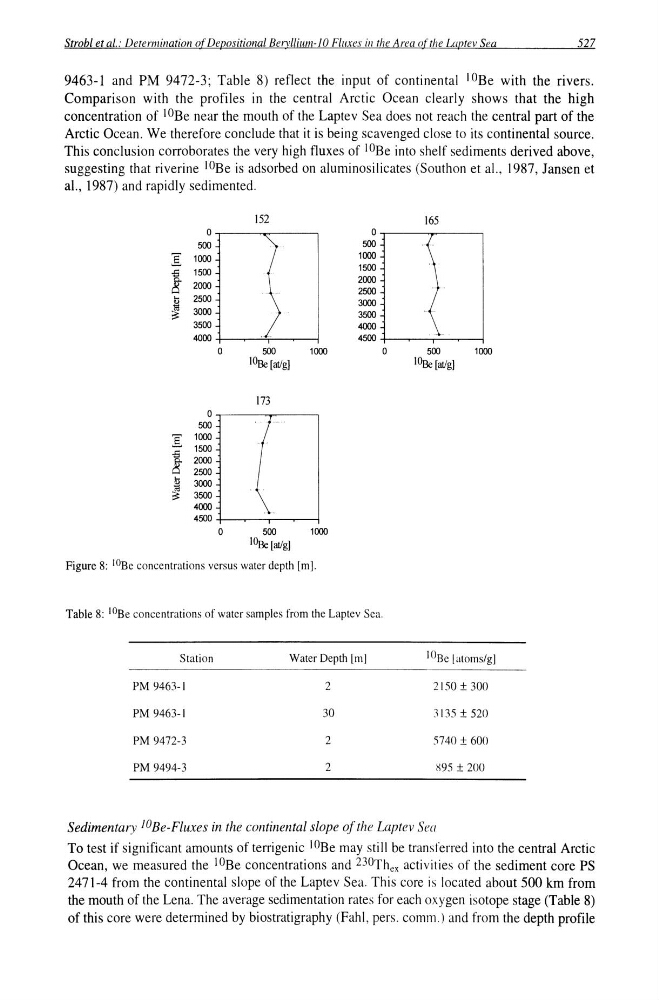
Comparison with the profiles in the central Arctic Ocean clearly shows that the high
concentration of lOBe near the mouth of the Laptev Sea does not reach the central part of the
Arctic Ocean. We therefore conclude that it is being scavenged close to its continental source.
This conclusion corroborates the very high fluxes of lOBe into shelf sediments derived above,
suggesting that riverine lOBe is adsorbed on aluminosilicates (Southon et aI., 1987, Jansen et
aI., 1987) and rapidly sedimented.
152
165
0
0
500
500
I 1000
1000
!
1500
1500
2000
2000
2500
t 2500
3000
~ 3000
3500
3500
4000
4000
4500
500
1000
0
500
1000
lOse [at/g]
lOse [at/g]
173
0
500
I
1000
1500
!
2000
2500
, 3000
3500
4000
4500
0
500
1000
lOse [at/g]
Figure 8: lOBe concentrations versus water depth [mI.
Table 8: tOBe concentrations of water samples from the Laptev Sea.
Station
Water Depth [m]
I ()Bc I atoms/g]
PM 9463-1
2
2150 ± 30O
PM 9463-1
30
3135 ± 520
PM 9472-3
2
5740 ± 600
PM 9494-3
2
X95 ± 200
Sedimentary lOBe-Fluxes in the continental slope o{ the Laptev .'leu
To test if significant amounts of terrigenic lOBe may still be transferred into the central Arctic
Ocean, we measured the lOBe concentrations and 230Thex activities of the sediment core PS
2471-4 from the continental slope of the Laptev Sea. This core is located about 500 km from
the mouth of the Lena. The average sedimentation rates for each ox ygen isotope stage (Table 8)
of this core were determined by biostratigraphy (Fahl, pers. comm.) and from the depth profile
527
9463-1 and PM 9472-3; Table 8) reflect the input of continental lOBe with the rivers.
Comparison with the profiles in the central Arctic Ocean clearly shows that the high
concentration of lOBe near the mouth of the Laptev Sea does not reach the central part of the
Arctic Ocean. We therefore conclude that it is being scavenged close to its continental source.
This conclusion corroborates the very high fluxes of lOBe into shelf sediments derived above,
suggesting that riverine lOBe is adsorbed on aluminosilicates (Southon et aI., 1987, Jansen et
aI., 1987) and rapidly sedimented.
152
165
0
0
500
500
I 1000
1000
!
1500
1500
2000
2000
2500
t 2500
3000
~ 3000
3500
3500
4000
4000
4500
500
1000
0
500
1000
lOse [at/g]
lOse [at/g]
173
0
500
I
1000
1500
!
2000
2500
, 3000
3500
4000
4500
0
500
1000
lOse [at/g]
Figure 8: lOBe concentrations versus water depth [mI.
Table 8: tOBe concentrations of water samples from the Laptev Sea.
Station
Water Depth [m]
I ()Bc I atoms/g]
PM 9463-1
2
2150 ± 30O
PM 9463-1
30
3135 ± 520
PM 9472-3
2
5740 ± 600
PM 9494-3
2
X95 ± 200
Sedimentary lOBe-Fluxes in the continental slope o{ the Laptev .'leu
To test if significant amounts of terrigenic lOBe may still be transferred into the central Arctic
Ocean, we measured the lOBe concentrations and 230Thex activities of the sediment core PS
2471-4 from the continental slope of the Laptev Sea. This core is located about 500 km from
the mouth of the Lena. The average sedimentation rates for each ox ygen isotope stage (Table 8)
of this core were determined by biostratigraphy (Fahl, pers. comm.) and from the depth profile