

518
Land-Ocean Systems in the Siberian Arctic: Dynamics and History
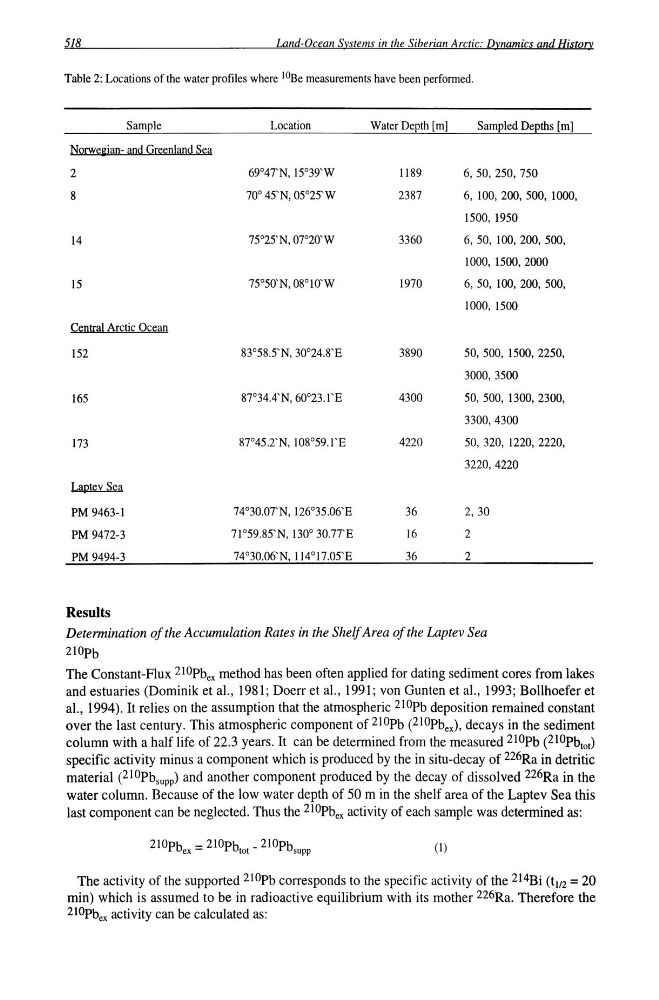
Table 2: Locations of the water profiles where lOBe measurements have been performed.
Sample
Norwegian- and Greenland Sea
2
S
14
15
Central Arctic Ocean
152
165
173
Laptev Sea
PM 9463-1
PM 9472-3
PM 9494-3
Results
Location
69°4TN, 15°39'W
70 0 45'N, 05°25'W
75°50'N,OSOIO'W
ST45.2'N, IOs 0 59.l'E
74°30.0TN, 126°35.06'E
71°59.S5'N, 130 0 30.7TE
74°30.06'N,114°17.05'E
Water Depth [m]
1189
2387
3360
1970
3S90
4300
4220
36
16
36
Sampled Depths [m]
6, 50, 250, 750
6, 100, 200, 500, 1000,
1500, 1950
6, 50, 100, 200, 500,
1000, 1500,2000
6, 50, 100, 200, 500,
1000, 1500
50, 500, 1500, 2250,
3000, 3500
50, 500, 1300, 2300,
3300, 4300
50, 320, 1220, 2220,
3220, 4220
2, 30
2
2
Determination of the Accumulation Rates in the Shelf Area of the Laptev Sea
210Pb
The Constant-Flux 210Pbex method has been often applied for dating sediment cores from lakes
and estuaries (Dominik et aI., 1981; Doerr et aI., 1991; von Gunten et ai., 1993; Bollhoefer et
aI., 1994), It relies on the assumption that the atmospheric 210Pb deposition remained constant
over the last century. This atmospheric component of 210Pb (ZIOPbex), decays in the sediment
column with a half life of 22.3 years. It can be determined from the measured 210Pb (21OPbtot)
specific activity minus a component which is produced by the in situ-decay of 226Ra in detritic
material (21OPb supp ) and another component produced by the decay of dissolved 226Ra in the
water column. Because of the low water depth of 50 m in the shelf area of the Laptev Sea this
last component can be neglected. Thus the 210Pbex activity of each sample was determined as:
(1)
The activity of the supported 210Pb corresponds to the specific activity of the 214Bi (t1/2 = 20
min) which is assumed to be in radioactive equilibrium with its mother 226Ra. Therefore the
210Pbex activity can be calculated as:
Land-Ocean Systems in the Siberian Arctic: Dynamics and History
Table 2: Locations of the water profiles where lOBe measurements have been performed.
Sample
Norwegian- and Greenland Sea
2
S
14
15
Central Arctic Ocean
152
165
173
Laptev Sea
PM 9463-1
PM 9472-3
PM 9494-3
Results
Location
69°4TN, 15°39'W
70 0 45'N, 05°25'W
75°50'N,OSOIO'W
ST45.2'N, IOs 0 59.l'E
74°30.0TN, 126°35.06'E
71°59.S5'N, 130 0 30.7TE
74°30.06'N,114°17.05'E
Water Depth [m]
1189
2387
3360
1970
3S90
4300
4220
36
16
36
Sampled Depths [m]
6, 50, 250, 750
6, 100, 200, 500, 1000,
1500, 1950
6, 50, 100, 200, 500,
1000, 1500,2000
6, 50, 100, 200, 500,
1000, 1500
50, 500, 1500, 2250,
3000, 3500
50, 500, 1300, 2300,
3300, 4300
50, 320, 1220, 2220,
3220, 4220
2, 30
2
2
Determination of the Accumulation Rates in the Shelf Area of the Laptev Sea
210Pb
The Constant-Flux 210Pbex method has been often applied for dating sediment cores from lakes
and estuaries (Dominik et aI., 1981; Doerr et aI., 1991; von Gunten et ai., 1993; Bollhoefer et
aI., 1994), It relies on the assumption that the atmospheric 210Pb deposition remained constant
over the last century. This atmospheric component of 210Pb (ZIOPbex), decays in the sediment
column with a half life of 22.3 years. It can be determined from the measured 210Pb (21OPbtot)
specific activity minus a component which is produced by the in situ-decay of 226Ra in detritic
material (21OPb supp ) and another component produced by the decay of dissolved 226Ra in the
water column. Because of the low water depth of 50 m in the shelf area of the Laptev Sea this
last component can be neglected. Thus the 210Pbex activity of each sample was determined as:
(1)
The activity of the supported 210Pb corresponds to the specific activity of the 214Bi (t1/2 = 20
min) which is assumed to be in radioactive equilibrium with its mother 226Ra. Therefore the
210Pbex activity can be calculated as: