

Strobl et al.: Determination of Depositional Bervllium-lO Fluxes in the Area of the Laptev Sea
517
Material and methods
The sediment cores (Table I) investigated in our study were recovered during the Expeditions
Transdrift II (Kassens, 1995) and ARK IX/4 (Ftitterer, 1994). Further we determined the lOBe
concentrations of 4 water profiles from the Norwegian and Greenland Sea (Thiede and Hempel,
1991), 3 profiles from the central Arctic Ocean (Ftitterer, 1992) and water samples from the
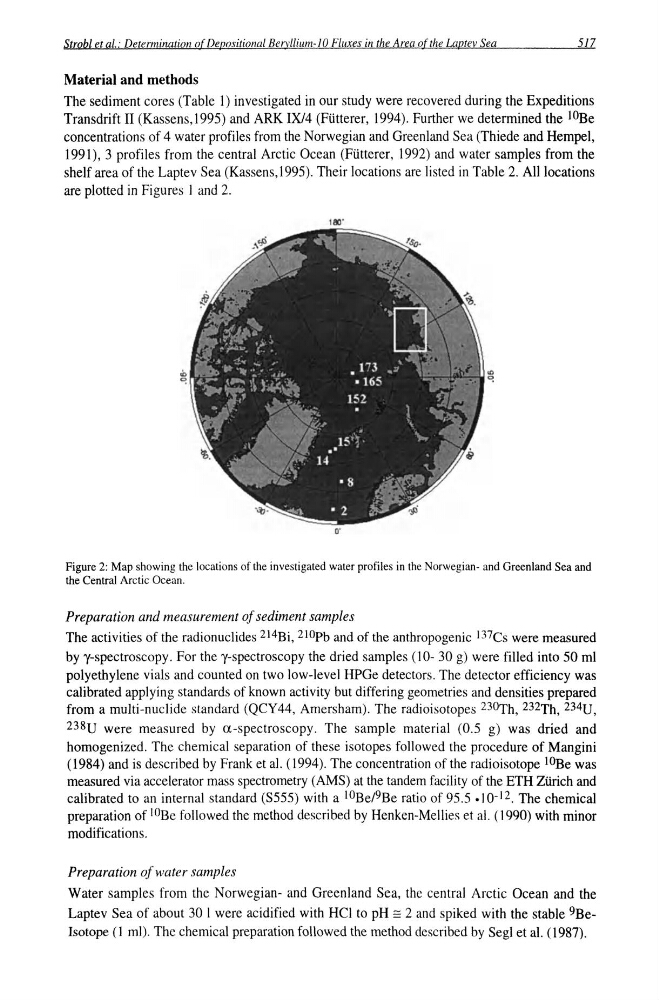
shelf area of the Laptev Sea (Kassens, 1995). Their locations are listed in Table 2. All locations
are plotted in Figures I and 2.
II!O'
D'
Figure 2: Map showing the locations of the investigated water profiles in the Norwegian- and Greenland Sea and
the Central Arctic Ocean.
Preparation and measurement of sediment samples
The activities of the radionuclides 214Bi, 2lOPb and of the anthropogenic 137Cs were measured
by y-spectroscopy. For the y-spectroscopy the dried samples (10- 30 g) were filled into 50 ml
polyethylene vials and counted on two low-level HPGe detectors. The detector efficiency was
calibrated applying standards of known activity but differing geometries and densities prepared
from a multi-nuclide standard (QCY44, Amersham) . The radioisotopes 230Th, 232Th, 234U,
238U were measured by a-spectroscopy. The sample material (0.5 g) was dried and
homogenized. The chemical separation of these isotopes followed the procedure of Mangini
(1984) and is described by Frank et al. (1994). The concentration of the radioisotope lOBe was
measured via accelerator mass spectrometry (AMS) at the tandem facility of the ETH ZUrich and
calibrated to an internal standard (S555) with a IOBe/ 9 Be ratio of 95.5 .10- 12. The chemical
preparation of lOBe followed the method described by Henken-Mellies et al. (1990) with minor
modifications.
Preparation of water samples
Water samples from the Norwegian- and Greenland Sea, the central Arctic Ocean and the
Laptev Sea of about 30 I were acidified with HCI to pH == 2 and spiked with the stable 9BeIsotope (I ml). The chemical preparation followed the method described by Segl et al. (1987).
517
Material and methods
The sediment cores (Table I) investigated in our study were recovered during the Expeditions
Transdrift II (Kassens, 1995) and ARK IX/4 (Ftitterer, 1994). Further we determined the lOBe
concentrations of 4 water profiles from the Norwegian and Greenland Sea (Thiede and Hempel,
1991), 3 profiles from the central Arctic Ocean (Ftitterer, 1992) and water samples from the
shelf area of the Laptev Sea (Kassens, 1995). Their locations are listed in Table 2. All locations
are plotted in Figures I and 2.
II!O'
D'
Figure 2: Map showing the locations of the investigated water profiles in the Norwegian- and Greenland Sea and
the Central Arctic Ocean.
Preparation and measurement of sediment samples
The activities of the radionuclides 214Bi, 2lOPb and of the anthropogenic 137Cs were measured
by y-spectroscopy. For the y-spectroscopy the dried samples (10- 30 g) were filled into 50 ml
polyethylene vials and counted on two low-level HPGe detectors. The detector efficiency was
calibrated applying standards of known activity but differing geometries and densities prepared
from a multi-nuclide standard (QCY44, Amersham) . The radioisotopes 230Th, 232Th, 234U,
238U were measured by a-spectroscopy. The sample material (0.5 g) was dried and
homogenized. The chemical separation of these isotopes followed the procedure of Mangini
(1984) and is described by Frank et al. (1994). The concentration of the radioisotope lOBe was
measured via accelerator mass spectrometry (AMS) at the tandem facility of the ETH ZUrich and
calibrated to an internal standard (S555) with a IOBe/ 9 Be ratio of 95.5 .10- 12. The chemical
preparation of lOBe followed the method described by Henken-Mellies et al. (1990) with minor
modifications.
Preparation of water samples
Water samples from the Norwegian- and Greenland Sea, the central Arctic Ocean and the
Laptev Sea of about 30 I were acidified with HCI to pH == 2 and spiked with the stable 9BeIsotope (I ml). The chemical preparation followed the method described by Segl et al. (1987).