

Sie~ert et al.: Paleoclimntic Indicators from Permnfrost Seguences
487
analysis, namely sites LA022, LA025, and LA06. The results obtained from the first two
sections characterize vegetation of the Kargin Interstadial, while the pollen diagram of the
LA06 section in part contradicts the radiocarbon datings and the stratigraphic classification thus
remains partially problematic.
Site LA022 is located on the 60-65 m lake terrace to the west of the Tolton-Pastakh-Yuryakh
mouth (Figures 1 and 2). In its lower portion, the section consisted of ice-rich grey clayey silt
alternating with brownish grey sand. Sandy layers had a massive or very fine lens-shaped
cryostructure, whereas the silt layers were characterized by a coarse lattice-like structure. Rustcoloured zones enriched with iron hydroxides were observed at the contact between ice lenses
and ground aggregates. A small ice wedge was found within the succession (Figure 6). These
cryogenic features suggest a syngenetic sediment freezing, likely under conditions found in
shallow lacustrine environments which dry up seasonally or during periodic lake level changes.
The upper part of the section consists of light grey or grey-brown sandy deposits with
interlayers of silt, clay and floated peat. The low ice content, the fine lens-shaped cryostructure
of the clay and silt layers, and the massive cryostructure of the sand layers also argue for a
formation under the above mentioned conditions. All sediments contained wood - primarily
branches and twigs of shrubs. Radiocarbon measurements of these remains gave ages of
greater than 46000 yr BP (Table 2, No 1-4). The top sediments seem to have been reworked by
slope wasting, and samples were therefore not taken for radiocarbon dating.
8180 [%o} SMOW
-35
-30
-25
-20
-15
-1 0
-110
-130
~
-150
0
~
A
-170
(fJ
0
- 190
~
Dead ice:
-210
I
""
<.0
[J Labaz area
-230
•
Norilsk area
-250
8180 [%o} SMOW
-35
-30
-25
-20
- 15
- 1 0
- 11 0
-130 ~
-150 0
~
B
-170
(fJ
'"0"
-1 90 ~
0
Holocene
-210
I
"" 00
•
Kargin
-230
•
Sartan
-250
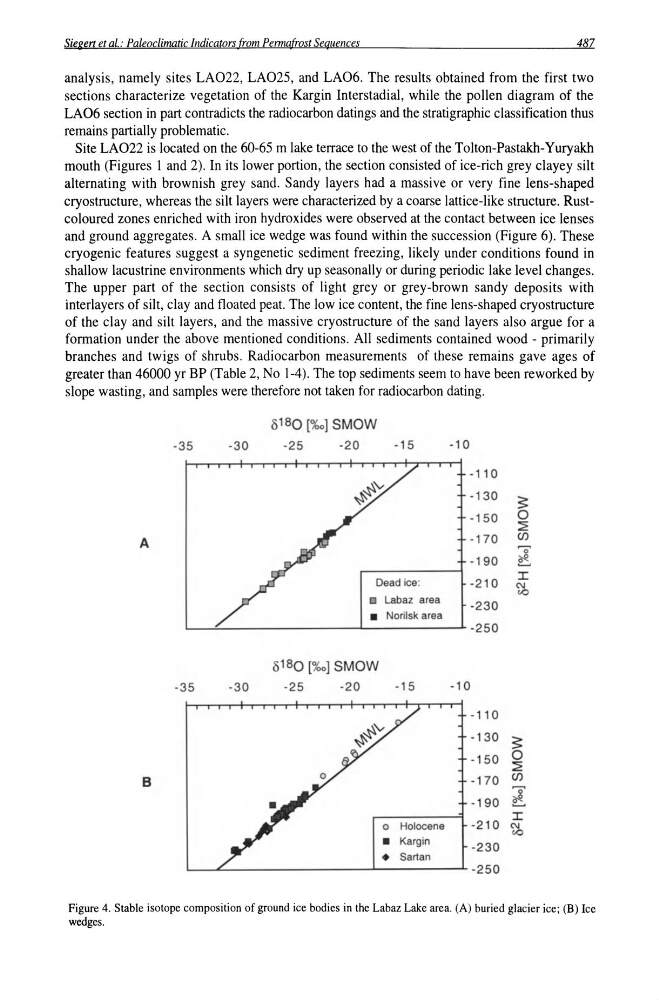
Figure 4. Stable isotope composition of ground ice bodies in the Labaz Lake area. (A) buried glacier ice; (B) Ice
wedges.
487
analysis, namely sites LA022, LA025, and LA06. The results obtained from the first two
sections characterize vegetation of the Kargin Interstadial, while the pollen diagram of the
LA06 section in part contradicts the radiocarbon datings and the stratigraphic classification thus
remains partially problematic.
Site LA022 is located on the 60-65 m lake terrace to the west of the Tolton-Pastakh-Yuryakh
mouth (Figures 1 and 2). In its lower portion, the section consisted of ice-rich grey clayey silt
alternating with brownish grey sand. Sandy layers had a massive or very fine lens-shaped
cryostructure, whereas the silt layers were characterized by a coarse lattice-like structure. Rustcoloured zones enriched with iron hydroxides were observed at the contact between ice lenses
and ground aggregates. A small ice wedge was found within the succession (Figure 6). These
cryogenic features suggest a syngenetic sediment freezing, likely under conditions found in
shallow lacustrine environments which dry up seasonally or during periodic lake level changes.
The upper part of the section consists of light grey or grey-brown sandy deposits with
interlayers of silt, clay and floated peat. The low ice content, the fine lens-shaped cryostructure
of the clay and silt layers, and the massive cryostructure of the sand layers also argue for a
formation under the above mentioned conditions. All sediments contained wood - primarily
branches and twigs of shrubs. Radiocarbon measurements of these remains gave ages of
greater than 46000 yr BP (Table 2, No 1-4). The top sediments seem to have been reworked by
slope wasting, and samples were therefore not taken for radiocarbon dating.
8180 [%o} SMOW
-35
-30
-25
-20
-15
-1 0
-110
-130
~
-150
0
~
A
-170
(fJ
0
- 190
~
Dead ice:
-210
I
""
<.0
[J Labaz area
-230
•
Norilsk area
-250
8180 [%o} SMOW
-35
-30
-25
-20
- 15
- 1 0
- 11 0
-130 ~
-150 0
~
B
-170
(fJ
'"0"
-1 90 ~
0
Holocene
-210
I
"" 00
•
Kargin
-230
•
Sartan
-250
Figure 4. Stable isotope composition of ground ice bodies in the Labaz Lake area. (A) buried glacier ice; (B) Ice
wedges.