

486
Land-Ocean Systems in the Siberian Arctic: Dynamics and History
of post-glacial times (Figure 2). Fluvio-lacustrine deposits often contain floating peat layers. At
one location, an autochthonous peat bed was found. In places, lacustrine sediments give way to
overlying ice-rich permafrost deposits with polygonal ice wedges of up to 15 m thickness and 5
m width - the so-called ,Ice Complex, (Figure 5). Radiocarbon data (Table 2: No 5, 6) from
this exposed Ice Complex showed ages of more than 42000 yr BP for the lower part (LA09) as
well as for the top layer below a thermo-erosional unconformity (LA015).
Deposits of the Ice Complex consist of weakly layered sandy silts with fine plant detritus and,
in places, with subvertical grass roots. A banded lens-shaped cryostructure interlocked with the
lateral ice wedge boundaries is characteristic. As a whole, these features are typical for a
syngenetic transition of deposits to permafrost under subaerial conditions, perhaps in a
seasonally drying lacustrine environment. Recently, analogous ice wedge growth occurred in
the very flat shore zones of Labaz and other lakes. The stable isotopic composition in two
investigated ice wedges varied between -24.3%0 and -30.7%0, and -184%0 and -234%0 for OISO
and 02H, respectively. As a rule, the ice wedges are covered with an unconformity by
Holocene, very ice-rich loam (,ice-ground,). In places, peat beds with a younger Holocene ice
wedge generation were formed above the Pleistocene Ice Complex. The stable oxygen and
hydrogen isotope ratio of Holocene generation are clearly different from those of Late
Pleistocene ice wedges as shown in Figure 4.
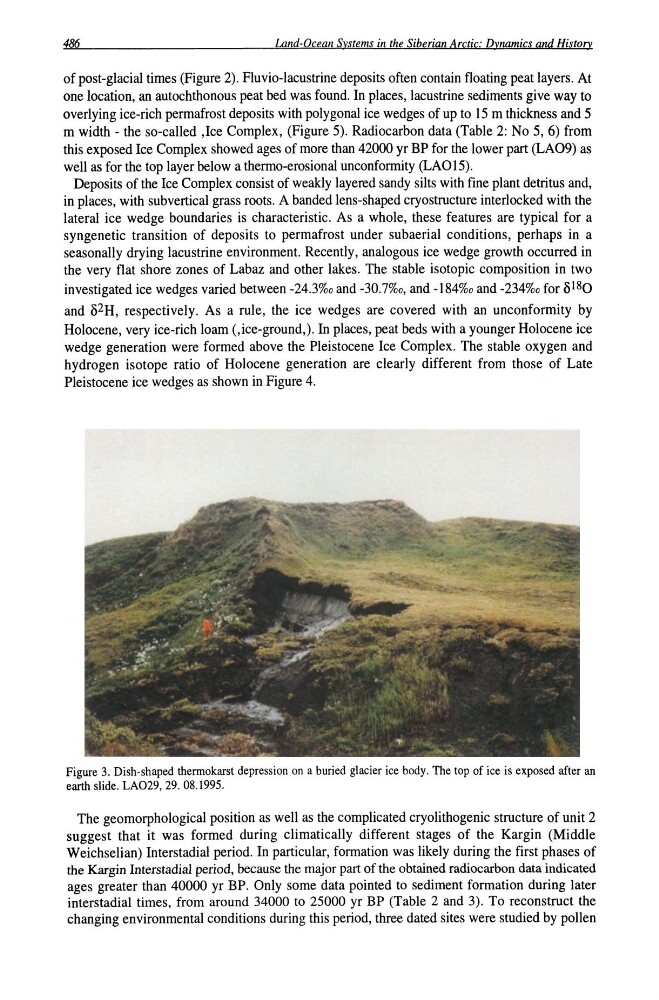
Figure 3. Dish-shaped thermokarst depression on a buried glacier ice body. The top of ice is exposed after an
earth slide. LA029, 29. OS.1995.
The geomorphological position as well as the complicated cryolithogenic structure of unit 2
suggest that it was formed during climatically different stages of the Kargin (Middle
Weichselian) Interstadial period. In particular, formation was likely during the first phases of
the Kargin Interstadial period, because the major part of the obtained radiocarbon data indicated
ages greater than 40000 yr BP. Only some data pointed to sediment formation during later
interstadial times, from around 34000 to 25000 yr BP (Table 2 and 3). To reconstruct the
changing environmental conditions during this period, three dated sites were studied by pollen
Land-Ocean Systems in the Siberian Arctic: Dynamics and History
of post-glacial times (Figure 2). Fluvio-lacustrine deposits often contain floating peat layers. At
one location, an autochthonous peat bed was found. In places, lacustrine sediments give way to
overlying ice-rich permafrost deposits with polygonal ice wedges of up to 15 m thickness and 5
m width - the so-called ,Ice Complex, (Figure 5). Radiocarbon data (Table 2: No 5, 6) from
this exposed Ice Complex showed ages of more than 42000 yr BP for the lower part (LA09) as
well as for the top layer below a thermo-erosional unconformity (LA015).
Deposits of the Ice Complex consist of weakly layered sandy silts with fine plant detritus and,
in places, with subvertical grass roots. A banded lens-shaped cryostructure interlocked with the
lateral ice wedge boundaries is characteristic. As a whole, these features are typical for a
syngenetic transition of deposits to permafrost under subaerial conditions, perhaps in a
seasonally drying lacustrine environment. Recently, analogous ice wedge growth occurred in
the very flat shore zones of Labaz and other lakes. The stable isotopic composition in two
investigated ice wedges varied between -24.3%0 and -30.7%0, and -184%0 and -234%0 for OISO
and 02H, respectively. As a rule, the ice wedges are covered with an unconformity by
Holocene, very ice-rich loam (,ice-ground,). In places, peat beds with a younger Holocene ice
wedge generation were formed above the Pleistocene Ice Complex. The stable oxygen and
hydrogen isotope ratio of Holocene generation are clearly different from those of Late
Pleistocene ice wedges as shown in Figure 4.
Figure 3. Dish-shaped thermokarst depression on a buried glacier ice body. The top of ice is exposed after an
earth slide. LA029, 29. OS.1995.
The geomorphological position as well as the complicated cryolithogenic structure of unit 2
suggest that it was formed during climatically different stages of the Kargin (Middle
Weichselian) Interstadial period. In particular, formation was likely during the first phases of
the Kargin Interstadial period, because the major part of the obtained radiocarbon data indicated
ages greater than 40000 yr BP. Only some data pointed to sediment formation during later
interstadial times, from around 34000 to 25000 yr BP (Table 2 and 3). To reconstruct the
changing environmental conditions during this period, three dated sites were studied by pollen