

464
Land-Ocean Svstems in the Siberian Arctic: Dynamics and History
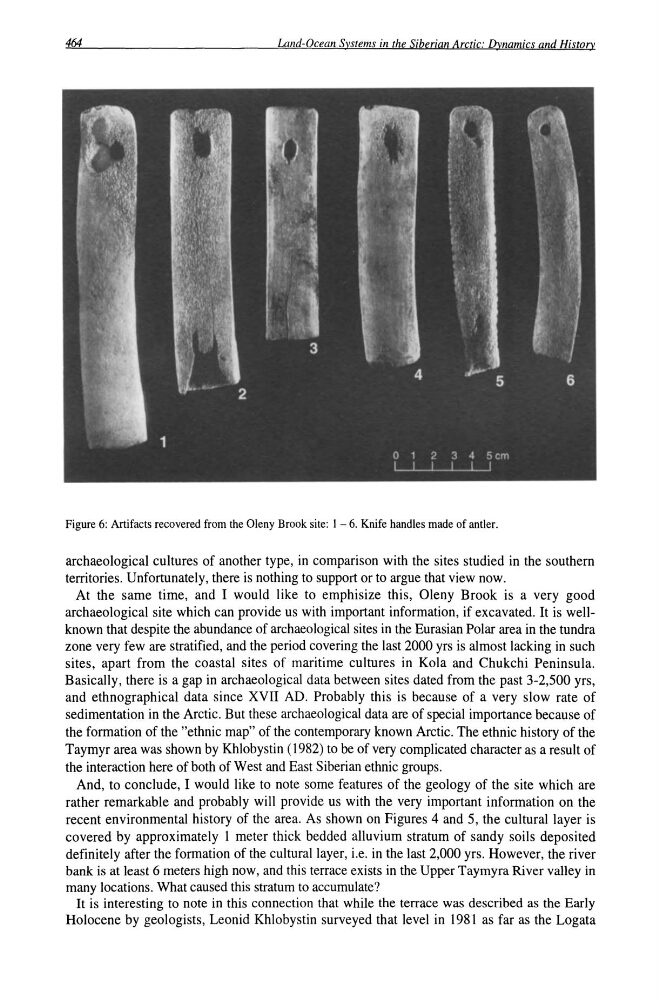
Figure 6: Artifacts recovered from the Oleny Brook site: 1 - 6. Knife handles made of antler.
archaeological cultures of another type, in comparison with the sites studied in the southern
territories. Unfortunately, there is nothing to support or to argue that view now.
At the same time, and I would like to emphisize this, Oleny Brook is a very good
archaeological site which can provide us with important information, if excavated. It is wellknown that despite the abundance of archaeological sites in the Eurasian Polar area in the tundra
zone very few are stratified, and the period covering the last 2000 yrs is almost lacking in such
sites, apart from the coastal sites of maritime cultures in Kola and Chukchi Peninsula.
Basically, there is a gap in archaeological data between sites dated from the past 3-2,500 yrs,
and ethnographical data since XVII AD. Probably this is because of a very slow rate of
sedimentation in the Arctic. But these archaeological data are of special importance because of
the formation of the "ethnic map" of the contemporary known Arctic. The ethnic history of the
Taymyr area was shown by Khlobystin (1982) to be of very complicated character as a result of
the interaction here of both of West and East Siberian ethnic groups.
And, to conclude, I would like to note some features of the geology of the site which are
rather remarkable and probably will provide us with the very important information on the
recent environmental history of the area. As shown on Figures 4 and 5, the cultural layer is
covered by approximately I meter thick bedded alluvium stratum of sandy soils deposited
definitely after the formation of the cultural layer, i.e. in the last 2,000 yrs. However, the river
bank is at least 6 meters high now, and this terrace exists in the Upper Taymyra River valley in
many locations. What caused this stratum to accumulate?
It is interesting to note in this connection that while the terrace was described as the Early
Holocene by geologists, Leonid Khlobystin surveyed that level in 1981 as far as the Logata
Land-Ocean Svstems in the Siberian Arctic: Dynamics and History
Figure 6: Artifacts recovered from the Oleny Brook site: 1 - 6. Knife handles made of antler.
archaeological cultures of another type, in comparison with the sites studied in the southern
territories. Unfortunately, there is nothing to support or to argue that view now.
At the same time, and I would like to emphisize this, Oleny Brook is a very good
archaeological site which can provide us with important information, if excavated. It is wellknown that despite the abundance of archaeological sites in the Eurasian Polar area in the tundra
zone very few are stratified, and the period covering the last 2000 yrs is almost lacking in such
sites, apart from the coastal sites of maritime cultures in Kola and Chukchi Peninsula.
Basically, there is a gap in archaeological data between sites dated from the past 3-2,500 yrs,
and ethnographical data since XVII AD. Probably this is because of a very slow rate of
sedimentation in the Arctic. But these archaeological data are of special importance because of
the formation of the "ethnic map" of the contemporary known Arctic. The ethnic history of the
Taymyr area was shown by Khlobystin (1982) to be of very complicated character as a result of
the interaction here of both of West and East Siberian ethnic groups.
And, to conclude, I would like to note some features of the geology of the site which are
rather remarkable and probably will provide us with the very important information on the
recent environmental history of the area. As shown on Figures 4 and 5, the cultural layer is
covered by approximately I meter thick bedded alluvium stratum of sandy soils deposited
definitely after the formation of the cultural layer, i.e. in the last 2,000 yrs. However, the river
bank is at least 6 meters high now, and this terrace exists in the Upper Taymyra River valley in
many locations. What caused this stratum to accumulate?
It is interesting to note in this connection that while the terrace was described as the Early
Holocene by geologists, Leonid Khlobystin surveyed that level in 1981 as far as the Logata