

452
Land-Ocean Systems in the Siberian Arctic: Dynamics and History
while Taymyr had lake levels 60 m above present unless there was tectonic control on the size
of Lake Taymyr.
Early Weichselian - the last glacial event in the area?
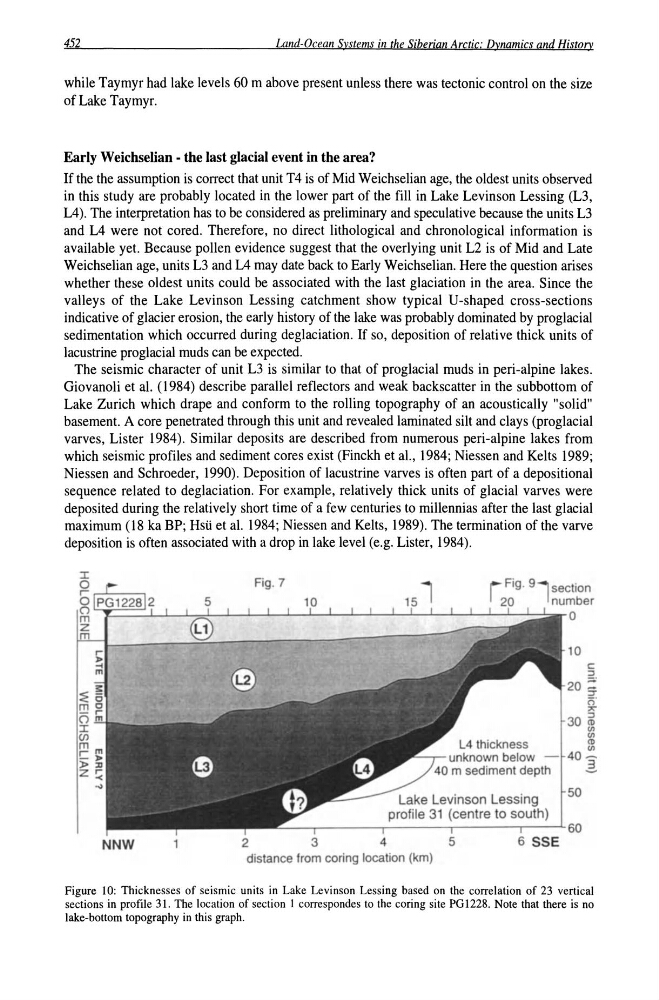
If the the assumption is correct that unit T4 is of Mid Weichselian age, the oldest units observed
in this study are probably located in the lower part of the fill in Lake Levinson Lessing (L3,
U). The interpretation has to be considered as preliminary and speculative because the units L3
and U were not cored. Therefore, no direct lithological and chronological information is
available yet. Because pollen evidence suggest that the overlying unit L2 is of Mid and Late
Weichselian age, units L3 and U may date back to Early Weichselian. Here the question arises
whether these oldest units could be associated with the last glaciation in the area. Since the
valleys of the Lake Levinson Lessing catchment show typical V-shaped cross-sections
indicative of glacier erosion, the early history of the lake was probably dominated by proglacial
sedimentation which occurred during deglaciation. If so, deposition of relative thick units of
lacustrine proglacial muds can be expected.
The seismic character of unit L3 is similar to that of proglacial muds in peri-alpine lakes.
Giovanoli et aI. (1984) describe parallel reflectors and weak backscatter in the subbottom of
Lake Zurich which drape and conform to the rolling topography of an acoustically "solid"
basement. A core penetrated through this unit and revealed laminated silt and clays (proglacial
varves, Lister 1984). Similar deposits are described from numerous peri-alpine lakes from
which seismic profiles and sediment cores exist (Finckh et aI., 1984; Niessen and Kelts 1989;
Niessen and Schroeder, 1990). Deposition of lacustrine varves is often part of a depositional
sequence related to deglaciation. For example, relatively thick units of glacial varves were
deposited during the relatively short time of a few centuries to millennias after the last glacial
maximum (18 ka BP; Hsii et aI. 1984; Niessen and Kelts, 1989). The termination of the varve
deposition is often associated with a drop in lake level (e.g. Lister, 1984).
NNW
Fig. 7
L4 th ickness
unknown below
40 m sediment depth
Lake Levinson Lessing
profile 31 (centre to south)
50
~~------.-------.------.--~ 60
2
3
4
5
6 SSE
distance from coring location (km)
Figure 10: Thicknesses of seismic units in Lake Levinson Lessing based on the correlation of 23 vertical
sections in profile 31. The location of section 1 correspondes to the coring site PG 1228. Note that there is no
lake-bottom topography in this graph.
Land-Ocean Systems in the Siberian Arctic: Dynamics and History
while Taymyr had lake levels 60 m above present unless there was tectonic control on the size
of Lake Taymyr.
Early Weichselian - the last glacial event in the area?
If the the assumption is correct that unit T4 is of Mid Weichselian age, the oldest units observed
in this study are probably located in the lower part of the fill in Lake Levinson Lessing (L3,
U). The interpretation has to be considered as preliminary and speculative because the units L3
and U were not cored. Therefore, no direct lithological and chronological information is
available yet. Because pollen evidence suggest that the overlying unit L2 is of Mid and Late
Weichselian age, units L3 and U may date back to Early Weichselian. Here the question arises
whether these oldest units could be associated with the last glaciation in the area. Since the
valleys of the Lake Levinson Lessing catchment show typical V-shaped cross-sections
indicative of glacier erosion, the early history of the lake was probably dominated by proglacial
sedimentation which occurred during deglaciation. If so, deposition of relative thick units of
lacustrine proglacial muds can be expected.
The seismic character of unit L3 is similar to that of proglacial muds in peri-alpine lakes.
Giovanoli et aI. (1984) describe parallel reflectors and weak backscatter in the subbottom of
Lake Zurich which drape and conform to the rolling topography of an acoustically "solid"
basement. A core penetrated through this unit and revealed laminated silt and clays (proglacial
varves, Lister 1984). Similar deposits are described from numerous peri-alpine lakes from
which seismic profiles and sediment cores exist (Finckh et aI., 1984; Niessen and Kelts 1989;
Niessen and Schroeder, 1990). Deposition of lacustrine varves is often part of a depositional
sequence related to deglaciation. For example, relatively thick units of glacial varves were
deposited during the relatively short time of a few centuries to millennias after the last glacial
maximum (18 ka BP; Hsii et aI. 1984; Niessen and Kelts, 1989). The termination of the varve
deposition is often associated with a drop in lake level (e.g. Lister, 1984).
NNW
Fig. 7
L4 th ickness
unknown below
40 m sediment depth
Lake Levinson Lessing
profile 31 (centre to south)
50
~~------.-------.------.--~ 60
2
3
4
5
6 SSE
distance from coring location (km)
Figure 10: Thicknesses of seismic units in Lake Levinson Lessing based on the correlation of 23 vertical
sections in profile 31. The location of section 1 correspondes to the coring site PG 1228. Note that there is no
lake-bottom topography in this graph.