

444
Land-Ocean Systems in the Siberian Arctic: Dynamics and History
topography above small topographic highs in the profundal area of the lake (Figure 7, Figure
8)_ Like Ll, unit L2 is well stratified but reflectors show generally weaker backscatter (Figure
7). In the central part of the lake, at about 18 m subbottom, a set of strong reflectors is present
which can also be seen in the "drape" above topographic highs (Figure 8). These reflectors
prevent deeper sound penetration in most parts of the profundal area. Abrupt onsets and lateral
discontinuity of the reflectors are typical for a high content of sedimentary gas.
Core PG 1228 penetrated the top 13 m of the unit L2 (Figure 8). The sediments are laminated
and of similar texture to those of unit Ll. The LlIL2 boundary is marked by a significant
downcore decrease in water content as well as a decrease in the water-content variability (Figure
8). Strong subbottom reflectors (gas) occur over a depth interval where pollen results suggest a
rapid alternation of stadial and interstadial periods (Figure 8).
UnitL3
Unit L3 is characterised by draping subbottom topographies even in shallower water above 35
m, and by relatively weak backscatter (Figure 9). The lower boundary can only be traced to a
sediment depth of about 40 m where a unit thickness of 17 m is observed (Figure 10). With
increasing water depth, the L21L3 boundary becomes less distinct. In the deepest part of the
lake the boundary is not seen in high resolution-mode profiles because sound penetration
through unit L2 is limited. Near the coring location, however, the lower boundary of L3 is
located deeper than 56 m subbottom because high penetration profiles show stratified deposits
down to that sediment depth.
S
(m)
30
5
6 a.
(t)
7'S.
8 ::T
40
9]:
10
11
12
13
14
50
0.9km
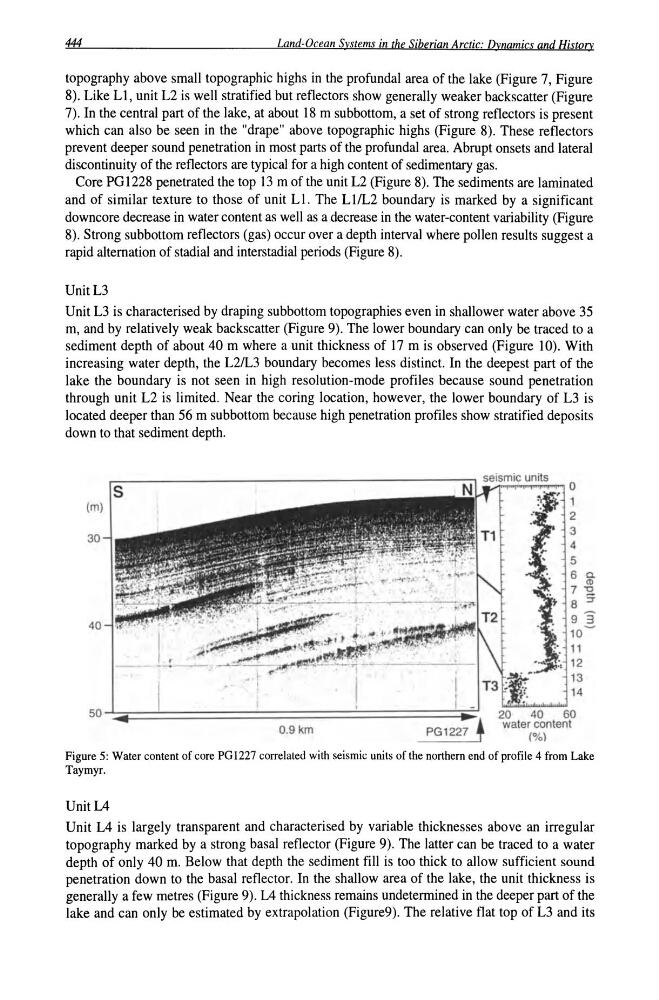
Figure 5: Water content of core PG 1227 correlated with seismic units of the northern end of profile 4 from Lake
Taymyr.
UnitL4
Unit L4 is largely transparent and characterised by variable thicknesses above an irregular
topography marked by a strong basal reflector (Figure 9). The latter can be traced to a water
depth of only 40 m. Below that depth the sediment fill is too thick to allow sufficient sound
penetration down to the basal reflector. In the shallow area of the lake, the unit thickness is
generally a few metres (Figure 9). L4 thickness remains undetermined in the deeper part of the
lake and can only be estimated by extrapolation (Figure9). The relative flat top of L3 and its
Land-Ocean Systems in the Siberian Arctic: Dynamics and History
topography above small topographic highs in the profundal area of the lake (Figure 7, Figure
8)_ Like Ll, unit L2 is well stratified but reflectors show generally weaker backscatter (Figure
7). In the central part of the lake, at about 18 m subbottom, a set of strong reflectors is present
which can also be seen in the "drape" above topographic highs (Figure 8). These reflectors
prevent deeper sound penetration in most parts of the profundal area. Abrupt onsets and lateral
discontinuity of the reflectors are typical for a high content of sedimentary gas.
Core PG 1228 penetrated the top 13 m of the unit L2 (Figure 8). The sediments are laminated
and of similar texture to those of unit Ll. The LlIL2 boundary is marked by a significant
downcore decrease in water content as well as a decrease in the water-content variability (Figure
8). Strong subbottom reflectors (gas) occur over a depth interval where pollen results suggest a
rapid alternation of stadial and interstadial periods (Figure 8).
UnitL3
Unit L3 is characterised by draping subbottom topographies even in shallower water above 35
m, and by relatively weak backscatter (Figure 9). The lower boundary can only be traced to a
sediment depth of about 40 m where a unit thickness of 17 m is observed (Figure 10). With
increasing water depth, the L21L3 boundary becomes less distinct. In the deepest part of the
lake the boundary is not seen in high resolution-mode profiles because sound penetration
through unit L2 is limited. Near the coring location, however, the lower boundary of L3 is
located deeper than 56 m subbottom because high penetration profiles show stratified deposits
down to that sediment depth.
S
(m)
30
5
6 a.
(t)
7'S.
8 ::T
40
9]:
10
11
12
13
14
50
0.9km
Figure 5: Water content of core PG 1227 correlated with seismic units of the northern end of profile 4 from Lake
Taymyr.
UnitL4
Unit L4 is largely transparent and characterised by variable thicknesses above an irregular
topography marked by a strong basal reflector (Figure 9). The latter can be traced to a water
depth of only 40 m. Below that depth the sediment fill is too thick to allow sufficient sound
penetration down to the basal reflector. In the shallow area of the lake, the unit thickness is
generally a few metres (Figure 9). L4 thickness remains undetermined in the deeper part of the
lake and can only be estimated by extrapolation (Figure9). The relative flat top of L3 and its