

438
Land-Ocean Svstems in the Siberian Arctic: Dynamics and HistoO'
and to compare the seismic results with sediment core data. The following questions are
addressed: (i) How thick is the undisturbed post-glacial fill of the lacustrine basins? (ii) Is there
evidence in the seismic stratigraphy for past changes in the sedimentary environments? (iii)
What conclusions can be drawn about the timing of the last major glaciations in the area?
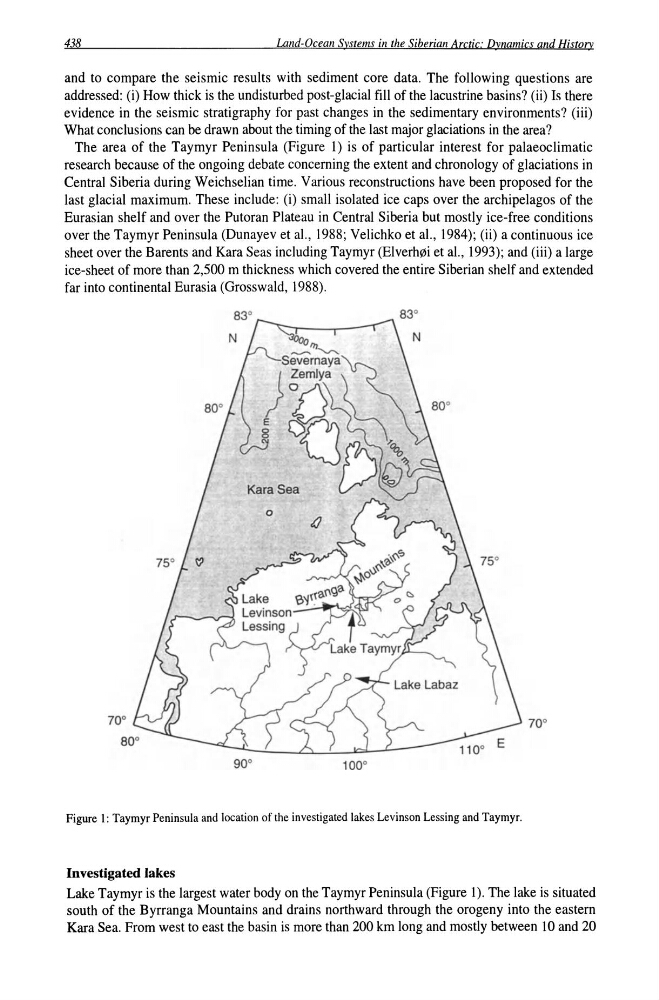
The area of the Taymyr Peninsula (Figure I) is of particular interest for palaeoclimatic
research because of the ongoing debate concerning the extent and chronology of glaciations in
Central Siberia during Weichselian time. Various reconstructions have been proposed for the
last glacial maximum. These include: (i) small isolated ice caps over the archipelagos of the
Eurasian shelf and over the Putoran Plateau in Central Siberia but mostly ice-free conditions
over the Taymyr Peninsula (Dunayev et aI., 1988; Velichko et aI., 1984); (ii) a continuous ice
sheet over the Barents and Kara Seas including Taymyr (Elverh~i et aI., 1993); and (iii) a large
ice-sheet of more than 2,500 m thickness which covered the entire Siberian shelf and extended
far into continental Eurasia (Grosswald, 1988).
Figure I: Taymyr Peninsula and location of the investigated lakes Levinson Lessing and Taymyr.
Investigated lakes
Lake Taymyr is the largest water body on the Taymyr Peninsula (Figure 1). The lake is situated
south of the Byrranga Mountains and drains northward through the orogeny into the eastern
Kara Sea. From west to east the basin is more than 200 km long and mostly between 10 and 20
Land-Ocean Svstems in the Siberian Arctic: Dynamics and HistoO'
and to compare the seismic results with sediment core data. The following questions are
addressed: (i) How thick is the undisturbed post-glacial fill of the lacustrine basins? (ii) Is there
evidence in the seismic stratigraphy for past changes in the sedimentary environments? (iii)
What conclusions can be drawn about the timing of the last major glaciations in the area?
The area of the Taymyr Peninsula (Figure I) is of particular interest for palaeoclimatic
research because of the ongoing debate concerning the extent and chronology of glaciations in
Central Siberia during Weichselian time. Various reconstructions have been proposed for the
last glacial maximum. These include: (i) small isolated ice caps over the archipelagos of the
Eurasian shelf and over the Putoran Plateau in Central Siberia but mostly ice-free conditions
over the Taymyr Peninsula (Dunayev et aI., 1988; Velichko et aI., 1984); (ii) a continuous ice
sheet over the Barents and Kara Seas including Taymyr (Elverh~i et aI., 1993); and (iii) a large
ice-sheet of more than 2,500 m thickness which covered the entire Siberian shelf and extended
far into continental Eurasia (Grosswald, 1988).
Figure I: Taymyr Peninsula and location of the investigated lakes Levinson Lessing and Taymyr.
Investigated lakes
Lake Taymyr is the largest water body on the Taymyr Peninsula (Figure 1). The lake is situated
south of the Byrranga Mountains and drains northward through the orogeny into the eastern
Kara Sea. From west to east the basin is more than 200 km long and mostly between 10 and 20