

Voinov and Zakharchuk: Large-Scale Variations of Sea Level in the Laplev Sea
33
Shelf waves
The cross- spectral analysis of the daily mean residual levels has revealed high coherence (0,68
- 0,98) between the level variations of the synoptical scale at various stations. Character of
spatial changes of the phases indicates that these sea level oscillations represent predominantly
progressive waves in the range of less than 60 days.
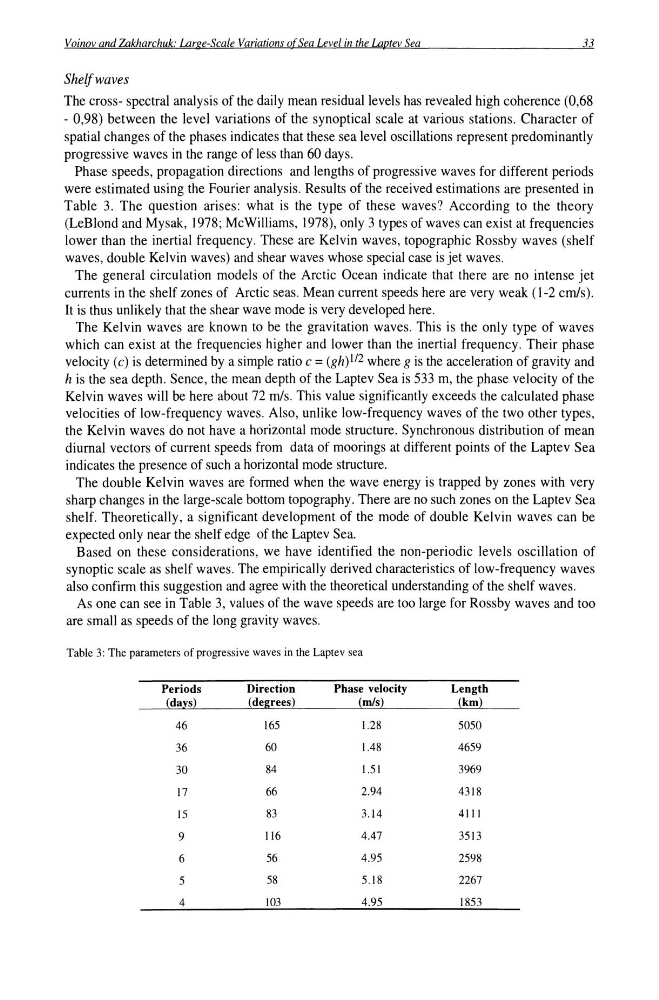
Phase speeds, propagation directions and lengths of progressive waves for different periods
were estimated using the Fourier analysis. Results of the received estimations are presented in
Table 3. The question arises: what is the type of these waves? According to the theory
(LeBlond and Mysak, 1978; McWilliams, 1978), only 3 types of waves can exist at frequencies
lower than the inertial frequency. These are Kelvin waves, topographic Rossby waves (shelf
waves, double Kelvin waves) and shear waves whose special case is jet waves.
The general circulation models of the Arctic Ocean indicate that there are no intense jet
currents in the shelf zones of Arctic seas. Mean current speeds here are very weak (1-2 cmls).
It is thus unlikely that the shear wave mode is very developed here.
The Kelvin waves are known to be the gravitation waves. This is the only type of waves
which can exist at the frequencies higher and lower than the inertial frequency. Their phase
velocity (c) is determined by a simple ratio c = (gh)I/2 where g is the acceleration of gravity and
h is the sea depth. Sence, the mean depth of the Laptev Sea is 533 m, the phase velocity of the
Kelvin waves will be here about 72 mls. This value significantly exceeds the calculated phase
velocities of low-frequency waves. Also, unlike low-frequency waves of the two other types,
the Kelvin waves do not have a horizontal mode structure. Synchronous distribution of mean
diurnal vectors of current speeds from data of moorings at different points of the Laptev Sea
indicates the presence of such a horizontal mode structure.
The double Kelvin waves are formed when the wave energy is trapped by zones with very
sharp changes in the large-scale bottom topography. There are no such zones on the Laptev Sea
shelf. Theoretically, a significant development of the mode of double Kelvin waves can be
expected only near the shelf edge of the Laptev Sea.
Based on these considerations, we have identified the non-periodic levels oscillation of
synoptic scale as shelf waves. The empirically derived characteristics of low-frequency waves
also confirm this suggestion and agree with the theoretical understanding of the shelf waves.
As one can see in Table 3, values of the wave speeds are too large for Rossby waves and too
are small as speeds of the long gravity waves.
Table 3: The parameters of progressive waves in the Laptev sea
Periods
Direction
Phase velocity
Length
(days)
(degrees)
(rn/s)
(km)
46
165
1.28
5050
36
60
1.48
4659
30
84
1.51
3969
17
66
2.94
4318
15
83
3.14
4111
9
116
4.47
3513
6
56
4.95
2598
5
58
5.18
2267
4
103
4.95
1853
33
Shelf waves
The cross- spectral analysis of the daily mean residual levels has revealed high coherence (0,68
- 0,98) between the level variations of the synoptical scale at various stations. Character of
spatial changes of the phases indicates that these sea level oscillations represent predominantly
progressive waves in the range of less than 60 days.
Phase speeds, propagation directions and lengths of progressive waves for different periods
were estimated using the Fourier analysis. Results of the received estimations are presented in
Table 3. The question arises: what is the type of these waves? According to the theory
(LeBlond and Mysak, 1978; McWilliams, 1978), only 3 types of waves can exist at frequencies
lower than the inertial frequency. These are Kelvin waves, topographic Rossby waves (shelf
waves, double Kelvin waves) and shear waves whose special case is jet waves.
The general circulation models of the Arctic Ocean indicate that there are no intense jet
currents in the shelf zones of Arctic seas. Mean current speeds here are very weak (1-2 cmls).
It is thus unlikely that the shear wave mode is very developed here.
The Kelvin waves are known to be the gravitation waves. This is the only type of waves
which can exist at the frequencies higher and lower than the inertial frequency. Their phase
velocity (c) is determined by a simple ratio c = (gh)I/2 where g is the acceleration of gravity and
h is the sea depth. Sence, the mean depth of the Laptev Sea is 533 m, the phase velocity of the
Kelvin waves will be here about 72 mls. This value significantly exceeds the calculated phase
velocities of low-frequency waves. Also, unlike low-frequency waves of the two other types,
the Kelvin waves do not have a horizontal mode structure. Synchronous distribution of mean
diurnal vectors of current speeds from data of moorings at different points of the Laptev Sea
indicates the presence of such a horizontal mode structure.
The double Kelvin waves are formed when the wave energy is trapped by zones with very
sharp changes in the large-scale bottom topography. There are no such zones on the Laptev Sea
shelf. Theoretically, a significant development of the mode of double Kelvin waves can be
expected only near the shelf edge of the Laptev Sea.
Based on these considerations, we have identified the non-periodic levels oscillation of
synoptic scale as shelf waves. The empirically derived characteristics of low-frequency waves
also confirm this suggestion and agree with the theoretical understanding of the shelf waves.
As one can see in Table 3, values of the wave speeds are too large for Rossby waves and too
are small as speeds of the long gravity waves.
Table 3: The parameters of progressive waves in the Laptev sea
Periods
Direction
Phase velocity
Length
(days)
(degrees)
(rn/s)
(km)
46
165
1.28
5050
36
60
1.48
4659
30
84
1.51
3969
17
66
2.94
4318
15
83
3.14
4111
9
116
4.47
3513
6
56
4.95
2598
5
58
5.18
2267
4
103
4.95
1853