

Ebel et al.: Laminated Sediments from Levinson-Lessing Lake
427
Long sediment cores were first recovered from Levinson-Lessing Lake during the 1995
expedition of the multi-disciplinary German-Russian Taymyr Project (Overduin et aI., 1996).
Coring in the central part of Levinson-Lessing lake resulted in a continuous sediment sequence
of 22.37 m length. Based on palynological results, the core represents a complete record from
the late Middle Weichselian to the present (Hahne and Melles, this volume). According to a
seismic survey, it comprises only the upper third of the lacustrine sediments in LevinsonLessing Lake, and is underlain by at least some additional 35 meters of laminated sediments
(Niessen et aI., this volume).
In this paper we present a description of the sediment core PG 1228, along with sediment
stratigraphical, geochemical and physical data. These results provide information concerning
the sedimentation processes in Levinson-Lessing Lake and their dependence on climatic
variations since the late Middle Weichselian.
pH
temperature °C
02 mgtl
2
5 15 25 35 45
10
.s 20
-E 30
Co
Q) 40
"C
....
250 nI
~:
80
- e - 17.6.96
J
-
24.6.96
--05.7.96
ice cover (2.5 - 1.0 m)
-
12.7.96
--9-22.7.96
---6- 07.8.96
no ice cover
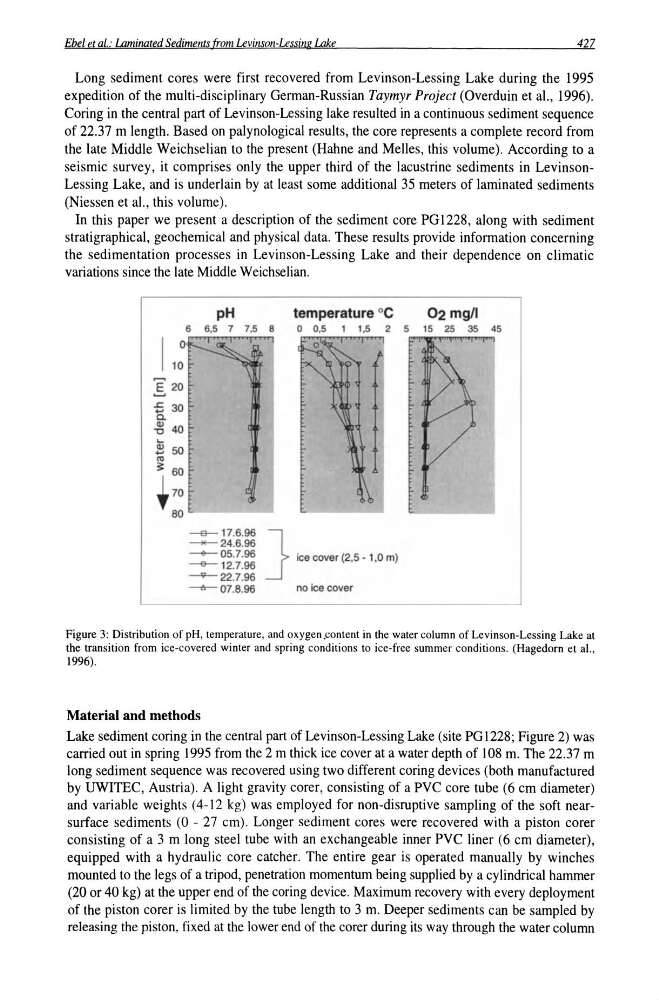
Figure 3: Distribution of pH, temperature, and oxygen .content in the water column of Levinson-Lessing Lake at
the transition from ice-covered winter and spring conditions to ice-free summer conditions. (Hagedorn et aI.,
1996).
Material and methods
Lake sediment coring in the central part of Levinson-Lessing Lake (site PG 1228; Figure 2) was
carried out in spring 1995 from the 2 m thick ice cover at a water depth of 108 m. The 22.37 m
long sediment sequence was recovered using two different coring devices (both manufactured
by UWITEC, Austria). A light gravity corer, consisting of a PVC core tube (6 cm diameter)
and variable weights (4-12 kg) was employed for non-disruptive sampling of the soft nearsurface sediments (0 - 27 cm). Longer sediment cores were recovered with a piston corer
consisting of a 3 m long steel tube with an exchangeable inner PVC liner (6 cm diameter),
equipped with a hydraulic core catcher. The entire gear is operated manually by winches
mounted to the legs of a tripod, penetration momentum being supplied by a cylindrical hammer
(20 or 40 kg) at the upper end of the coring device. Maximum recovery with every deployment
of the piston corer is limited by the tube length to 3 m. Deeper sediments can be sampled by
releasing the piston, fixed at the lower end of the corer during its way through the water column
427
Long sediment cores were first recovered from Levinson-Lessing Lake during the 1995
expedition of the multi-disciplinary German-Russian Taymyr Project (Overduin et aI., 1996).
Coring in the central part of Levinson-Lessing lake resulted in a continuous sediment sequence
of 22.37 m length. Based on palynological results, the core represents a complete record from
the late Middle Weichselian to the present (Hahne and Melles, this volume). According to a
seismic survey, it comprises only the upper third of the lacustrine sediments in LevinsonLessing Lake, and is underlain by at least some additional 35 meters of laminated sediments
(Niessen et aI., this volume).
In this paper we present a description of the sediment core PG 1228, along with sediment
stratigraphical, geochemical and physical data. These results provide information concerning
the sedimentation processes in Levinson-Lessing Lake and their dependence on climatic
variations since the late Middle Weichselian.
pH
temperature °C
02 mgtl
2
5 15 25 35 45
10
.s 20
-E 30
Co
Q) 40
"C
....
250 nI
~:
80
- e - 17.6.96
J
-
24.6.96
--05.7.96
ice cover (2.5 - 1.0 m)
-
12.7.96
--9-22.7.96
---6- 07.8.96
no ice cover
Figure 3: Distribution of pH, temperature, and oxygen .content in the water column of Levinson-Lessing Lake at
the transition from ice-covered winter and spring conditions to ice-free summer conditions. (Hagedorn et aI.,
1996).
Material and methods
Lake sediment coring in the central part of Levinson-Lessing Lake (site PG 1228; Figure 2) was
carried out in spring 1995 from the 2 m thick ice cover at a water depth of 108 m. The 22.37 m
long sediment sequence was recovered using two different coring devices (both manufactured
by UWITEC, Austria). A light gravity corer, consisting of a PVC core tube (6 cm diameter)
and variable weights (4-12 kg) was employed for non-disruptive sampling of the soft nearsurface sediments (0 - 27 cm). Longer sediment cores were recovered with a piston corer
consisting of a 3 m long steel tube with an exchangeable inner PVC liner (6 cm diameter),
equipped with a hydraulic core catcher. The entire gear is operated manually by winches
mounted to the legs of a tripod, penetration momentum being supplied by a cylindrical hammer
(20 or 40 kg) at the upper end of the coring device. Maximum recovery with every deployment
of the piston corer is limited by the tube length to 3 m. Deeper sediments can be sampled by
releasing the piston, fixed at the lower end of the corer during its way through the water column