

Hahne and Melles: Climate and Vegetation History ofthe Taymyr Peninsula
409
Galaziy and Parmuzin (1981). It is characterized by a strong vertical zonation, progressing
from larch-spruce or pure spruce forest close to the lake shore, via lichen-herb-dwarf-shrub
tundra, to rock-debris tundra and higher-rock tundra in high altitudes.
The 108 m deep Levinson-Lessing Lake is located in the southern Byrranga Mountains to the
west of Taymyr Lake (Figure 1). At the latter lake, positive air temperatures were recorded in
June, July, and August (30 year means: 0.6, 6.6, and 6.1 DC) by the Taymyr Meteorological
Station. In December, January, and February mean temperatures are below -30°C. The
precipitation ranges between 200 and 300 mm/a. The ground is snow-free in July and August,
and in some years also in June. The present-day vegetation in the Levinson-Lessing Lake
surroundings is composed of sweet grass, sedge, and herb communities. It shows a vertical
zonation in the surrounding hills, which reach altitudes of up to 570 m a.s.1. Specimens of
Betula and Alnus shrubs with dwarfish growths can be found in depressions and on favourably
exposed slopes. More detailed descriptions of the present-day vegetation are presented by
Zhurbenko (1995) and Anisimov and Pospelov (this volume).
Material and methods
The four lake sediment cores in this study were recovered during different expeditions (Figure
1, Table 1): Lama Lake was sampled in 1993 (Melles et aI., 1994a), Levinson-Lessing and
Kokora Lakes in 1995 (Bolshiyanov and Hubberten, 1996), and Changeable Lake in 1996
(Melles et aI., 1997). Coring was carried out in spring or early summer through holes in the
lake ice, with the exception of Lama Lake, which was sampled in summer from a floating
platform.
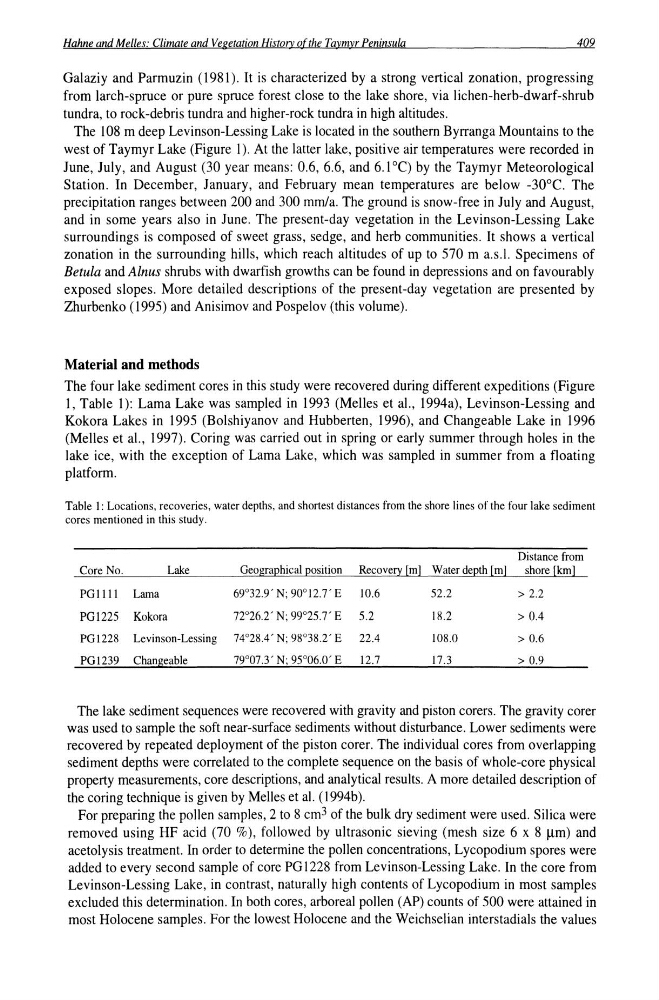
Table I: Locations, recoveries, water depths, and shortest distances from the shore lines of the four lake sediment
cores mentioned in this study.
Distance from
Core No.
Lake
GeograQhical Qosition
Recovel)' [m] Water deQth [m]
shore [krn]
PGIIll Lama
69°32.9' N; 90° 12.7' E
10.6
52.2
> 2.2
PG1225 Kokora
72°26.2' N; 99°25.7' E
5.2
18.2
> 0.4
PG1228 Levinson-Lessing
74°28.4' N; 98°38.2' E
22.4
108.0
> 0.6
PGl239 Changeable
79°07.3' N; 95°06.0' E
12.7
17.3
> 0.9
The lake sediment sequences were recovered with gravity and piston corers. The gravity corer
was used to sample the soft near-surface sediments without disturbance. Lower sediments were
recovered by repeated deployment of the piston corer. The individual cores from overlapping
sediment depths were correlated to the complete sequence on the basis of whole-core physical
property measurements, core descriptions, and analytical results. A more detailed description of
the coring technique is given by Melles et al. (I 994b ).
For preparing the pollen samples, 2 to 8 cm 3 of the bulk dry sediment were used. Silica were
removed using HF acid (70 %), followed by ultrasonic sieving (mesh size 6 x 811m) and
acetolysis treatment. In order to determine the pollen concentrations, Lycopodium spores were
added to every second sample of core PG 1228 from Levinson-Lessing Lake. In the core from
Levinson-Lessing Lake, in contrast, naturally high contents of Lycopodium in most samples
excluded this determination. In both cores, arboreal pollen (AP) counts of 500 were attained in
most Holocene samples. For the lowest Holocene and the Weichselian interstadials the values
409
Galaziy and Parmuzin (1981). It is characterized by a strong vertical zonation, progressing
from larch-spruce or pure spruce forest close to the lake shore, via lichen-herb-dwarf-shrub
tundra, to rock-debris tundra and higher-rock tundra in high altitudes.
The 108 m deep Levinson-Lessing Lake is located in the southern Byrranga Mountains to the
west of Taymyr Lake (Figure 1). At the latter lake, positive air temperatures were recorded in
June, July, and August (30 year means: 0.6, 6.6, and 6.1 DC) by the Taymyr Meteorological
Station. In December, January, and February mean temperatures are below -30°C. The
precipitation ranges between 200 and 300 mm/a. The ground is snow-free in July and August,
and in some years also in June. The present-day vegetation in the Levinson-Lessing Lake
surroundings is composed of sweet grass, sedge, and herb communities. It shows a vertical
zonation in the surrounding hills, which reach altitudes of up to 570 m a.s.1. Specimens of
Betula and Alnus shrubs with dwarfish growths can be found in depressions and on favourably
exposed slopes. More detailed descriptions of the present-day vegetation are presented by
Zhurbenko (1995) and Anisimov and Pospelov (this volume).
Material and methods
The four lake sediment cores in this study were recovered during different expeditions (Figure
1, Table 1): Lama Lake was sampled in 1993 (Melles et aI., 1994a), Levinson-Lessing and
Kokora Lakes in 1995 (Bolshiyanov and Hubberten, 1996), and Changeable Lake in 1996
(Melles et aI., 1997). Coring was carried out in spring or early summer through holes in the
lake ice, with the exception of Lama Lake, which was sampled in summer from a floating
platform.
Table I: Locations, recoveries, water depths, and shortest distances from the shore lines of the four lake sediment
cores mentioned in this study.
Distance from
Core No.
Lake
GeograQhical Qosition
Recovel)' [m] Water deQth [m]
shore [krn]
PGIIll Lama
69°32.9' N; 90° 12.7' E
10.6
52.2
> 2.2
PG1225 Kokora
72°26.2' N; 99°25.7' E
5.2
18.2
> 0.4
PG1228 Levinson-Lessing
74°28.4' N; 98°38.2' E
22.4
108.0
> 0.6
PGl239 Changeable
79°07.3' N; 95°06.0' E
12.7
17.3
> 0.9
The lake sediment sequences were recovered with gravity and piston corers. The gravity corer
was used to sample the soft near-surface sediments without disturbance. Lower sediments were
recovered by repeated deployment of the piston corer. The individual cores from overlapping
sediment depths were correlated to the complete sequence on the basis of whole-core physical
property measurements, core descriptions, and analytical results. A more detailed description of
the coring technique is given by Melles et al. (I 994b ).
For preparing the pollen samples, 2 to 8 cm 3 of the bulk dry sediment were used. Silica were
removed using HF acid (70 %), followed by ultrasonic sieving (mesh size 6 x 811m) and
acetolysis treatment. In order to determine the pollen concentrations, Lycopodium spores were
added to every second sample of core PG 1228 from Levinson-Lessing Lake. In the core from
Levinson-Lessing Lake, in contrast, naturally high contents of Lycopodium in most samples
excluded this determination. In both cores, arboreal pollen (AP) counts of 500 were attained in
most Holocene samples. For the lowest Holocene and the Weichselian interstadials the values