

390
Land-Ocean Systems in the Siberian Arctic: Dynamics and History
Lama Lake
PG1111
d i versity indices
chronozones
counting
number of diatom
Shannon-Weaverevenness
(Khotinsky,
1984,
sum
taxa 'S'
Index 'H'
'E'
DAZ Mangerud
e1 31 .. 1974)
0.0
,
(~r BP)
.
9
.
.9
c: ..
1.0
,
8
'iii
\
.tl
,
::l
,
(J)
~ 2500
- ... --- - ......
(
2.0
,
\
7
~
0
.0
,
.0
,
::l
(J)
3.0
.. 5000
,
-------. ..,
I
6
.9
4.0
c:
.!!I
,
<
,
5
12 8000
-------5.0
4
3
0
m ~9200
-------6.0
2
Pre,
boreal
'E'E
, ,
-""'10300 -
II>~
.~ =:;
Younger
'Co.
euplanktonic total
Dryas
II> II>
I/)'C
base:
500
50
2 2,5 3 3,5 4 a,s 0,6 0,7 0,8 0,9
10.6m
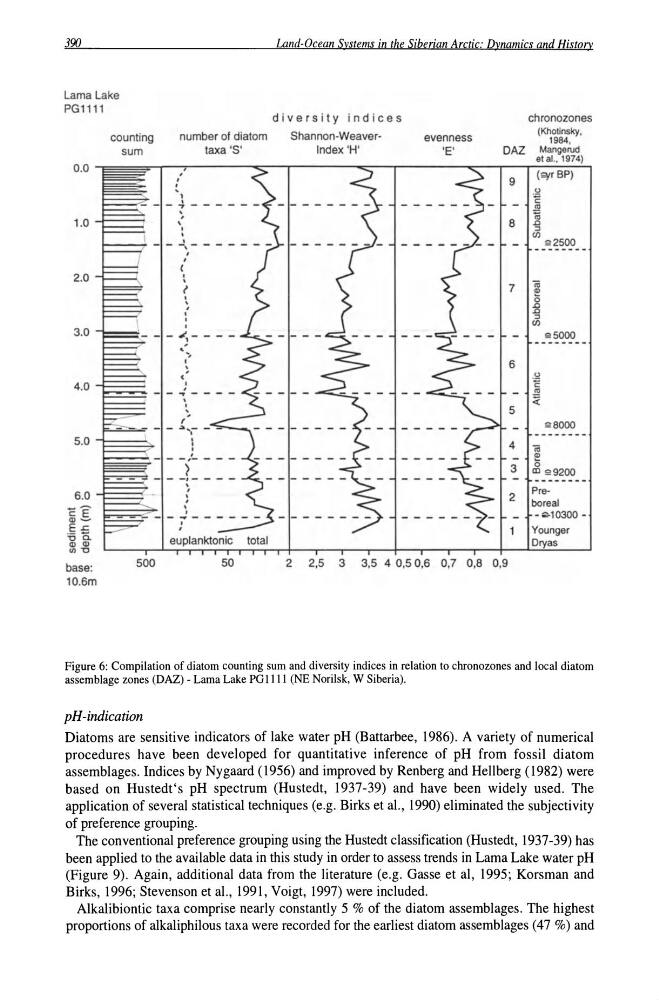
Figure 6: Compilation of diatom counting sum and diversity indices in relation to chronozones and local diatom
assemblage zones (DAZ) - Lama Lake PG IIII (NE Norilsk, W Siberia).
pH-indication
Diatoms are sensitive indicators of lake water pH (Battarbee, 1986). A variety of numerical
procedures have been developed for quantitative inference of pH from fossil diatom
assemblages. Indices by Nygaard (1956) and improved by Renberg and Hellberg (1982) were
based on Hustedt's pH spectrum (Hustedt, 1937-39) and have been widely used. The
application of several statistical techniques (e.g. Birks et aI., 1990) eliminated the subjectivity
of preference grouping.
The conventional preference grouping using the Hustedt classification (Hustedt, 1937-39) has
been applied to the available data in this study in order to assess trends in Lama Lake water pH
(Figure 9). Again, additional data from the literature (e.g. Gasse et ai, 1995; Korsman and
Birks, 1996; Stevenson et a!., 1991, Voigt, 1997) were included.
Alkalibiontic taxa comprise nearly constantly 5 % of the diatom assemblages. The highest
proportions of alkaliphilous taxa were recorded for the earliest diatom assemblages (47 %) and
Land-Ocean Systems in the Siberian Arctic: Dynamics and History
Lama Lake
PG1111
d i versity indices
chronozones
counting
number of diatom
Shannon-Weaverevenness
(Khotinsky,
1984,
sum
taxa 'S'
Index 'H'
'E'
DAZ Mangerud
e1 31 .. 1974)
0.0
,
(~r BP)
.
9
.
.9
c: ..
1.0
,
8
'iii
\
.tl
,
::l
,
(J)
~ 2500
- ... --- - ......
(
2.0
,
\
7
~
0
.0
,
.0
,
::l
(J)
3.0
.. 5000
,
-------. ..,
I
6
.9
4.0
c:
.!!I
,
<
,
5
12 8000
-------5.0
4
3
0
m ~9200
-------6.0
2
Pre,
boreal
'E'E
, ,
-""'10300 -
II>~
.~ =:;
Younger
'Co.
euplanktonic total
Dryas
II> II>
I/)'C
base:
500
50
2 2,5 3 3,5 4 a,s 0,6 0,7 0,8 0,9
10.6m
Figure 6: Compilation of diatom counting sum and diversity indices in relation to chronozones and local diatom
assemblage zones (DAZ) - Lama Lake PG IIII (NE Norilsk, W Siberia).
pH-indication
Diatoms are sensitive indicators of lake water pH (Battarbee, 1986). A variety of numerical
procedures have been developed for quantitative inference of pH from fossil diatom
assemblages. Indices by Nygaard (1956) and improved by Renberg and Hellberg (1982) were
based on Hustedt's pH spectrum (Hustedt, 1937-39) and have been widely used. The
application of several statistical techniques (e.g. Birks et aI., 1990) eliminated the subjectivity
of preference grouping.
The conventional preference grouping using the Hustedt classification (Hustedt, 1937-39) has
been applied to the available data in this study in order to assess trends in Lama Lake water pH
(Figure 9). Again, additional data from the literature (e.g. Gasse et ai, 1995; Korsman and
Birks, 1996; Stevenson et a!., 1991, Voigt, 1997) were included.
Alkalibiontic taxa comprise nearly constantly 5 % of the diatom assemblages. The highest
proportions of alkaliphilous taxa were recorded for the earliest diatom assemblages (47 %) and