

Kienel: Late Weichselian to Holocene Diatom Succession in a Sediment Core
Lama Lake
PG1111
chryso- ratio
phydiatomsl
cean crysoph.
diatom valves
cysts cysts
DAZ
0.0
1.0...J----I
~-~ --------------2.0~
4.0 ~----.,.I
1;;;~~ __ ~ __ ~ _____________ _
6.0 ""'--"7"
<=E Q)~
E .c
'50. Q) Q)
"'"0
25
50
75
100
125
150
20
max.: 6.68 m
numbers I mm microscope transect
9
8
7
6
5
4
3
2
30
389
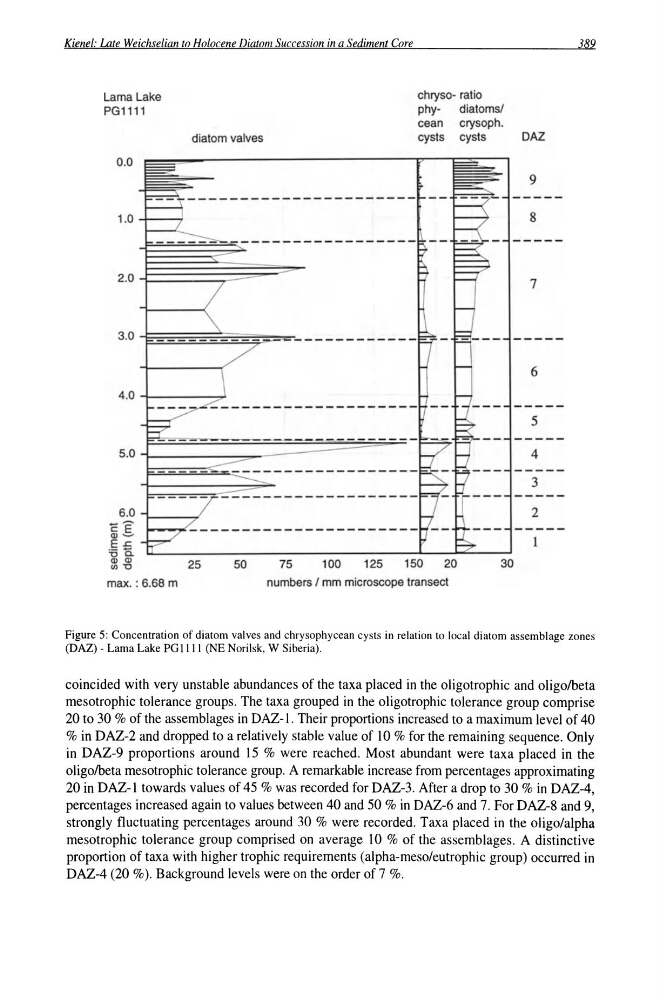
Figure 5: Concentration of diatom valves and chrysophycean cysts in relation to local diatom assemblage zones
(DAZ) - Lama Lake PO 1111 (NE Norilsk. W Siberia).
coincided with very unstable abundances of the taxa placed in the oligotrophic and oligo/beta
mesotrophic tolerance groups. The taxa grouped in the oligotrophic tolerance group comprise
20 to 30 % of the assemblages in DAZ-I. Their proportions increased to a maximum level of 40
% in DAZ-2 and dropped to a relatively stable value of 10 % for the remaining sequence. Only
in DAZ-9 proportions around 15 % were reached. Most abundant were taxa placed in the
oligo/beta mesotrophic tolerance group. A remarkable increase from percentages approximating
20 in DAZ-l towards values of 45 % was recorded for DAZ-3. After a drop to 30 % in DAZ-4,
percentages increased again to values between 40 and 50 % in DAZ-6 and 7. For DAZ-8 and 9,
strongly fluctuating percentages around 30 % were recorded. Taxa placed in the oligo/alpha
mesotrophic tolerance group comprised on average 10 % of the assemblages. A distinctive
proportion of taxa with higher trophic requirements (alpha-meso/eutrophic group) occurred in
DAZ-4 (20 %). Background levels were on the order of 7 %.
Lama Lake
PG1111
chryso- ratio
phydiatomsl
cean crysoph.
diatom valves
cysts cysts
DAZ
0.0
1.0...J----I
~-~ --------------2.0~
4.0 ~----.,.I
1;;;~~ __ ~ __ ~ _____________ _
6.0 ""'--"7"
<=E Q)~
E .c
'50. Q) Q)
"'"0
25
50
75
100
125
150
20
max.: 6.68 m
numbers I mm microscope transect
9
8
7
6
5
4
3
2
30
389
Figure 5: Concentration of diatom valves and chrysophycean cysts in relation to local diatom assemblage zones
(DAZ) - Lama Lake PO 1111 (NE Norilsk. W Siberia).
coincided with very unstable abundances of the taxa placed in the oligotrophic and oligo/beta
mesotrophic tolerance groups. The taxa grouped in the oligotrophic tolerance group comprise
20 to 30 % of the assemblages in DAZ-I. Their proportions increased to a maximum level of 40
% in DAZ-2 and dropped to a relatively stable value of 10 % for the remaining sequence. Only
in DAZ-9 proportions around 15 % were reached. Most abundant were taxa placed in the
oligo/beta mesotrophic tolerance group. A remarkable increase from percentages approximating
20 in DAZ-l towards values of 45 % was recorded for DAZ-3. After a drop to 30 % in DAZ-4,
percentages increased again to values between 40 and 50 % in DAZ-6 and 7. For DAZ-8 and 9,
strongly fluctuating percentages around 30 % were recorded. Taxa placed in the oligo/alpha
mesotrophic tolerance group comprised on average 10 % of the assemblages. A distinctive
proportion of taxa with higher trophic requirements (alpha-meso/eutrophic group) occurred in
DAZ-4 (20 %). Background levels were on the order of 7 %.