

374
Land-Ocean Systems in the Siberian Arctic: Dynamics and History
there was no evidence in the Lama Lake core for a decreasing input of Pb over the last 20 years_
This could be the result of the ongoing mining activities in the Noril'sk area as well as of the
continuous use of Pb additives in Russian fuel until the present.
1000
100
0
t> 10
IL
C 10
Q)
E
~
.2
C
w
0,1
•
lake sediments, this study
IlllII Greenland ice 1989 Boutron et aI. , (1991)
o arctic aerosol 1986, Vinogradova and Polissar (1995)
o spider webs of clean air regions 1990-91 ,
Germany, Rachold et aI. , (1992)
Pb
Cd
Zn
Cu
Ni
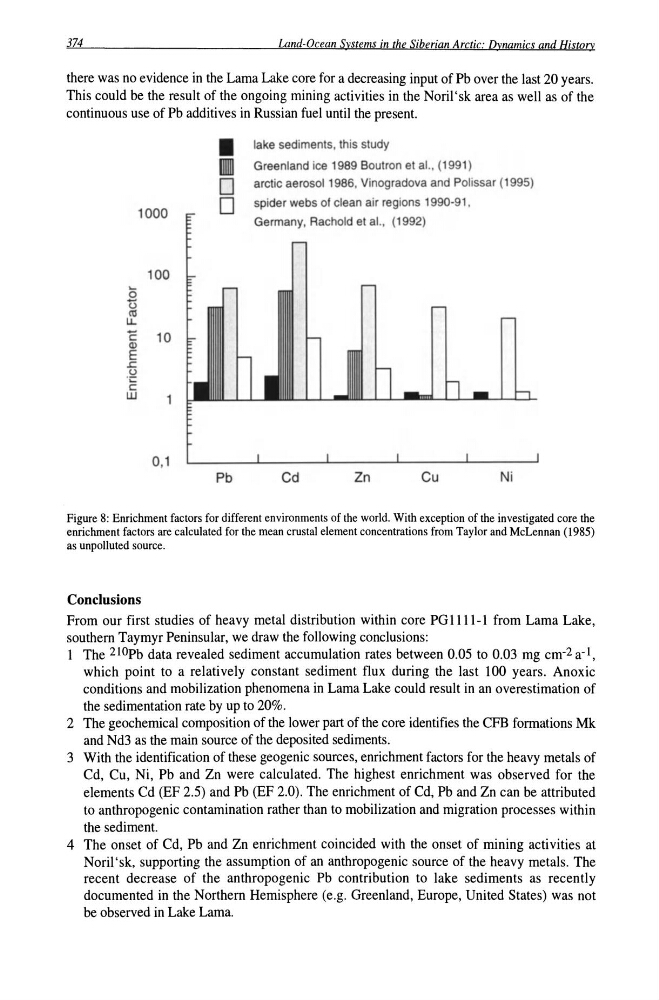
Figure 8: Enrichment factors for different environments of the world. With exception of the investigated core the
enrichment factors are calculated for the mean crustal element concentrations from Taylor and McLennan (1985)
as unpolluted source.
Conclusions
From our first studies of heavy metal distribution within core PG 1111-1 from Lama Lake,
southern Taymyr Peninsular, we draw the following conclusions:
1 The 210Pb data revealed sediment accumulation rates between 0.05 to 0.03 mg cm-2 a-I,
which point to a relatively constant sediment flux during the last 100 years. Anoxic
conditions and mobilization phenomena in Lama Lake could result in an overestimation of
the sedimentation rate by up to 20%.
2 The geochemical composition of the lower part of the core identifies the CFB formations Mk
and Nd3 as the main source of the deposited sediments.
3 With the identification of these geogenic sources, enrichment factors for the heavy metals of
Cd, Cu, Ni, Pb and Zn were calculated. The highest enrichment was observed for the
elements Cd (EF 2.5) and Pb (EF 2.0). The enrichment of Cd, Pb and Zn can be attributed
to anthropogenic contamination rather than to mobilization and migration processes within
the sediment.
4 The onset of Cd, Pb and Zn enrichment coincided with the onset of mining activities at
Noril'sk, supporting the assumption of an anthropogenic source of the heavy metals. The
recent decrease of the anthropogenic Pb contribution to lake sediments as recently
documented in the Northern Hemisphere (e.g. Greenland, Europe, United States) was not
be observed in Lake Lama.
Land-Ocean Systems in the Siberian Arctic: Dynamics and History
there was no evidence in the Lama Lake core for a decreasing input of Pb over the last 20 years_
This could be the result of the ongoing mining activities in the Noril'sk area as well as of the
continuous use of Pb additives in Russian fuel until the present.
1000
100
0
t> 10
IL
C 10
Q)
E
~
.2
C
w
0,1
•
lake sediments, this study
IlllII Greenland ice 1989 Boutron et aI. , (1991)
o arctic aerosol 1986, Vinogradova and Polissar (1995)
o spider webs of clean air regions 1990-91 ,
Germany, Rachold et aI. , (1992)
Pb
Cd
Zn
Cu
Ni
Figure 8: Enrichment factors for different environments of the world. With exception of the investigated core the
enrichment factors are calculated for the mean crustal element concentrations from Taylor and McLennan (1985)
as unpolluted source.
Conclusions
From our first studies of heavy metal distribution within core PG 1111-1 from Lama Lake,
southern Taymyr Peninsular, we draw the following conclusions:
1 The 210Pb data revealed sediment accumulation rates between 0.05 to 0.03 mg cm-2 a-I,
which point to a relatively constant sediment flux during the last 100 years. Anoxic
conditions and mobilization phenomena in Lama Lake could result in an overestimation of
the sedimentation rate by up to 20%.
2 The geochemical composition of the lower part of the core identifies the CFB formations Mk
and Nd3 as the main source of the deposited sediments.
3 With the identification of these geogenic sources, enrichment factors for the heavy metals of
Cd, Cu, Ni, Pb and Zn were calculated. The highest enrichment was observed for the
elements Cd (EF 2.5) and Pb (EF 2.0). The enrichment of Cd, Pb and Zn can be attributed
to anthropogenic contamination rather than to mobilization and migration processes within
the sediment.
4 The onset of Cd, Pb and Zn enrichment coincided with the onset of mining activities at
Noril'sk, supporting the assumption of an anthropogenic source of the heavy metals. The
recent decrease of the anthropogenic Pb contribution to lake sediments as recently
documented in the Northern Hemisphere (e.g. Greenland, Europe, United States) was not
be observed in Lake Lama.