

362
Land-Ocean Systems in the Siberian Arctic: Dynamics and History
10'
15'
20 '
25'
E
36'
o
I
2
I
12.6
Lama Lake
34' -
.
-----,-'
. .............
............ 31.6 .
25.5 "
32 ' -
----~
,-----,,'~
".;'
...........-~
---- ·48. 7
50. 0 --___ --20_
---PGlll l -l .
5?2('....
• 70~------_-=--=--=--=-4:;
52.2
\ 72.2
( : - - - - - _____ ;;;
_____ ~~.1
'..........
71.9
\ 87.3 .
- - - - - _
...... __
..................
91 .6
----------- --...-.,...... -- -- ....... _-r--__
--- --.- ----. ----80_
- -
- - -
- - 60
----20_ -40_
91.0 ·
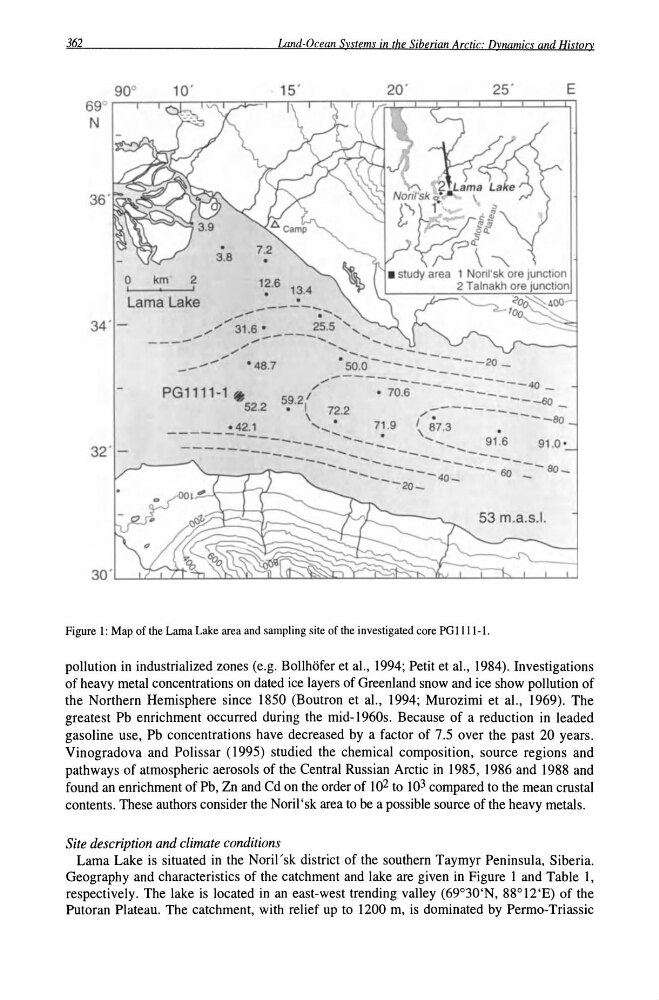
Figure 1: Map of the Lama Lake area and sampling site of the investigated core PG 1111-1.
pollution in industrialized zones (e.g. Bollhofer et a!., 1994; Petit et a!., 1984). Investigations
of heavy metal concentrations on dated ice layers of Greenland snow and ice show pollution of
the Northern Hemisphere since 1850 (Boutron et aI., 1994; Murozimi et aI., 1969). The
greatest Pb enrichment occurred during the mid-1960s. Because of a reduction in leaded
gasoline use, Pb concentrations have decreased by a factor of 7.5 over the past 20 years.
Vinogradova and Polissar (1995) studied the chemical composition, source regions and
pathways of atmospheric aerosols of the Central Russian Arctic in 1985, 1986 and 1988 and
found an enrichment of Pb, Zn and Cd on the order of 10 2 to 10 3 compared to the mean crustal
contents. These authors consider the Noril 'sk area to be a possible source of the heavy metals.
Site description and climate conditions
Lama Lake is situated in the Noril'sk district of the southern Taymyr Peninsula, Siberia.
Geography and characteristics of the catchment and lake are given in Figure 1 and Table 1,
respectively. The lake is located in an east-west trending valley (69°30'N, 88°12'E) of the
Putoran Plateau. The catchment, with relief up to 1200 m, is dominated by Permo-Triassic
Land-Ocean Systems in the Siberian Arctic: Dynamics and History
10'
15'
20 '
25'
E
36'
o
I
2
I
12.6
Lama Lake
34' -
.
-----,-'
. .............
............ 31.6 .
25.5 "
32 ' -
----~
,-----,,'~
".;'
...........-~
---- ·48. 7
50. 0 --___ --20_
---PGlll l -l .
5?2('....
• 70~------_-=--=--=--=-4:;
52.2
\ 72.2
( : - - - - - _____ ;;;
_____ ~~.1
'..........
71.9
\ 87.3 .
- - - - - _
...... __
..................
91 .6
----------- --...-.,...... -- -- ....... _-r--__
--- --.- ----. ----80_
- -
- - -
- - 60
----20_ -40_
91.0 ·
Figure 1: Map of the Lama Lake area and sampling site of the investigated core PG 1111-1.
pollution in industrialized zones (e.g. Bollhofer et a!., 1994; Petit et a!., 1984). Investigations
of heavy metal concentrations on dated ice layers of Greenland snow and ice show pollution of
the Northern Hemisphere since 1850 (Boutron et aI., 1994; Murozimi et aI., 1969). The
greatest Pb enrichment occurred during the mid-1960s. Because of a reduction in leaded
gasoline use, Pb concentrations have decreased by a factor of 7.5 over the past 20 years.
Vinogradova and Polissar (1995) studied the chemical composition, source regions and
pathways of atmospheric aerosols of the Central Russian Arctic in 1985, 1986 and 1988 and
found an enrichment of Pb, Zn and Cd on the order of 10 2 to 10 3 compared to the mean crustal
contents. These authors consider the Noril 'sk area to be a possible source of the heavy metals.
Site description and climate conditions
Lama Lake is situated in the Noril'sk district of the southern Taymyr Peninsula, Siberia.
Geography and characteristics of the catchment and lake are given in Figure 1 and Table 1,
respectively. The lake is located in an east-west trending valley (69°30'N, 88°12'E) of the
Putoran Plateau. The catchment, with relief up to 1200 m, is dominated by Permo-Triassic