

Zimichev et al.: The Features ofthe Hydrological Regime ofthe Lake-River Systems
359
ground component of the outflow below the downstream section of the Krasnaya river is about
0.027 km 3 , i.e. about 15 % of the total outflow from the lake basin. In 1994, a year with a
low water supply, the values Y (100 %), YI (47 %) and Y2 (18 %) were measured over the
incomplete hydrological cycle (from June 29 to August30).
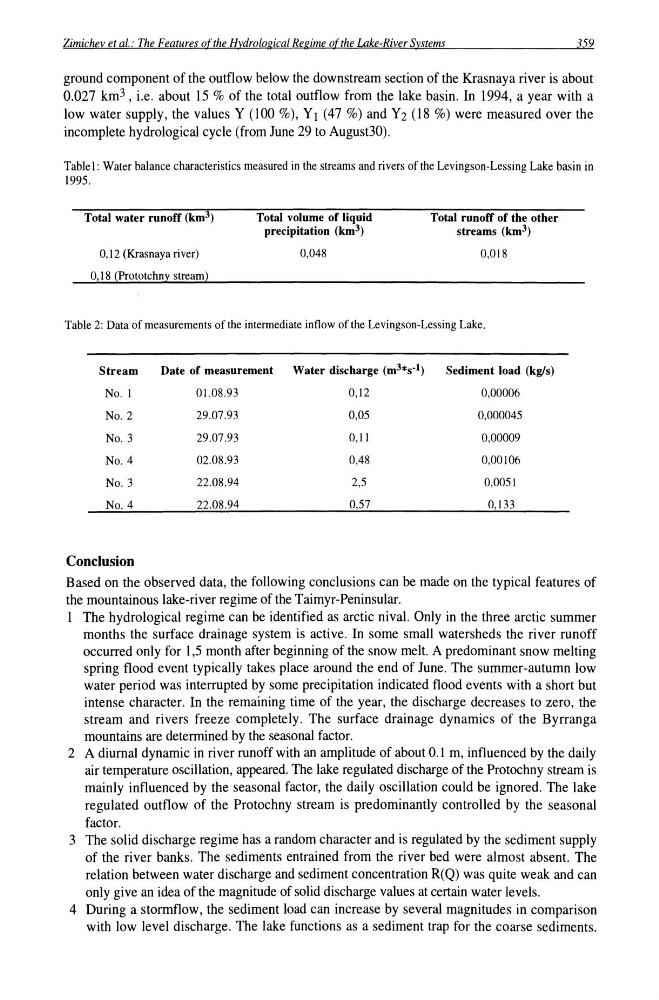
Table1: Water balance characteristics measured in the streams and riYers of the Levingson-Lessing Lake basin in
1995.
Total water runoff (km 3 )
0,12 (Krasnaya river)
0,18 (Prototchny stream)
Total volume of liquid
precipitation (km 3 )
0,048
Total runoff of the other
streams (km 3 )
0,oJ8
Table 2: Data of measurements of the intermediate inflow of the Levingson-Lessing Lake.
Stream
Date of measurement
Water discharge (m 3 *s-l)
Sediment load (kgls)
No. I
01.08.93
0,12
0,00006
No.2
29.07.93
0,05
0,000045
No.3
29.07.93
0,11
0,00009
No.4
02.08.93
0,48
0,00106
No.3
22.08.94
2,5
0,0051
No.4
22.08.94
0,57
0,133
Conclusion
Based on the observed data, the following conclusions can be made on the typical features of
the mountainous lake-river regime of the Taimyr-Peninsular.
I The hydrological regime can be identified as arctic nival. Only in the three arctic summer
months the surface drainage system is active. In some small watersheds the river runoff
occurred only for 1,5 month after beginning of the snow melt. A predominant snow melting
spring flood event typically takes place around the end of June. The summer-autumn low
water period was interrupted by some precipitation indicated flood events with a short but
intense character. In the remaining time of the year, the discharge decreases to zero, the
stream and rivers freeze completely. The surface drainage dynamics of the Byrranga
mountains are determined by the seasonal factor.
2 A diurnal dynamic in river runoff with an amplitude of about 0.1 m, influenced by the daily
air temperature oscillation, appeared. The lake regulated discharge of the Protochny stream is
mainly influenced by the seasonal factor, the daily oscillation could be ignored. The lake
regulated outflow of the Protochny stream is predominantly controlled by the seasonal
factor.
3 The solid discharge regime has a random character and is regulated by the sediment supply
of the river banks. The sediments entrained from the river bed were almost absent. The
relation between water discharge and sediment concentration R(Q) was quite weak and can
only give an idea of the magnitude of solid discharge values at certain water levels.
4 During a stormflow, the sediment load can increase by several magnitudes in comparison
with low level discharge. The lake functions as a sediment trap for the coarse sediments.
359
ground component of the outflow below the downstream section of the Krasnaya river is about
0.027 km 3 , i.e. about 15 % of the total outflow from the lake basin. In 1994, a year with a
low water supply, the values Y (100 %), YI (47 %) and Y2 (18 %) were measured over the
incomplete hydrological cycle (from June 29 to August30).
Table1: Water balance characteristics measured in the streams and riYers of the Levingson-Lessing Lake basin in
1995.
Total water runoff (km 3 )
0,12 (Krasnaya river)
0,18 (Prototchny stream)
Total volume of liquid
precipitation (km 3 )
0,048
Total runoff of the other
streams (km 3 )
0,oJ8
Table 2: Data of measurements of the intermediate inflow of the Levingson-Lessing Lake.
Stream
Date of measurement
Water discharge (m 3 *s-l)
Sediment load (kgls)
No. I
01.08.93
0,12
0,00006
No.2
29.07.93
0,05
0,000045
No.3
29.07.93
0,11
0,00009
No.4
02.08.93
0,48
0,00106
No.3
22.08.94
2,5
0,0051
No.4
22.08.94
0,57
0,133
Conclusion
Based on the observed data, the following conclusions can be made on the typical features of
the mountainous lake-river regime of the Taimyr-Peninsular.
I The hydrological regime can be identified as arctic nival. Only in the three arctic summer
months the surface drainage system is active. In some small watersheds the river runoff
occurred only for 1,5 month after beginning of the snow melt. A predominant snow melting
spring flood event typically takes place around the end of June. The summer-autumn low
water period was interrupted by some precipitation indicated flood events with a short but
intense character. In the remaining time of the year, the discharge decreases to zero, the
stream and rivers freeze completely. The surface drainage dynamics of the Byrranga
mountains are determined by the seasonal factor.
2 A diurnal dynamic in river runoff with an amplitude of about 0.1 m, influenced by the daily
air temperature oscillation, appeared. The lake regulated discharge of the Protochny stream is
mainly influenced by the seasonal factor, the daily oscillation could be ignored. The lake
regulated outflow of the Protochny stream is predominantly controlled by the seasonal
factor.
3 The solid discharge regime has a random character and is regulated by the sediment supply
of the river banks. The sediments entrained from the river bed were almost absent. The
relation between water discharge and sediment concentration R(Q) was quite weak and can
only give an idea of the magnitude of solid discharge values at certain water levels.
4 During a stormflow, the sediment load can increase by several magnitudes in comparison
with low level discharge. The lake functions as a sediment trap for the coarse sediments.