

348
Land-Ocean Systems in the Siberian Arctic: Dynamics and History
process has a negative feedback on soil respiration (Billings et aI., 1984; Oberbauer et aI.,
1991; Silvola et aI., 1996). This effect can, however, be modified through density of the soil
and lateral flow of oxygen-rich water. Higher watertables could also cause lower
COremmissions due to lowered COrdiffusion rates. This fact, however would result in a
time-lag in COz-emmissions after times of high water levels, which can not be seen from the
data presented here. The combined effect of lower temperatures in higher soil horizons due to
the higher water table causes some problems to filter out the significance of the factor water
from field-data. Future laboratory experiments on microcosms and modeling of the results will
help to filter out these different factors. Other factors controlling CO2-flux may be explained by
intrinsic site differences, e.g. litter quality, soil density, vegetation composition and microbial
population (Nadelhoffer et aI., 1991).
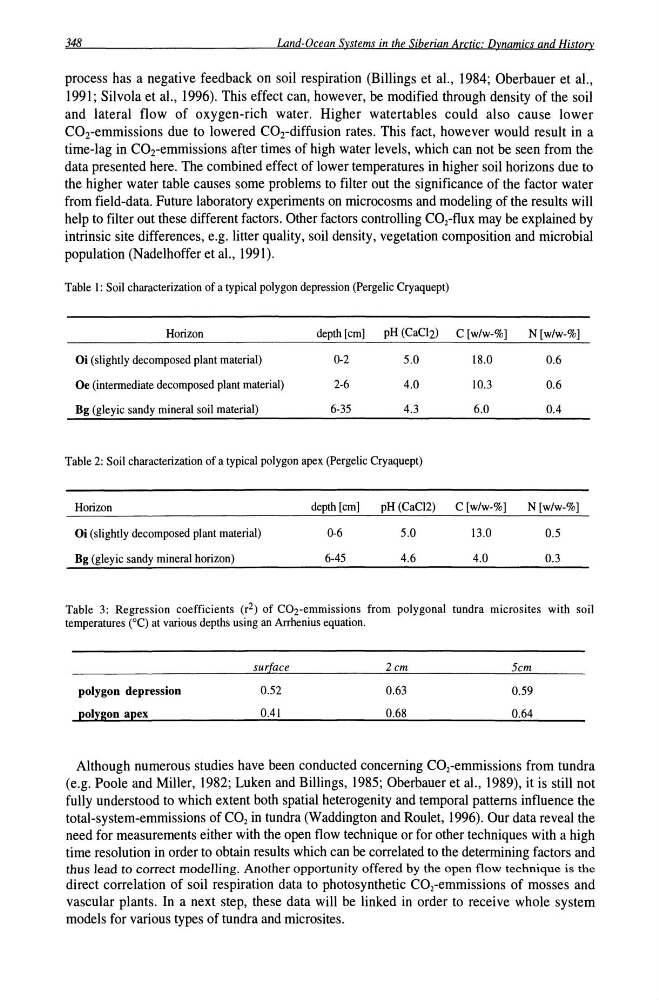
Table 1: Soil characterization of a typical polygon depression (Pergeiic Cryaquept)
Horizon
depth [cml
pH (CaCI2)
C [w/w-%]
N[w/w-%]
Oi (slightly decomposed plant material)
0-2
5.0
18.0
0.6
Oe (intermediate decomposed plant material)
2-6
4.0
10.3
0.6
Bg (gleyic sandy mineral soil material)
6-35
4.3
6.0
0.4
Table 2: Soil characterization of a typical polygon apex (Pergelic Cryaquept)
Horizon
depth [cm]
pH (CaCI2)
C [w/w-%]
N [w/w-%]
Oi (slightly decomposed plant material)
0-6
5.0
13.0
0.5
Bg (gleyic sandy mineral horizon)
6-45
4.6
4.0
0.3
Table 3: Regression coefficients (rz) of C02-emmissions from polygonal tundra microsites with soil
temperatures COC) at various depths using an Arrhenius equation.
polygon depression
polygon apex
surface
0.52
0.41
2cm
0.63
0.68
5cm
0.59
0.64
Although numerous studies have been conducted concerning CO2-emmissions from tundra
(e.g. Poole and Miller, 1982; Luken and Billings, 1985; Oberbauer et aI., 1989), it is still not
fully understood to which extent both spatial heterogenity and temporal patterns influence the
total-system-emmissions of CO2 in tundra (Waddington and Roulet, 1996). Our data reveal the
need for measurements either with the open flow technique or for other techniques with a high
time resolution in order to obtain results which can be correlated to the determining factors and
thus lead to correct modelling. Another opportunity offered by the open flow technique is the
direct correlation of soil respiration data to photosynthetic CO2-emmissions of mosses and
vascular plants. In a next step, these data will be linked in order to receive whole system
models for various types of tundra and microsites.
Land-Ocean Systems in the Siberian Arctic: Dynamics and History
process has a negative feedback on soil respiration (Billings et aI., 1984; Oberbauer et aI.,
1991; Silvola et aI., 1996). This effect can, however, be modified through density of the soil
and lateral flow of oxygen-rich water. Higher watertables could also cause lower
COremmissions due to lowered COrdiffusion rates. This fact, however would result in a
time-lag in COz-emmissions after times of high water levels, which can not be seen from the
data presented here. The combined effect of lower temperatures in higher soil horizons due to
the higher water table causes some problems to filter out the significance of the factor water
from field-data. Future laboratory experiments on microcosms and modeling of the results will
help to filter out these different factors. Other factors controlling CO2-flux may be explained by
intrinsic site differences, e.g. litter quality, soil density, vegetation composition and microbial
population (Nadelhoffer et aI., 1991).
Table 1: Soil characterization of a typical polygon depression (Pergeiic Cryaquept)
Horizon
depth [cml
pH (CaCI2)
C [w/w-%]
N[w/w-%]
Oi (slightly decomposed plant material)
0-2
5.0
18.0
0.6
Oe (intermediate decomposed plant material)
2-6
4.0
10.3
0.6
Bg (gleyic sandy mineral soil material)
6-35
4.3
6.0
0.4
Table 2: Soil characterization of a typical polygon apex (Pergelic Cryaquept)
Horizon
depth [cm]
pH (CaCI2)
C [w/w-%]
N [w/w-%]
Oi (slightly decomposed plant material)
0-6
5.0
13.0
0.5
Bg (gleyic sandy mineral horizon)
6-45
4.6
4.0
0.3
Table 3: Regression coefficients (rz) of C02-emmissions from polygonal tundra microsites with soil
temperatures COC) at various depths using an Arrhenius equation.
polygon depression
polygon apex
surface
0.52
0.41
2cm
0.63
0.68
5cm
0.59
0.64
Although numerous studies have been conducted concerning CO2-emmissions from tundra
(e.g. Poole and Miller, 1982; Luken and Billings, 1985; Oberbauer et aI., 1989), it is still not
fully understood to which extent both spatial heterogenity and temporal patterns influence the
total-system-emmissions of CO2 in tundra (Waddington and Roulet, 1996). Our data reveal the
need for measurements either with the open flow technique or for other techniques with a high
time resolution in order to obtain results which can be correlated to the determining factors and
thus lead to correct modelling. Another opportunity offered by the open flow technique is the
direct correlation of soil respiration data to photosynthetic CO2-emmissions of mosses and
vascular plants. In a next step, these data will be linked in order to receive whole system
models for various types of tundra and microsites.