

Sommerkom et at.: Carbon Dioxide and Methane Emmissions at Arctic Tundra Sites
347
Peterson and Billings, 1975, Svensson, 1980, Moore, 1986). Several studies indicate that
surface temperatures are better correlated with soil CO,-flux than are temperatures of deeper
horizons (Luken and Billings, 1985, Moore, 1986). The data in the present paper shows best
correlation with the temperature at 2 cm depth. This suggests that the major source of CO, from
the soil may be found around this layer, which is only 1 cm or less below the photosynthetic
active parts of the mosses and thus still in the layer of living mosstissue.
t ttl j,II
J J ~ J
Q
8 ~
~
-.:t
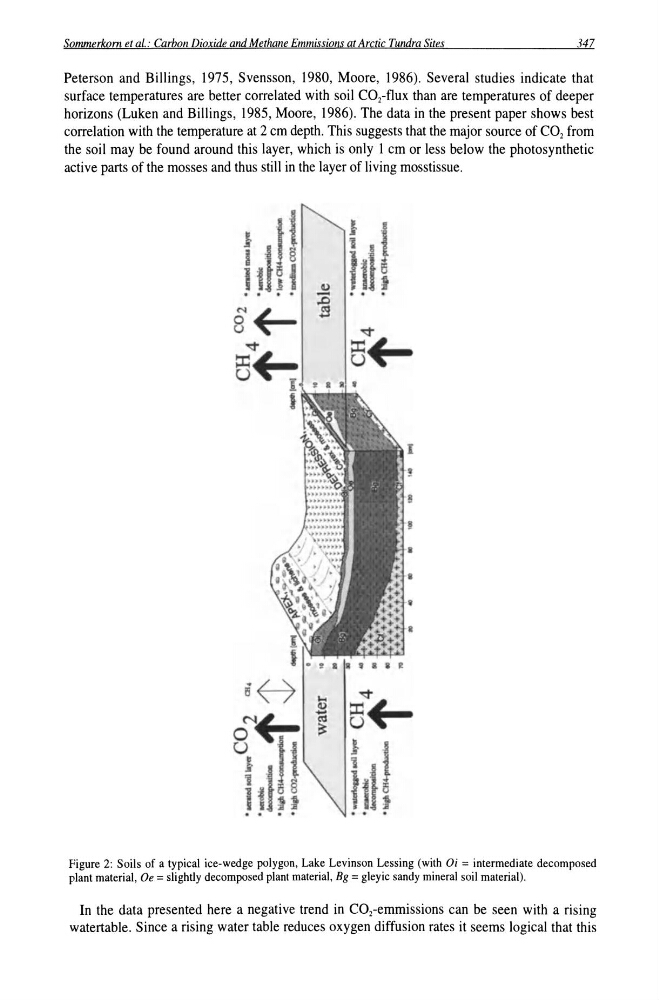
a+Figure 2: Soils of a typical ice-wedge polygon, Lake Levinson Lessing (with Oi = intermediate decomposed
plant material, Oe = slightly decomposed plant material, Bg = gleyic sandy mineral soil material).
In the data presented here a negative trend in CO,-emmissions can be seen with a rising
watertable. Since a rising water table reduces oxygen diffusion rates it seems logical that this
347
Peterson and Billings, 1975, Svensson, 1980, Moore, 1986). Several studies indicate that
surface temperatures are better correlated with soil CO,-flux than are temperatures of deeper
horizons (Luken and Billings, 1985, Moore, 1986). The data in the present paper shows best
correlation with the temperature at 2 cm depth. This suggests that the major source of CO, from
the soil may be found around this layer, which is only 1 cm or less below the photosynthetic
active parts of the mosses and thus still in the layer of living mosstissue.
t ttl j,II
J J ~ J
Q
8 ~
~
-.:t
a+Figure 2: Soils of a typical ice-wedge polygon, Lake Levinson Lessing (with Oi = intermediate decomposed
plant material, Oe = slightly decomposed plant material, Bg = gleyic sandy mineral soil material).
In the data presented here a negative trend in CO,-emmissions can be seen with a rising
watertable. Since a rising water table reduces oxygen diffusion rates it seems logical that this