

294
Land-Ocean Systems in the Siberian Arctic: Dynamics and History
plain. But unfortunately in the publication cited no reason is given for this extremely important
statement.
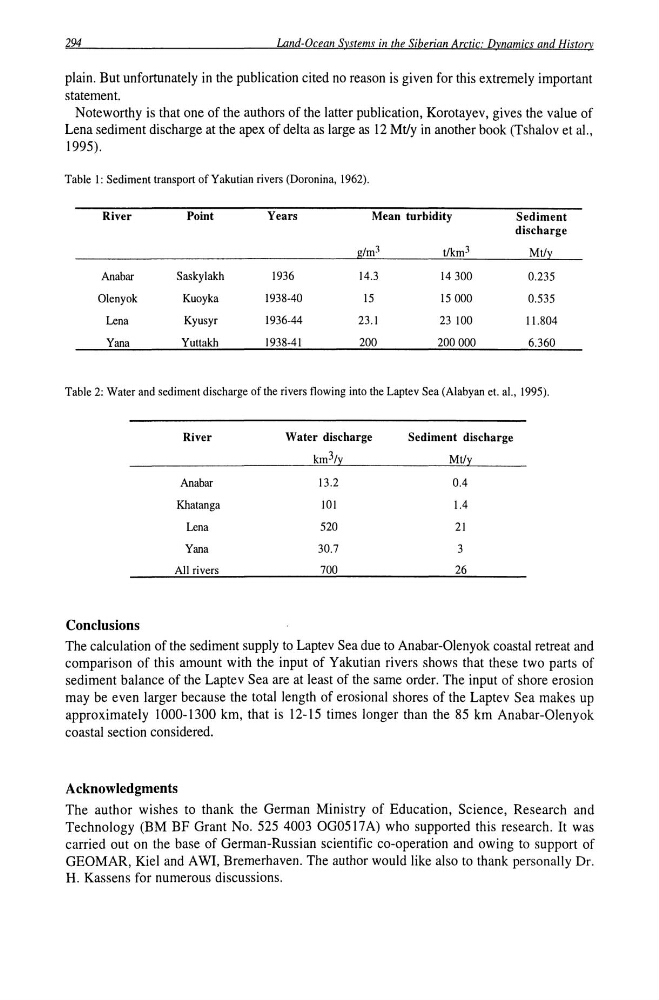
Noteworthy is that one of the authors of the latter publication, Korotayev, gives the value of
Lena sediment discharge at the apex of delta as large as 12 Mtly in another book (Tshalov et aI.,
1995).
Table I: Sediment transport of Yakutian rivers (Doronina, 1962).
River
Point
Years
Mean turbidity
Sediment
discharge
g/m3
tlkm 3
Mtly
Anabar
Saskylakh
1936
14.3
14300
0.235
Olenyok
Kuoyka
1938-40
15
15 000
0.535
Lena
Kyusyr
1936-44
23.1
23100
11.804
Yana
Yuttakh
1938-41
200
200 000
6.360
Table 2: Water and sediment discharge of the rivers flowing into the Laptev Sea (Alabyan et. aI., 1995).
River
Water discharge
Sediment discharge
km3/y
Mtly
Anabar
13.2
0.4
Khatanga
101
1.4
Lena
520
21
Yana
30.7
3
All rivers
700
26
Conclusions
The calculation of the sediment supply to Laptev Sea due to Anabar-Olenyok coastal retreat and
comparison of this amount with the input of Yakutian rivers shows that these two parts of
sediment balance of the Laptev Sea are at least of the same order. The input of shore erosion
may be even larger because the total length of erosional shores of the Laptev Sea makes up
approximately 1000- 1300 km, that is 12-15 times longer than the 85 km Anabar-Olenyok
coastal section considered.
Acknowledgments
The author wishes to thank the German Ministry of Education, Science, Research and
Technology (BM BF Grant No. 525 4003 OG05I7A) who supported this research. It was
carried out on the base of German-Russian scientific co-operation and owing to support of
GEOMAR, Kiel and AWl, Bremerhaven. The author would like also to thank personally Dr.
H. Kassens for numerous discussions.
Land-Ocean Systems in the Siberian Arctic: Dynamics and History
plain. But unfortunately in the publication cited no reason is given for this extremely important
statement.
Noteworthy is that one of the authors of the latter publication, Korotayev, gives the value of
Lena sediment discharge at the apex of delta as large as 12 Mtly in another book (Tshalov et aI.,
1995).
Table I: Sediment transport of Yakutian rivers (Doronina, 1962).
River
Point
Years
Mean turbidity
Sediment
discharge
g/m3
tlkm 3
Mtly
Anabar
Saskylakh
1936
14.3
14300
0.235
Olenyok
Kuoyka
1938-40
15
15 000
0.535
Lena
Kyusyr
1936-44
23.1
23100
11.804
Yana
Yuttakh
1938-41
200
200 000
6.360
Table 2: Water and sediment discharge of the rivers flowing into the Laptev Sea (Alabyan et. aI., 1995).
River
Water discharge
Sediment discharge
km3/y
Mtly
Anabar
13.2
0.4
Khatanga
101
1.4
Lena
520
21
Yana
30.7
3
All rivers
700
26
Conclusions
The calculation of the sediment supply to Laptev Sea due to Anabar-Olenyok coastal retreat and
comparison of this amount with the input of Yakutian rivers shows that these two parts of
sediment balance of the Laptev Sea are at least of the same order. The input of shore erosion
may be even larger because the total length of erosional shores of the Laptev Sea makes up
approximately 1000- 1300 km, that is 12-15 times longer than the 85 km Anabar-Olenyok
coastal section considered.
Acknowledgments
The author wishes to thank the German Ministry of Education, Science, Research and
Technology (BM BF Grant No. 525 4003 OG05I7A) who supported this research. It was
carried out on the base of German-Russian scientific co-operation and owing to support of
GEOMAR, Kiel and AWl, Bremerhaven. The author would like also to thank personally Dr.
H. Kassens for numerous discussions.