

Are: The Role of Coastal Retreat for Sedimentation in the Laptev Sea
289
sea by destruction of the shores. At present we can only use an assumed maximum depth for
the shore face supplying the sea with sediments. This approach can not be substantiated reliabl,
because of a lack of real data. For a better approach repeated bathymetric surveys with
sufficiently long time intervals are needed first of all. Such data exist (Kluyev, 1970) and they
have to be used in future investigations.
Most data on the shore retreat rate of Arctic seas are published by Are (1985), Reimnitz at al.
(1988) and Barnes et al. (1991). The height of coastal bluffs may be obtained from topographic
maps at 1:25 000 scale. Satisfactory data on lithology of coastal sediments are presented on
geological maps of I: 1 000000 and larger scales. The Map of Yakutia permafrost landscapes
of 1:2 500 000 scale gives but a rough idea of the coastal sediment ice content. The height of
the cliffs and near shore bathymetry may be obtained from the topographic maps of 1: 25 000
and other scales. Various additional data may be found in numerous scientific publications.
Actual field observations would of course be of great importance.
Methodology of determination of shore erosion input into the sediment balance of the
Laptev Sea
The quantity of sediments supplied to the sea by shore erosion may be calculated on the base of
two different principal ideas. The classical theory of abrasion supposes that the retreat of
abrasion shore has a limit determined by the minimum inclination of the shore face (Zenkovich,
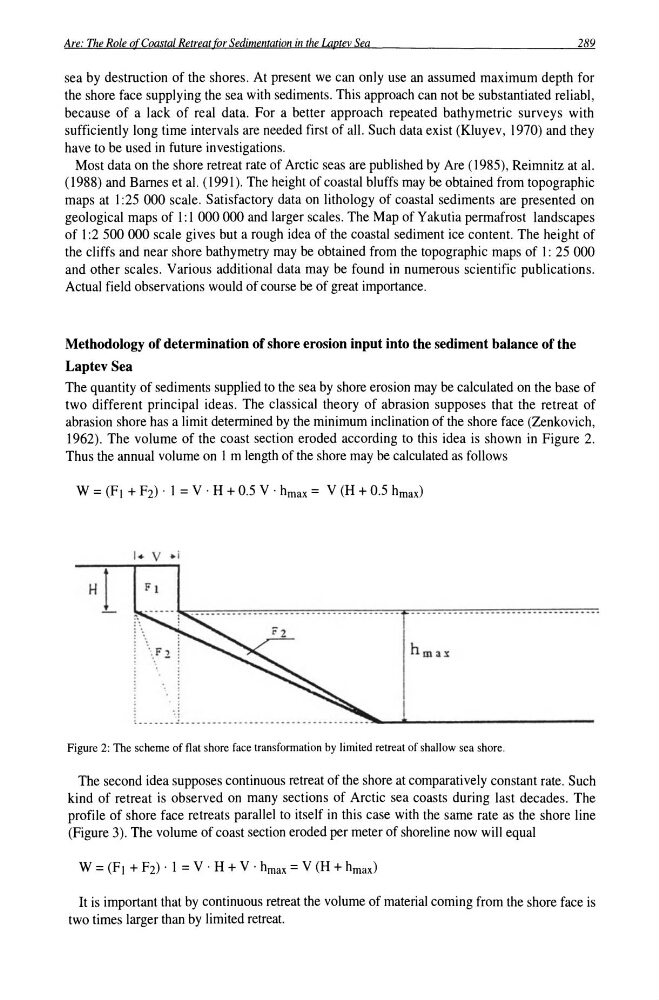
1962). The volume of the coast section eroded according to this idea is shown in Figure 2.
Thus the annual volume on 1 m length of the shore may be calculated as follows
W = (F I + F2) . I = V . H + 0.5 V . hmax = V (H + 0.5 hmax)
1+ V .. i
Figure 2: The scheme of flat shore face transformation by limited retreat of shallow sea shore.
The second idea supposes continuous retreat of the shore at comparatively constant rate. Such
kind of retreat is observed on many sections of Arctic sea coasts during last decades. The
profile of shore face retreats parallel to itself in this case with the same rate as the shore line
(Figure 3). The volume of coast section eroded per meter of shoreline now will equal
W = (F I + F2) . 1 = V . H + V . hmax = V (H + hmax)
It is important that by continuous retreat the volume of material coming from the shore face is
two times larger than by limited retreat.
289
sea by destruction of the shores. At present we can only use an assumed maximum depth for
the shore face supplying the sea with sediments. This approach can not be substantiated reliabl,
because of a lack of real data. For a better approach repeated bathymetric surveys with
sufficiently long time intervals are needed first of all. Such data exist (Kluyev, 1970) and they
have to be used in future investigations.
Most data on the shore retreat rate of Arctic seas are published by Are (1985), Reimnitz at al.
(1988) and Barnes et al. (1991). The height of coastal bluffs may be obtained from topographic
maps at 1:25 000 scale. Satisfactory data on lithology of coastal sediments are presented on
geological maps of I: 1 000000 and larger scales. The Map of Yakutia permafrost landscapes
of 1:2 500 000 scale gives but a rough idea of the coastal sediment ice content. The height of
the cliffs and near shore bathymetry may be obtained from the topographic maps of 1: 25 000
and other scales. Various additional data may be found in numerous scientific publications.
Actual field observations would of course be of great importance.
Methodology of determination of shore erosion input into the sediment balance of the
Laptev Sea
The quantity of sediments supplied to the sea by shore erosion may be calculated on the base of
two different principal ideas. The classical theory of abrasion supposes that the retreat of
abrasion shore has a limit determined by the minimum inclination of the shore face (Zenkovich,
1962). The volume of the coast section eroded according to this idea is shown in Figure 2.
Thus the annual volume on 1 m length of the shore may be calculated as follows
W = (F I + F2) . I = V . H + 0.5 V . hmax = V (H + 0.5 hmax)
1+ V .. i
Figure 2: The scheme of flat shore face transformation by limited retreat of shallow sea shore.
The second idea supposes continuous retreat of the shore at comparatively constant rate. Such
kind of retreat is observed on many sections of Arctic sea coasts during last decades. The
profile of shore face retreats parallel to itself in this case with the same rate as the shore line
(Figure 3). The volume of coast section eroded per meter of shoreline now will equal
W = (F I + F2) . 1 = V . H + V . hmax = V (H + hmax)
It is important that by continuous retreat the volume of material coming from the shore face is
two times larger than by limited retreat.