

288
Land-Ocean Systems in the Siberian Arctic: Dynamics and History
and migration of gases into atmosphere. The gas emission into atmosphere in the areas of rich
gas fields may dramatically influence the global changes of climate, favoring development of
green house effect.
Shore erosion is a source of sediments coming into the sea from the land. Therefore it plays a
part in formation of Arctic sea sediment balance. But the importance of this part is not
determined reliably till now. For a long time the sediment discharge of rivers was considered in
Russia as the main terrestrial input into the sediment balance of the seas. Suzdalsky (1974)
made a very rough comparison of river and shore input into White, Barents and Kara Seas and
obtained values of the same order. He pointed out the necessity of further investigations.
Shuyski (1983) made a new but also very rough evaluation and came to the conclusion that
abrasion of sea shores and shore faces brings to the World Ocean as many sediments as the
river transport to their mouths.
At present it is possible to determine the input of shore erosion into the sediment balance of
Arctic seas more accurately than in previous attempts. The main goal of this paper is to evaluate
the input of coastal erosion into the sediment balance of Laptev Sea. For this purpose we need
the data on shore retreat rate (V, m/y), height of the cliffs (H, m), water depth at the lower
boundary of the shore face, lithology of sediments composing the coast, volumetric ice content
of these sediments and their dry bulk density.
Among the parameters listed the least studied and understood is the lower boundary of the
shore face, which corresponds to the average maximum wave base, that is, the maximum depth
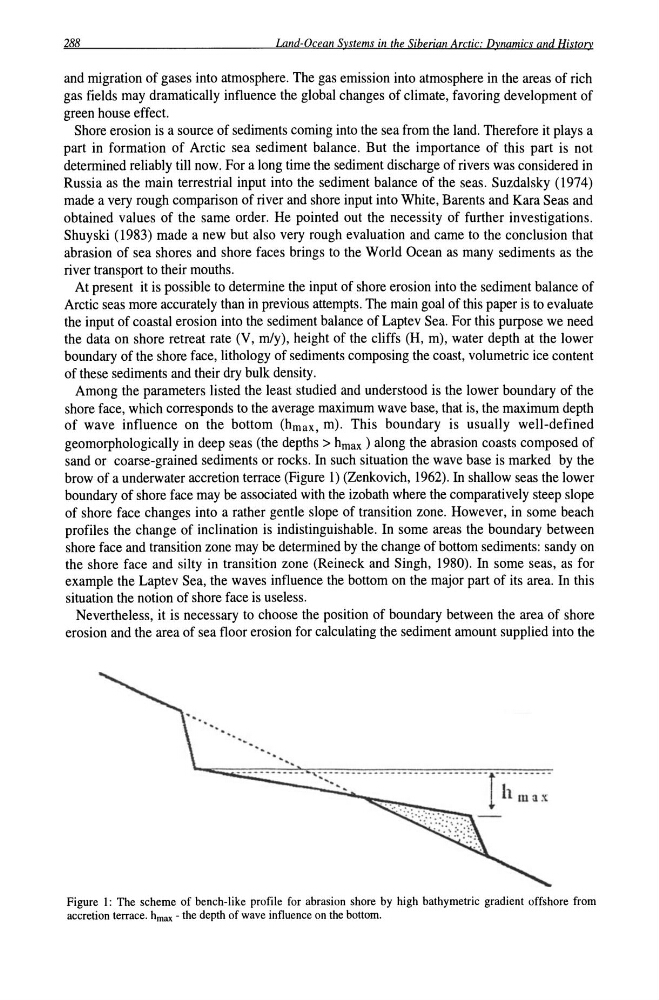
of wave influence on the bottom (hmax , m). This boundary is usually well-defined
geomorphologically in deep seas (the depths> hmax ) along the abrasion coasts composed of
sand or coarse-grained sediments or rocks. In such situation the wave base is marked by the
brow of a underwater accretion terrace (Figure 1) (Zenkovich, 1962). In shallow seas the lower
boundary of shore face may be associated with the izobath where the comparatively steep slope
of shore face changes into a rather gentle slope of transition zone. However, in some beach
profiles the change of inclination is indistinguishable. In some areas the boundary between
shore face and transition zone may be determined by the change of bottom sediments: sandy on
the shore face and silty in transition zone (Reineck and Singh, 1980). In some seas, as for
example the Laptev Sea, the waves influence the bottom on the major part of its area. In this
situation the notion of shore face is useless.
Nevertheless, it is necessary to choose the position of boundary between the area of shore
erosion and the area of sea floor erosion for calculating the sediment amount supplied into the
'.
'.
-------. ----~"':':':~-------------------------'r---------.
h lUa :<:
.
..
Figure 1: The scheme of bench-like profile for abrasion shore by high bathymetric gradient offshore from
accretion terrace. hmax - the depth of wave influence on the bottom.
Land-Ocean Systems in the Siberian Arctic: Dynamics and History
and migration of gases into atmosphere. The gas emission into atmosphere in the areas of rich
gas fields may dramatically influence the global changes of climate, favoring development of
green house effect.
Shore erosion is a source of sediments coming into the sea from the land. Therefore it plays a
part in formation of Arctic sea sediment balance. But the importance of this part is not
determined reliably till now. For a long time the sediment discharge of rivers was considered in
Russia as the main terrestrial input into the sediment balance of the seas. Suzdalsky (1974)
made a very rough comparison of river and shore input into White, Barents and Kara Seas and
obtained values of the same order. He pointed out the necessity of further investigations.
Shuyski (1983) made a new but also very rough evaluation and came to the conclusion that
abrasion of sea shores and shore faces brings to the World Ocean as many sediments as the
river transport to their mouths.
At present it is possible to determine the input of shore erosion into the sediment balance of
Arctic seas more accurately than in previous attempts. The main goal of this paper is to evaluate
the input of coastal erosion into the sediment balance of Laptev Sea. For this purpose we need
the data on shore retreat rate (V, m/y), height of the cliffs (H, m), water depth at the lower
boundary of the shore face, lithology of sediments composing the coast, volumetric ice content
of these sediments and their dry bulk density.
Among the parameters listed the least studied and understood is the lower boundary of the
shore face, which corresponds to the average maximum wave base, that is, the maximum depth
of wave influence on the bottom (hmax , m). This boundary is usually well-defined
geomorphologically in deep seas (the depths> hmax ) along the abrasion coasts composed of
sand or coarse-grained sediments or rocks. In such situation the wave base is marked by the
brow of a underwater accretion terrace (Figure 1) (Zenkovich, 1962). In shallow seas the lower
boundary of shore face may be associated with the izobath where the comparatively steep slope
of shore face changes into a rather gentle slope of transition zone. However, in some beach
profiles the change of inclination is indistinguishable. In some areas the boundary between
shore face and transition zone may be determined by the change of bottom sediments: sandy on
the shore face and silty in transition zone (Reineck and Singh, 1980). In some seas, as for
example the Laptev Sea, the waves influence the bottom on the major part of its area. In this
situation the notion of shore face is useless.
Nevertheless, it is necessary to choose the position of boundary between the area of shore
erosion and the area of sea floor erosion for calculating the sediment amount supplied into the
'.
'.
-------. ----~"':':':~-------------------------'r---------.
h lUa :<:
.
..
Figure 1: The scheme of bench-like profile for abrasion shore by high bathymetric gradient offshore from
accretion terrace. hmax - the depth of wave influence on the bottom.