

Behrends et at.: Distribution Patterns ofHeavv Minerals in Siberian Rivers
273
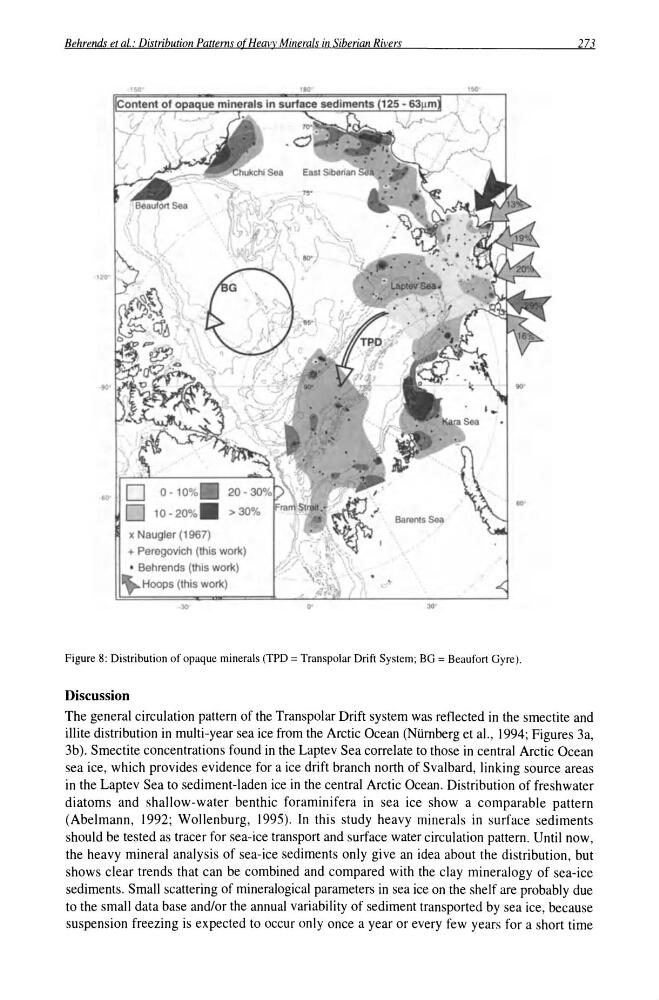
Figure 8: Distribution of opaque minerals (TPD = Transpolar Drift System; BG = Beaufort Gyre).
Discussion
The general circulation pattern of the Transpolar Drift system was reflected in the smectite and
illite distribution in multi-year sea ice from the Arctic Ocean (Ntirnberg et aI., 1994; Figures 3a,
3b). Smectite concentrations found in the Laptev Sea correlate to those in central Arctic Ocean
sea ice, which provides evidence for a ice drift branch north of Svalbard, linking source areas
in the Laptev Sea to sediment-laden ice in the central Arctic Ocean. Distribution of freshwater
diatoms and shallow-water benthic foraminifera in sea ice show a comparable pattern
(Abelmann, 1992; Wollenburg, 1995). In this study heavy minerals in surface sediments
should be tested as tracer for sea-ice transport and surface water circulation pattern. Until now,
the heavy mineral analysis of sea-ice sediments only give an idea about the distribution, but
shows clear trends that can be combined and compared with the clay mineralogy of sea-ice
sediments. Small scattering of mineralogical parameters in sea ice on the shelf are probably due
to the small data base and/or the annual variability of sediment transported by sea ice, because
suspension freezing is expected to occur only once a year or every few years for a short time
273
Figure 8: Distribution of opaque minerals (TPD = Transpolar Drift System; BG = Beaufort Gyre).
Discussion
The general circulation pattern of the Transpolar Drift system was reflected in the smectite and
illite distribution in multi-year sea ice from the Arctic Ocean (Ntirnberg et aI., 1994; Figures 3a,
3b). Smectite concentrations found in the Laptev Sea correlate to those in central Arctic Ocean
sea ice, which provides evidence for a ice drift branch north of Svalbard, linking source areas
in the Laptev Sea to sediment-laden ice in the central Arctic Ocean. Distribution of freshwater
diatoms and shallow-water benthic foraminifera in sea ice show a comparable pattern
(Abelmann, 1992; Wollenburg, 1995). In this study heavy minerals in surface sediments
should be tested as tracer for sea-ice transport and surface water circulation pattern. Until now,
the heavy mineral analysis of sea-ice sediments only give an idea about the distribution, but
shows clear trends that can be combined and compared with the clay mineralogy of sea-ice
sediments. Small scattering of mineralogical parameters in sea ice on the shelf are probably due
to the small data base and/or the annual variability of sediment transported by sea ice, because
suspension freezing is expected to occur only once a year or every few years for a short time