

216
Land-Ocean Systems in the Siberian Arctic: Dynamics and History
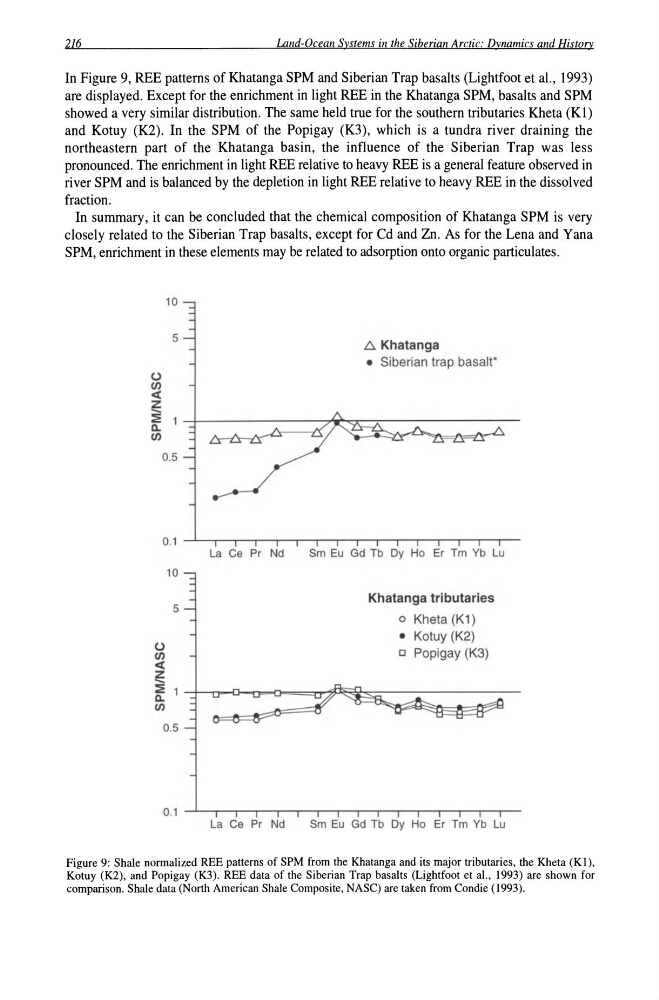
In Figure 9, REE patterns of Khatanga SPM and Siberian Trap basalts (Lightfoot et aI., 1993)
are displayed. Except for the enrichment in light REE in the Khatanga SPM, basalts and SPM
showed a very similar distribution. The same held true for the southern tributaries Kheta (Kl)
and Kotuy (K2). In the SPM of the Popigay (K3), which is a tundra river draining the
northeastern part of the Khatanga basin, the influence of the Siberian Trap was less
pronounced. The enrichment in light REE relative to heavy REE is a general feature observed in
river SPM and is balanced by the depletion in light REE relative to heavy REE in the dissolved
fraction.
In summary, it can be concluded that the chemical composition of Khatanga SPM is very
closely related to the Siberian Trap basalts, except for Cd and Zn. As for the Lena and Yana
SPM, enrichment in these elements may be related to adsorption onto organic particulates.
u
en
«
~
10
5
l:::. Khatanga
• Siberian trap basalt'
~ 1 -+---------------7~~-.----------------Q.
en
0.5
u
en
« z
~
Q.
en
10
5
0.5
La Ce Pr Nd
La Ce Pr Nd
Sm Eu Gd Tb Oy Ho Er Tm Yb Lu
Khatanga tributaries
o Kheta (Kl)
• Kotuy (K2)
CJ Popigay (K3)
Sm Eu Gd Tb Oy Ho Er Tm Yb Lu
Figure 9: Shale normalized REE patterns of SPM from the Khatanga and its major tributaries, the Kheta (KI),
Kotuy (K2), and Popigay (K3). REE data of the Siberian Trap basalts (Lightfoot et ai., 1993) are shown for
comparison. Shale data (North American Shale Composite, NASC) are taken from Condie (1993).
Land-Ocean Systems in the Siberian Arctic: Dynamics and History
In Figure 9, REE patterns of Khatanga SPM and Siberian Trap basalts (Lightfoot et aI., 1993)
are displayed. Except for the enrichment in light REE in the Khatanga SPM, basalts and SPM
showed a very similar distribution. The same held true for the southern tributaries Kheta (Kl)
and Kotuy (K2). In the SPM of the Popigay (K3), which is a tundra river draining the
northeastern part of the Khatanga basin, the influence of the Siberian Trap was less
pronounced. The enrichment in light REE relative to heavy REE is a general feature observed in
river SPM and is balanced by the depletion in light REE relative to heavy REE in the dissolved
fraction.
In summary, it can be concluded that the chemical composition of Khatanga SPM is very
closely related to the Siberian Trap basalts, except for Cd and Zn. As for the Lena and Yana
SPM, enrichment in these elements may be related to adsorption onto organic particulates.
u
en
«
~
10
5
l:::. Khatanga
• Siberian trap basalt'
~ 1 -+---------------7~~-.----------------Q.
en
0.5
u
en
« z
~
Q.
en
10
5
0.5
La Ce Pr Nd
La Ce Pr Nd
Sm Eu Gd Tb Oy Ho Er Tm Yb Lu
Khatanga tributaries
o Kheta (Kl)
• Kotuy (K2)
CJ Popigay (K3)
Sm Eu Gd Tb Oy Ho Er Tm Yb Lu
Figure 9: Shale normalized REE patterns of SPM from the Khatanga and its major tributaries, the Kheta (KI),
Kotuy (K2), and Popigay (K3). REE data of the Siberian Trap basalts (Lightfoot et ai., 1993) are shown for
comparison. Shale data (North American Shale Composite, NASC) are taken from Condie (1993).