

208
Land-Ocean Systems in the Siberian Arctic: Dynamics and History
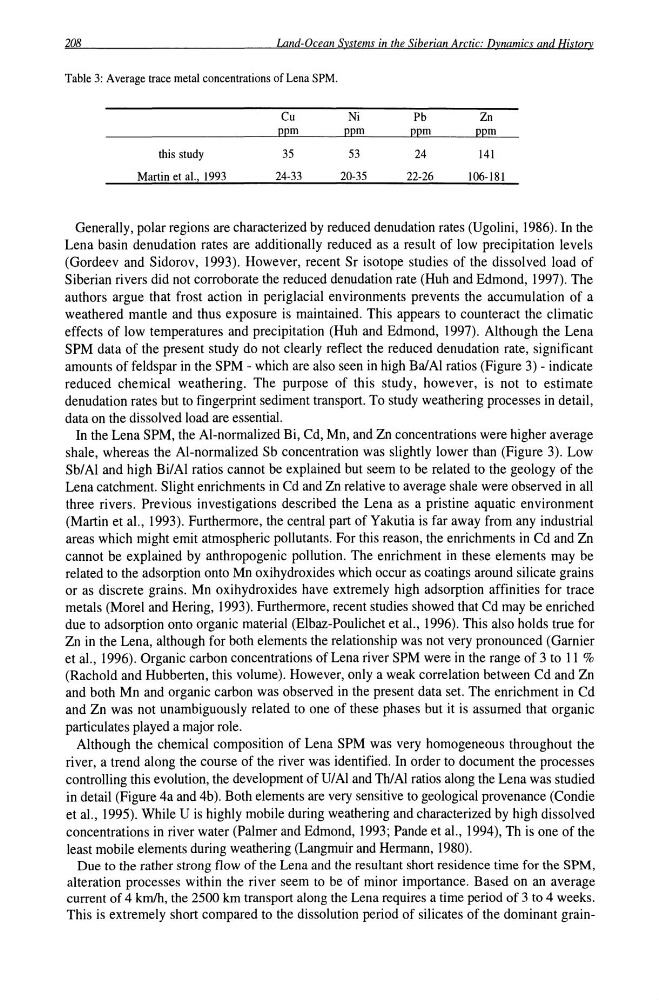
Table 3: Average trace metal concentrations of Lena SPM.
Cu
Ni
Pb
Zn
ppm
ppm
ppm
ppm
this study
35
53
24
141
Martin et aI., 1993
24-33
20-35
22-26
106-J8J
Generally, polar regions are characterized by reduced denudation rates (Ugolini, 1986). In the
Lena basin denudation rates are additionally reduced as a result of low precipitation levels
(Gordeev and Sidorov, 1993). However, recent Sr isotope studies of the dissolved load of
Siberian rivers did not corroborate the reduced denudation rate (Huh and Edmond, 1997). The
authors argue that frost action in periglacial environments prevents the accumulation of a
weathered mantle and thus exposure is maintained. This appears to counteract the climatic
effects of low temperatures and precipitation (Huh and Edmond, 1997). Although the Lena
SPM data of the present study do not clearly reflect the reduced denudation rate, significant
amounts of feldspar in the SPM - which are also seen in high Ba/ Al ratios (Figure 3) - indicate
reduced chemical weathering. The purpose of this study, however, is not to estimate
denudation rates but to fingerprint sediment transport. To study weathering processes in detail,
data on the dissolved load are essential.
In the Lena SPM, the AI-normalized Bi, Cd, Mn, and Zn concentrations were higher average
shale, whereas the AI-normalized Sb concentration was slightly lower than (Figure 3). Low
Sb/AI and high BilAI ratios cannot be explained but seem to be related to the geology of the
Lena catchment. Slight enrichments in Cd and Zn relative to average shale were observed in all
three rivers. Previous investigations described the Lena as a pristine aquatic environment
(Martin et aI., 1993). Furthermore, the central part of Yakutia is far away from any industrial
areas which might emit atmospheric pollutants. For this reason, the enrichments in Cd and Zn
cannot be explained by anthropogenic pollution. The enrichment in these elements may be
related to the adsorption onto Mn oxihydroxides which occur as coatings around silicate grains
or as discrete grains. Mn oxihydroxides have extremely high adsorption affinities for trace
metals (Morel and Hering, 1993). Furthermore, recent studies showed that Cd may be enriched
due to adsorption onto organic material (Elbaz-Poulichet et aI., 1996). This also holds true for
Zn in the Lena, although for both elements the relationship was not very pronounced (Garnier
et aI., 1996). Organic carbon concentrations of Lena river SPM were in the range of 3 to 11 %
(Rachold and Hubberten, this volume). However, only a weak correlation between Cd and Zn
and both Mn and organic carbon was observed in the present data set. The enrichment in Cd
and Zn was not unambiguously related to one of these phases but it is assumed that organic
particulates played a major role.
Although the chemical composition of Lena SPM was very homogeneous throughout the
river, a trend along the course of the river was identified. In order to document the processes
controlling this evolution, the development of UI AI and Thl Al ratios along the Lena was studied
in detail (Figure 4a and 4b). Both elements are very sensitive to geological provenance (Condie
et aI., 1995). While U is highly mobile during weathering and characterized by high dissolved
concentrations in river water (Palmer and Edmond, 1993; Pande et aI., 1994), Th is one of the
least mobile elements during weathering (Langmuir and Hermann, 1980).
Due to the rather strong flow of the Lena and the resultant short residence time for the SPM,
alteration processes within the river seem to be of minor importance. Based on an average
current of 4 kmlh, the 2500 km transport along the Lena requires a time period of 3 to 4 weeks.
This is extremely short compared to the dissolution period of silicates of the dominant grain-
Land-Ocean Systems in the Siberian Arctic: Dynamics and History
Table 3: Average trace metal concentrations of Lena SPM.
Cu
Ni
Pb
Zn
ppm
ppm
ppm
ppm
this study
35
53
24
141
Martin et aI., 1993
24-33
20-35
22-26
106-J8J
Generally, polar regions are characterized by reduced denudation rates (Ugolini, 1986). In the
Lena basin denudation rates are additionally reduced as a result of low precipitation levels
(Gordeev and Sidorov, 1993). However, recent Sr isotope studies of the dissolved load of
Siberian rivers did not corroborate the reduced denudation rate (Huh and Edmond, 1997). The
authors argue that frost action in periglacial environments prevents the accumulation of a
weathered mantle and thus exposure is maintained. This appears to counteract the climatic
effects of low temperatures and precipitation (Huh and Edmond, 1997). Although the Lena
SPM data of the present study do not clearly reflect the reduced denudation rate, significant
amounts of feldspar in the SPM - which are also seen in high Ba/ Al ratios (Figure 3) - indicate
reduced chemical weathering. The purpose of this study, however, is not to estimate
denudation rates but to fingerprint sediment transport. To study weathering processes in detail,
data on the dissolved load are essential.
In the Lena SPM, the AI-normalized Bi, Cd, Mn, and Zn concentrations were higher average
shale, whereas the AI-normalized Sb concentration was slightly lower than (Figure 3). Low
Sb/AI and high BilAI ratios cannot be explained but seem to be related to the geology of the
Lena catchment. Slight enrichments in Cd and Zn relative to average shale were observed in all
three rivers. Previous investigations described the Lena as a pristine aquatic environment
(Martin et aI., 1993). Furthermore, the central part of Yakutia is far away from any industrial
areas which might emit atmospheric pollutants. For this reason, the enrichments in Cd and Zn
cannot be explained by anthropogenic pollution. The enrichment in these elements may be
related to the adsorption onto Mn oxihydroxides which occur as coatings around silicate grains
or as discrete grains. Mn oxihydroxides have extremely high adsorption affinities for trace
metals (Morel and Hering, 1993). Furthermore, recent studies showed that Cd may be enriched
due to adsorption onto organic material (Elbaz-Poulichet et aI., 1996). This also holds true for
Zn in the Lena, although for both elements the relationship was not very pronounced (Garnier
et aI., 1996). Organic carbon concentrations of Lena river SPM were in the range of 3 to 11 %
(Rachold and Hubberten, this volume). However, only a weak correlation between Cd and Zn
and both Mn and organic carbon was observed in the present data set. The enrichment in Cd
and Zn was not unambiguously related to one of these phases but it is assumed that organic
particulates played a major role.
Although the chemical composition of Lena SPM was very homogeneous throughout the
river, a trend along the course of the river was identified. In order to document the processes
controlling this evolution, the development of UI AI and Thl Al ratios along the Lena was studied
in detail (Figure 4a and 4b). Both elements are very sensitive to geological provenance (Condie
et aI., 1995). While U is highly mobile during weathering and characterized by high dissolved
concentrations in river water (Palmer and Edmond, 1993; Pande et aI., 1994), Th is one of the
least mobile elements during weathering (Langmuir and Hermann, 1980).
Due to the rather strong flow of the Lena and the resultant short residence time for the SPM,
alteration processes within the river seem to be of minor importance. Based on an average
current of 4 kmlh, the 2500 km transport along the Lena requires a time period of 3 to 4 weeks.
This is extremely short compared to the dissolution period of silicates of the dominant grain-