

Sowvieva: Spring Stopover of Birds on the Laptev Sea Polynva
191
120·
- - 140·
160·
180
80
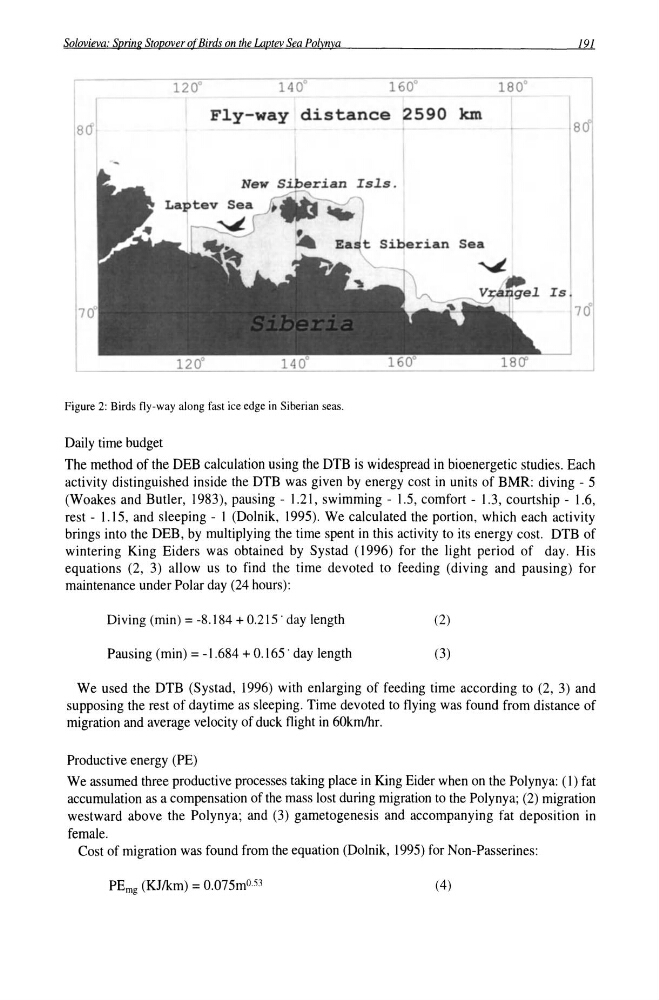
Fly-way distance 2590 km
Sea
70'
Is . j
70
--~~--------~~--Figure 2: Birds fly-way along fast ice edge in Siberian seas.
Daily time budget
The method of the DEB calculation using the DTB is widespread in bioenergetic studies. Each
activity distinguished inside the DTB was given by energy cost in units of BMR: diving - 5
(Woakes and Butler, 1983), pausing - 1.21, swimming - 1.5, comfort - 1.3, courtship - 1.6,
rest - 1.15, and sleeping - I (Dolnik, 1995). We calculated the portion, which each activity
brings into the DEB, by multiplying the time spent in this activity to its energy cost. DTB of
wintering King Eiders was obtained by Systad (1996) for the light period of day. His
equations (2, 3) allow us to find the time devoted to feeding (diving and pausing) for
maintenance under Polar day (24 hours):
Diving (min) = -8.184 + 0.215 . day length
(2)
Pausing (min) = -1.684 + 0.165 . day length
(3)
We used the DTB (Systad, 1996) with enlarging of feeding time according to (2, 3) and
supposing the rest of daytime as sleeping. Time devoted to flying was found from distance of
migration and average velocity of duck flight in 60kmlhr.
Productive energy (PE)
We assumed three productive processes taking place in King Eider when on the Polynya: (I) fat
accumulation as a compensation of the mass lost during migration to the Polynya; (2) migration
westward above the Polynya; and (3) gametogenesis and accompanying fat deposition in
female.
Cost of migration was found from the equation (Dolnik, 1995) for Non-Passerines:
PE mg (KJ/km) = 0.075m053
(4)
191
120·
- - 140·
160·
180
80
Fly-way distance 2590 km
Sea
70'
Is . j
70
--~~--------~~--Figure 2: Birds fly-way along fast ice edge in Siberian seas.
Daily time budget
The method of the DEB calculation using the DTB is widespread in bioenergetic studies. Each
activity distinguished inside the DTB was given by energy cost in units of BMR: diving - 5
(Woakes and Butler, 1983), pausing - 1.21, swimming - 1.5, comfort - 1.3, courtship - 1.6,
rest - 1.15, and sleeping - I (Dolnik, 1995). We calculated the portion, which each activity
brings into the DEB, by multiplying the time spent in this activity to its energy cost. DTB of
wintering King Eiders was obtained by Systad (1996) for the light period of day. His
equations (2, 3) allow us to find the time devoted to feeding (diving and pausing) for
maintenance under Polar day (24 hours):
Diving (min) = -8.184 + 0.215 . day length
(2)
Pausing (min) = -1.684 + 0.165 . day length
(3)
We used the DTB (Systad, 1996) with enlarging of feeding time according to (2, 3) and
supposing the rest of daytime as sleeping. Time devoted to flying was found from distance of
migration and average velocity of duck flight in 60kmlhr.
Productive energy (PE)
We assumed three productive processes taking place in King Eider when on the Polynya: (I) fat
accumulation as a compensation of the mass lost during migration to the Polynya; (2) migration
westward above the Polynya; and (3) gametogenesis and accompanying fat deposition in
female.
Cost of migration was found from the equation (Dolnik, 1995) for Non-Passerines:
PE mg (KJ/km) = 0.075m053
(4)