

Petryashov et al.: Macrobenthos Distribution ill the Laptev Sea
7~ Taimy::"
" ./t-- - - - -- - - ,
\O~ · E
nc'
I I!.'
" ..
..;7-:- -: "":)
). / -I "
':,
) . \
177
11
16
\
~ Kotel nyyf? ,I
,V'
/-______ -\
,,--' !15'
n'
11 ..
lloS"
140'
''' S ' E
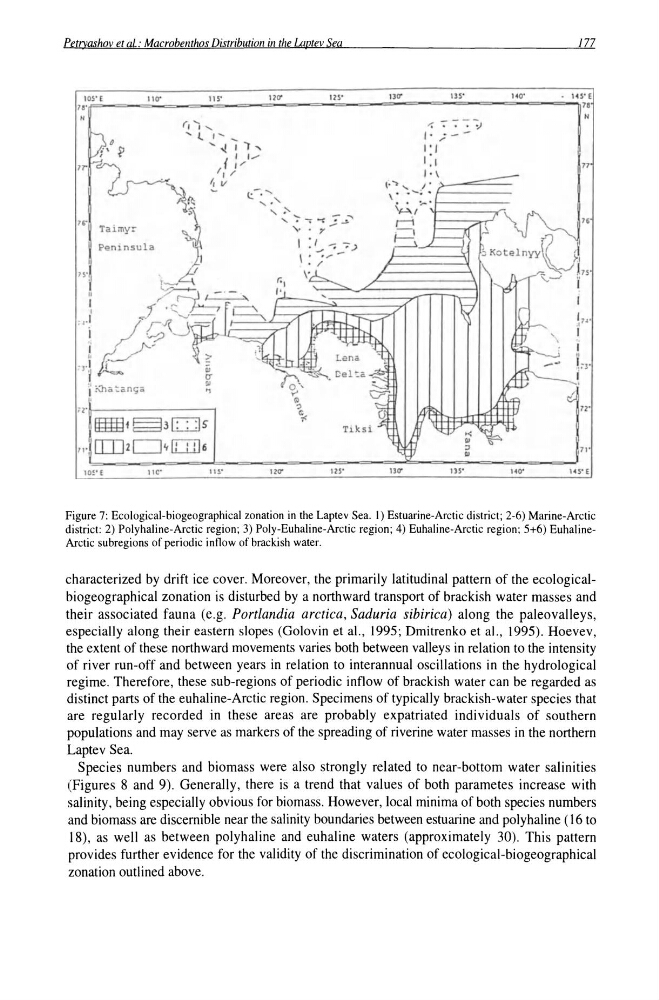
Figure 7: Ecological-biogeographical zonation in the Laptev Sea. I) Estuarine-Arctic district; 2-6) Marine-Arctic
district: 2) Polyhaline-Arctic region; 3) Poly-Euhaline-Arctic region; 4) Euhaline-Arctic region; 5+6) EuhalineArctic subregions of periodic inflow of brackish water.
characterized by drift ice cover. Moreover, the primarily latitudinal pattern of the ecologicalbiogeographical zonation is disturbed by a northward transport of brackish water masses and
their associated fauna (e.g. Portlandia arctica, Saduria sibirica) along the paleovalleys,
especially along their eastern slopes (Golovin et ai., 1995; Dmitrenko et ai., 1995). Hoevev,
the extent of these northward movements varies both between valleys in relation to the intensity
of river run-off and between years in relation to interannual oscillations in the hydrological
regime. Therefore, these sub-regions of periodic inflow of brackish water can be regarded as
distinct parts of the euhaline-Arctic region. Specimens of typically brackish-water species that
are regularly recorded in these areas are probably expatriated individuals of southern
populations and may serve as markers of the spreading of riverine water masses in the northern
Laptev Sea.
Species numbers and biomass were also strongly related to near-bottom water salinities
(Figures 8 and 9). Generally, there is a trend that values of both parametes increase with
salinity, being especially obvious for biomass. However, local minima of both species numbers
and biomass are discernible near the salinity boundaries between estuarine and polyhaline (16 to
18), as well as between polyhaline and euhaline waters (approximately 30). This pattern
provides further evidence for the validity of the discrimination of ecological-biogeographical
zonation outlined above.
7~ Taimy::"
" ./t-- - - - -- - - ,
\O~ · E
nc'
I I!.'
" ..
..;7-:- -: "":)
). / -I "
':,
) . \
177
11
16
\
~ Kotel nyyf? ,I
,V'
/-______ -\
,,--' !15'
n'
11 ..
lloS"
140'
''' S ' E
Figure 7: Ecological-biogeographical zonation in the Laptev Sea. I) Estuarine-Arctic district; 2-6) Marine-Arctic
district: 2) Polyhaline-Arctic region; 3) Poly-Euhaline-Arctic region; 4) Euhaline-Arctic region; 5+6) EuhalineArctic subregions of periodic inflow of brackish water.
characterized by drift ice cover. Moreover, the primarily latitudinal pattern of the ecologicalbiogeographical zonation is disturbed by a northward transport of brackish water masses and
their associated fauna (e.g. Portlandia arctica, Saduria sibirica) along the paleovalleys,
especially along their eastern slopes (Golovin et ai., 1995; Dmitrenko et ai., 1995). Hoevev,
the extent of these northward movements varies both between valleys in relation to the intensity
of river run-off and between years in relation to interannual oscillations in the hydrological
regime. Therefore, these sub-regions of periodic inflow of brackish water can be regarded as
distinct parts of the euhaline-Arctic region. Specimens of typically brackish-water species that
are regularly recorded in these areas are probably expatriated individuals of southern
populations and may serve as markers of the spreading of riverine water masses in the northern
Laptev Sea.
Species numbers and biomass were also strongly related to near-bottom water salinities
(Figures 8 and 9). Generally, there is a trend that values of both parametes increase with
salinity, being especially obvious for biomass. However, local minima of both species numbers
and biomass are discernible near the salinity boundaries between estuarine and polyhaline (16 to
18), as well as between polyhaline and euhaline waters (approximately 30). This pattern
provides further evidence for the validity of the discrimination of ecological-biogeographical
zonation outlined above.