

176
Land-Ocean Systems in the Siberian Arctic: Dynamics and History
bound to the very brackish surface waters (estuarine-Arctic waters with salinities of 5 to 18)
that may reach down to depths of 10, rarely 15 m. Echinoderms are absent in this zone. Further
north and/or at greater depths, salinities in the near-bottom water range between 18 and 30
(polyhaline-Arctic water) due to the admixture of riverine water during summer. In this zone,
the bivalve Portlandia arctica and the isopod Saduria sibirica replace their above-mentioned
sibling species, locally forming mass occurrences. The cumacean Diastylis sulcata is another
typical inhabitant of polyhaline waters. Only five echinoderm species, however, seem to
penetrate this brackish-water zone (Myriotrochus rinkii, Leptasterias groenlandica, Urasterias
linki, Stegophiura nodosa, Ophiocten sericeum). The effect of riverine inflow gradually
diminishes towards the north and with increasing depth. In regions with near-bottom water
salinities between 30 and 32 (poly-euhaline water), more echinoderm species thrive. The
indicator species of this region (where also the extensive winter polynyas of the Laptev Sea are
situated) is the bivalve Leionucula bellotii. In regions and/or depths where riverine influences
are negligible, near-bottom water salinities are always above 32 (euhaline water). Typical
species of this zone are the crustaceans Munnopsis typica and Munnopsurus giganteus, as well
as the echinoderms Ophiura sarsi and Ctenodiscus crispatus.
250
•
200
en
Q)
Ti 150
Q)
c..
en
'0
•
.... Q)
.0
E 100
OJ
z
50
10
• •
•
•
•
•
•
100
Depth, m
•
•
• •
•
•
•
1000
•
.. ,
• ••
10000
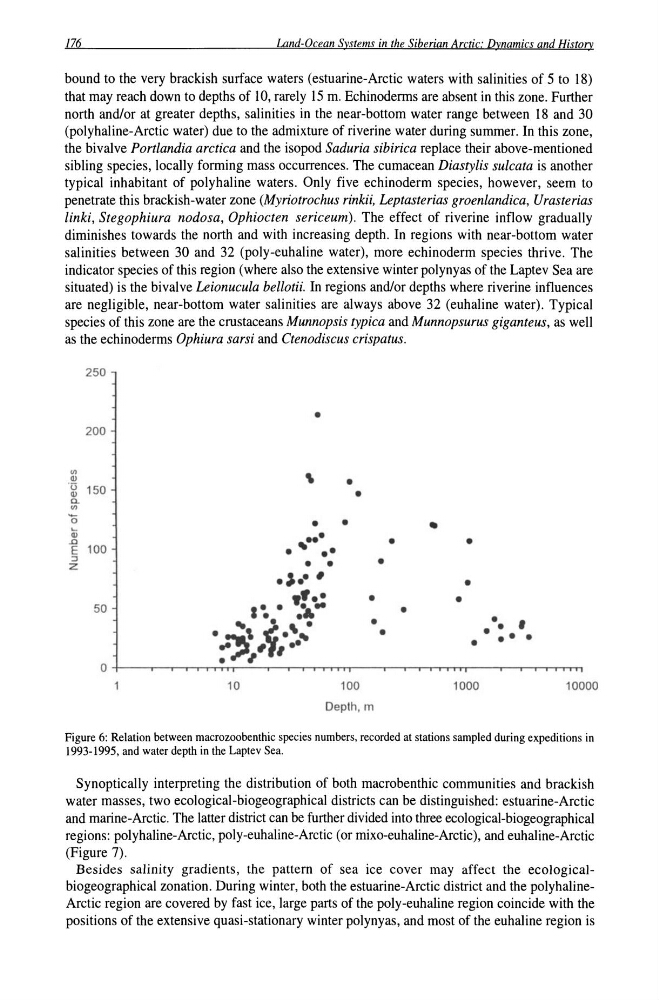
Figure 6: Relation between macrozoobenthic species numbers, recorded at stations sampled during expeditions in
1993-1995, and water depth in the Laptev Sea.
Synoptically interpreting the distribution of both macrobenthic communities and brackish
water masses, two ecological-biogeographical districts can be distinguished: estuarine-Arctic
and marine-Arctic. The latter district can be further divided into three ecological-biogeographical
regions: polyhaline-Arctic, poly-euhaline-Arctic (or mixo-euhaline-Arctic), and euhaline-Arctic
(Figure 7).
Besides salinity gradients, the pattern of sea ice cover may affect the ecologicalbiogeographical zonation. During winter, both the estuarine-Arctic district and the polyhalineArctic region are covered by fast ice, large parts of the poly-euhaline region coincide with the
positions of the extensive quasi-stationary winter polynyas, and most of the euhaline region is
Land-Ocean Systems in the Siberian Arctic: Dynamics and History
bound to the very brackish surface waters (estuarine-Arctic waters with salinities of 5 to 18)
that may reach down to depths of 10, rarely 15 m. Echinoderms are absent in this zone. Further
north and/or at greater depths, salinities in the near-bottom water range between 18 and 30
(polyhaline-Arctic water) due to the admixture of riverine water during summer. In this zone,
the bivalve Portlandia arctica and the isopod Saduria sibirica replace their above-mentioned
sibling species, locally forming mass occurrences. The cumacean Diastylis sulcata is another
typical inhabitant of polyhaline waters. Only five echinoderm species, however, seem to
penetrate this brackish-water zone (Myriotrochus rinkii, Leptasterias groenlandica, Urasterias
linki, Stegophiura nodosa, Ophiocten sericeum). The effect of riverine inflow gradually
diminishes towards the north and with increasing depth. In regions with near-bottom water
salinities between 30 and 32 (poly-euhaline water), more echinoderm species thrive. The
indicator species of this region (where also the extensive winter polynyas of the Laptev Sea are
situated) is the bivalve Leionucula bellotii. In regions and/or depths where riverine influences
are negligible, near-bottom water salinities are always above 32 (euhaline water). Typical
species of this zone are the crustaceans Munnopsis typica and Munnopsurus giganteus, as well
as the echinoderms Ophiura sarsi and Ctenodiscus crispatus.
250
•
200
en
Q)
Ti 150
Q)
c..
en
'0
•
.... Q)
.0
E 100
OJ
z
50
10
• •
•
•
•
•
•
100
Depth, m
•
•
• •
•
•
•
1000
•
.. ,
• ••
10000
Figure 6: Relation between macrozoobenthic species numbers, recorded at stations sampled during expeditions in
1993-1995, and water depth in the Laptev Sea.
Synoptically interpreting the distribution of both macrobenthic communities and brackish
water masses, two ecological-biogeographical districts can be distinguished: estuarine-Arctic
and marine-Arctic. The latter district can be further divided into three ecological-biogeographical
regions: polyhaline-Arctic, poly-euhaline-Arctic (or mixo-euhaline-Arctic), and euhaline-Arctic
(Figure 7).
Besides salinity gradients, the pattern of sea ice cover may affect the ecologicalbiogeographical zonation. During winter, both the estuarine-Arctic district and the polyhalineArctic region are covered by fast ice, large parts of the poly-euhaline region coincide with the
positions of the extensive quasi-stationary winter polynyas, and most of the euhaline region is