

148
Land-Ocean Svstems in the Siberian Arctic: Dynamics and History
(>2500 m, p=O.l5) were compared. However, since ice conditions might quickly change
during spring and summer in the Laptev Sea, a better relationship might only be detectable if the
variation in ice coverage over periods of weeks to months could be taken into account (see
Figure 4).
If open water areas persist long enough, nutrients become the limiting factor in the
oligotrophic outer Laptev Sea (Luchetta et ai., 1994). In the Laptev Sea nitrate concentrations
are rather low and can be depleted by the phytoplankton within 1-3 weeks due to the stable
stratification of the surface water layers. Thus, in late summer, plankton biomass and flux of
plankton detritus to sediments below persistent open water areas might be as low as in
completely ice-covered areas of the Laptev Sea due to nutrient exhaustion. In contrast, the
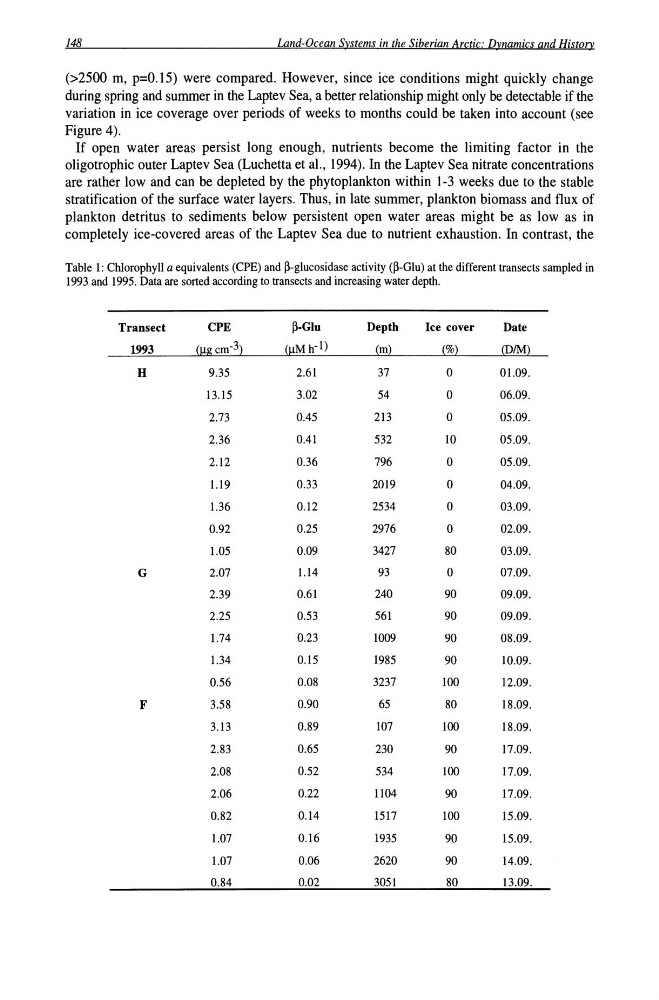
Table 1: Chlorophyll a equivalents (CPE) and ~-glucosidase activity (~-Glu) at the different transects sampled in
1993 and 1995. Data are sorted according to transects and increasing water depth.
Transect
ePE
~·Glu
Depth
Ice cover
Date
1993
(l1g cm-3)
(l1Mh- 1)
(m)
(%)
(DIM)
H
9.35
2.61
37
0
01.09.
13.15
3.02
54
0
06.09.
2.73
0.45
213
0
05.09.
2.36
0.41
532
10
05.09.
2.12
0.36
796
0
05.09.
1.19
0.33
2019
0
04.09.
1.36
0.12
2534
0
03.09.
0.92
0.25
2976
0
02.09.
1.05
0.09
3427
80
03.09.
G
2.07
1.14
93
0
07.09.
2.39
0.61
240
90
09.09.
2.25
0.53
561
90
09.09.
1.74
0.23
1009
90
08.09.
1.34
0.15
1985
90
10.09.
0.56
0.08
3237
100
12.09.
F
3.58
0.90
65
80
18.09.
3.13
0.89
107
100
18.09.
2.83
0.65
230
90
17.09.
2.08
0.52
534
100
17.09.
2.06
0.22
1104
90
17.09.
0.82
0.14
1517
100
15.09.
1.07
0.16
1935
90
15.09.
1.07
0.06
2620
90
14.09.
0.84
0.02
3051
80
13.09.
Land-Ocean Svstems in the Siberian Arctic: Dynamics and History
(>2500 m, p=O.l5) were compared. However, since ice conditions might quickly change
during spring and summer in the Laptev Sea, a better relationship might only be detectable if the
variation in ice coverage over periods of weeks to months could be taken into account (see
Figure 4).
If open water areas persist long enough, nutrients become the limiting factor in the
oligotrophic outer Laptev Sea (Luchetta et ai., 1994). In the Laptev Sea nitrate concentrations
are rather low and can be depleted by the phytoplankton within 1-3 weeks due to the stable
stratification of the surface water layers. Thus, in late summer, plankton biomass and flux of
plankton detritus to sediments below persistent open water areas might be as low as in
completely ice-covered areas of the Laptev Sea due to nutrient exhaustion. In contrast, the
Table 1: Chlorophyll a equivalents (CPE) and ~-glucosidase activity (~-Glu) at the different transects sampled in
1993 and 1995. Data are sorted according to transects and increasing water depth.
Transect
ePE
~·Glu
Depth
Ice cover
Date
1993
(l1g cm-3)
(l1Mh- 1)
(m)
(%)
(DIM)
H
9.35
2.61
37
0
01.09.
13.15
3.02
54
0
06.09.
2.73
0.45
213
0
05.09.
2.36
0.41
532
10
05.09.
2.12
0.36
796
0
05.09.
1.19
0.33
2019
0
04.09.
1.36
0.12
2534
0
03.09.
0.92
0.25
2976
0
02.09.
1.05
0.09
3427
80
03.09.
G
2.07
1.14
93
0
07.09.
2.39
0.61
240
90
09.09.
2.25
0.53
561
90
09.09.
1.74
0.23
1009
90
08.09.
1.34
0.15
1985
90
10.09.
0.56
0.08
3237
100
12.09.
F
3.58
0.90
65
80
18.09.
3.13
0.89
107
100
18.09.
2.83
0.65
230
90
17.09.
2.08
0.52
534
100
17.09.
2.06
0.22
1104
90
17.09.
0.82
0.14
1517
100
15.09.
1.07
0.16
1935
90
15.09.
1.07
0.06
2620
90
14.09.
0.84
0.02
3051
80
13.09.