

Grahl et at.: Pe/n~ic-Benthic Coupling in the Laptev Sea
East Siberian Sea
80
o
Laptev
Sea
147
Khatanga
Taymyr
Peninsula
= 1 ~M h-l
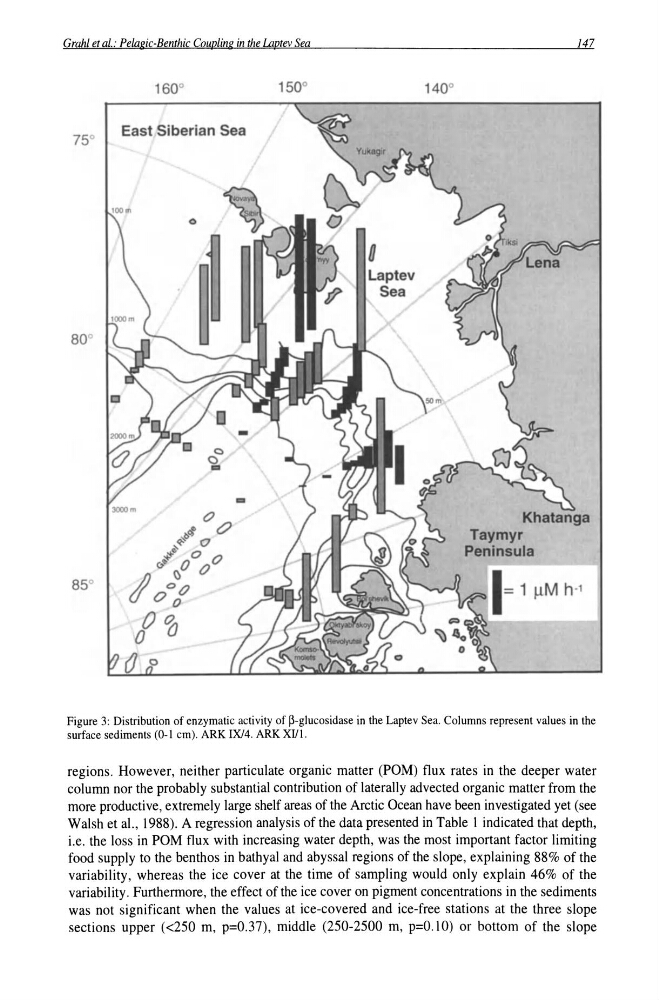
Figure 3: Distribution of enzymatic activity of ~-glucosidase in the Laptev Sea. Columns represent values in the
surface sediments (0-1 em). ARK IXl4. ARK XII I.
regions. However, neither particulate organic matter (POM) flux rates in the deeper water
column nor the probably substantial contribution of laterally advected organic matter from the
more productive, extremely large shelf areas of the Arctic Ocean have been investigated yet (see
Walsh et al., 1988). A regression analysis of the data presented in Table 1 indicated that depth,
i.e. the loss in POM flux with increasing water depth, was the most important factor limiting
food supply to the benthos in bathyal and abyssal regions of the slope, explaining 88% of the
variability, whereas the ice cover at the time of sampling would only explain 46% of the
variability. Furthermore, the effect of the ice cover on pigment concentrations in the sediments
was not significant when the values at ice-covered and ice-free stations at the three slope
sections upper «250 m, p=0.37), middle (250-2500 m, p=O.IO) or bottom of the slope
East Siberian Sea
80
o
Laptev
Sea
147
Khatanga
Taymyr
Peninsula
= 1 ~M h-l
Figure 3: Distribution of enzymatic activity of ~-glucosidase in the Laptev Sea. Columns represent values in the
surface sediments (0-1 em). ARK IXl4. ARK XII I.
regions. However, neither particulate organic matter (POM) flux rates in the deeper water
column nor the probably substantial contribution of laterally advected organic matter from the
more productive, extremely large shelf areas of the Arctic Ocean have been investigated yet (see
Walsh et al., 1988). A regression analysis of the data presented in Table 1 indicated that depth,
i.e. the loss in POM flux with increasing water depth, was the most important factor limiting
food supply to the benthos in bathyal and abyssal regions of the slope, explaining 88% of the
variability, whereas the ice cover at the time of sampling would only explain 46% of the
variability. Furthermore, the effect of the ice cover on pigment concentrations in the sediments
was not significant when the values at ice-covered and ice-free stations at the three slope
sections upper «250 m, p=0.37), middle (250-2500 m, p=O.IO) or bottom of the slope