

138
Land-Ocean Systems in the Siberian Arctic: Dynamics and History
frazil ice probably is exported with river water farther to the sea, where it may add to the bottom
surface of fast or drifting ice.
>.
~
~
180
'"
.!::
160
~
140
.g
120
.,
-~
100
N
80
.,
60
...
- 40
. .
'5
20
- 0
0
!:
t:l
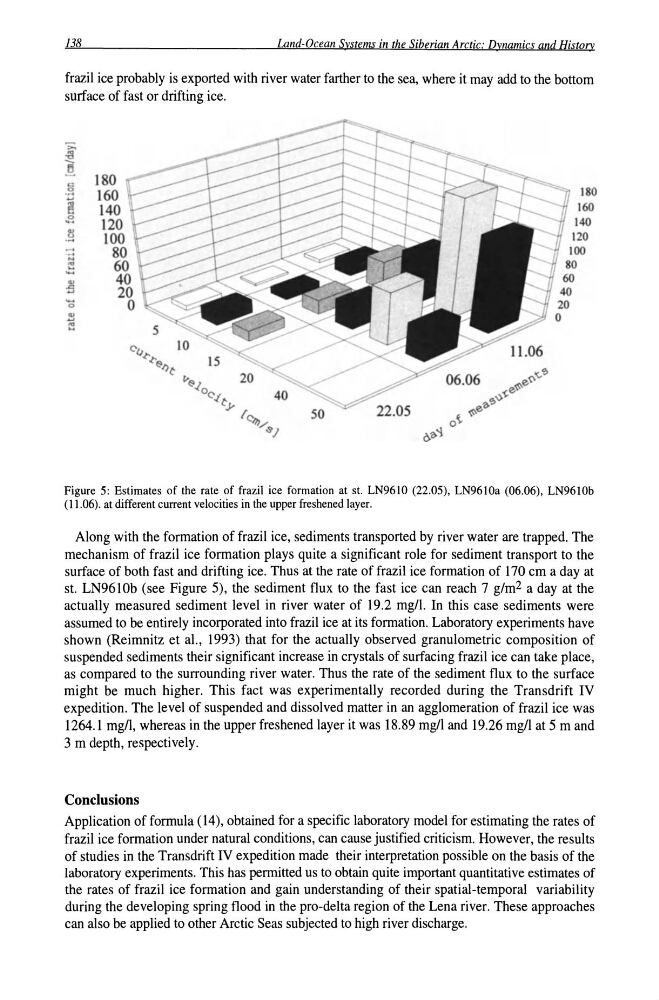
Figure 5: Estimates of the rate of frazil ice formation at st. LN9610 (22.05), LN96lOa (06.06), LN9610b
(11.06). at different current velocities in the upper freshened layer.
Along with the formation of frazil ice, sediments transported by river water are trapped. The
mechanism of frazil ice formation plays quite a significant role for sediment transport to the
surface of both fast and drifting ice. Thus at the rate of frazil ice formation of 170 cm a day at
st. LN9610b (see Figure 5), the sediment flux to the fast ice can reach 7 g/m2 a day at the
actually measured sediment level in river water of 19.2 mg/1. In this case sediments were
assumed to be entirely incorporated into frazil ice at its formation. Laboratory experiments have
shown (Reimnitz et aI., 1993) that for the actually observed granulometric composition of
suspended sediments their significant increase in crystals of surfacing frazil ice can take place,
as compared to the surrounding river water. Thus the rate of the sediment flux to the surface
might be much higher. This fact was experimentally recorded during the Transdrift IV
expedition. The level of suspended and dissolved matter in an agglomeration of frazil ice was
1264.1 mg/l, whereas in the upper freshened layer it was 18.89 mg/l and 19.26 mg/l at 5 m and
3 m depth, respectively.
Conclusions
Application of formula (14), obtained for a specific laboratory model for estimating the rates of
frazil ice formation under natural conditions, can cause justified criticism. However, the results
of studies in the Transdrift IV expedition made their interpretation possible on the basis of the
laboratory experiments. This has permitted us to obtain quite important quantitative estimates of
the rates of frazil ice formation and gain understanding of their spatial-temporal variability
during the developing spring flood in the pro-delta region of the Lena river. These approaches
can also be applied to other Arctic Seas subjected to high river discharge.
Land-Ocean Systems in the Siberian Arctic: Dynamics and History
frazil ice probably is exported with river water farther to the sea, where it may add to the bottom
surface of fast or drifting ice.
>.
~
~
180
'"
.!::
160
~
140
.g
120
.,
-~
100
N
80
.,
60
...
- 40
. .
'5
20
- 0
0
!:
t:l
Figure 5: Estimates of the rate of frazil ice formation at st. LN9610 (22.05), LN96lOa (06.06), LN9610b
(11.06). at different current velocities in the upper freshened layer.
Along with the formation of frazil ice, sediments transported by river water are trapped. The
mechanism of frazil ice formation plays quite a significant role for sediment transport to the
surface of both fast and drifting ice. Thus at the rate of frazil ice formation of 170 cm a day at
st. LN9610b (see Figure 5), the sediment flux to the fast ice can reach 7 g/m2 a day at the
actually measured sediment level in river water of 19.2 mg/1. In this case sediments were
assumed to be entirely incorporated into frazil ice at its formation. Laboratory experiments have
shown (Reimnitz et aI., 1993) that for the actually observed granulometric composition of
suspended sediments their significant increase in crystals of surfacing frazil ice can take place,
as compared to the surrounding river water. Thus the rate of the sediment flux to the surface
might be much higher. This fact was experimentally recorded during the Transdrift IV
expedition. The level of suspended and dissolved matter in an agglomeration of frazil ice was
1264.1 mg/l, whereas in the upper freshened layer it was 18.89 mg/l and 19.26 mg/l at 5 m and
3 m depth, respectively.
Conclusions
Application of formula (14), obtained for a specific laboratory model for estimating the rates of
frazil ice formation under natural conditions, can cause justified criticism. However, the results
of studies in the Transdrift IV expedition made their interpretation possible on the basis of the
laboratory experiments. This has permitted us to obtain quite important quantitative estimates of
the rates of frazil ice formation and gain understanding of their spatial-temporal variability
during the developing spring flood in the pro-delta region of the Lena river. These approaches
can also be applied to other Arctic Seas subjected to high river discharge.