

Golovin et al.: Frazil Ice Fonnation during the Spring Flood
135
Prandtl (1949) showed that Reynolds stresses D*:::: ( Ii· v' )112 characterize the intensity of
turbulent (vertical - u' and horizontal - v') velocity variations and depend on the external
velocity scale. Hence D*. represented by the expression (11) determines the required velocity
scale for the local Richardson number expressed through the external velocity scale U. As is
seen from (11), D* corresponding to ( Ii· v') 112, is approximately 10 times as small as the
characteristic external velocity scale in the turbulent layer D, which is fully consistent with
direct measurements of ( Ii) 1/2, ( V ) 112 and Reynolds stresses ( Ii . v') 112 obtained from them
(Kan and Tamai, 1994). The maximum value of turbulent velocity variations is observed in the
thin upper and lower parts of the pycnocline where vorticity is generated and turbulent
entrainment takes place (Kan and Tamai, 1994). Hence the expression for the local Richardson
number for the pycnocline between river and sea water under conditions when the salinity field
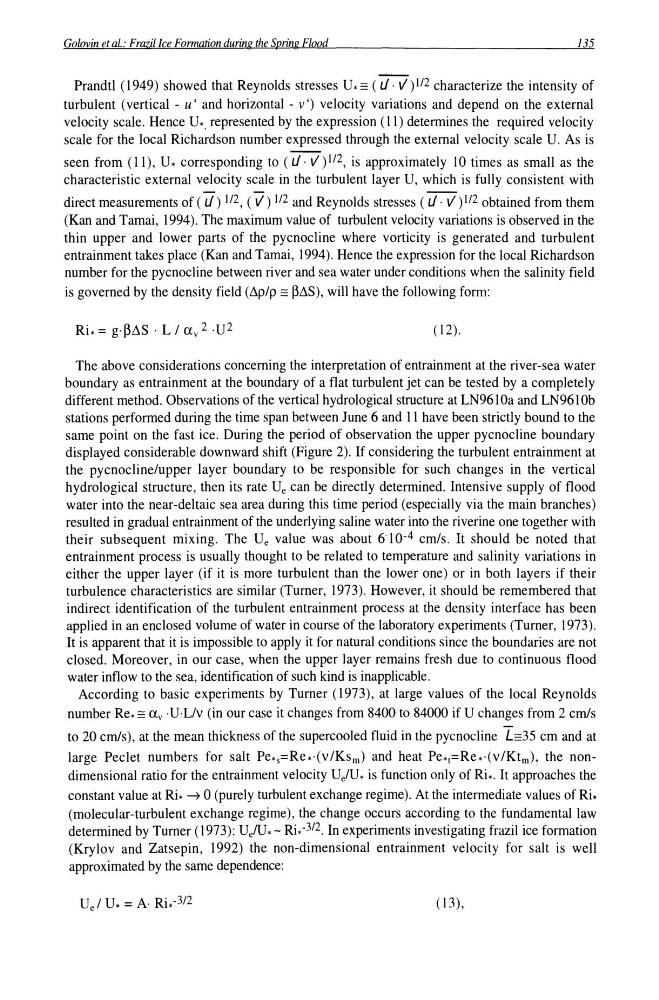
is governed by the density field (L'.p/p :::: ~L'.S), will have the following form:
(12).
The above considerations concerning the interpretation of entrainment at the river-sea water
boundary as entrainment at the boundary of a flat turbulent jet can be tested by a completely
different method. Observations of the vertical hydrological structure at LN961 Oa and LN961 Ob
stations performed during the time span between June 6 and II have been strictly bound to the
same point on the fast ice. During the period of observation the upper pycnocline boundary
displayed considerable downward shift (Figure 2). If considering the turbulent entrainment at
the pycnocline/upper layer boundary to be responsible for such changes in the vertical
hydrological structure, then its rate De can be directly determined. Intensive supply of flood
water into the near-deltaic sea area during this time period (especially via the main branches)
resulted in gradual entrainment of the underlying saline water into the riverine one together with
their subsequent mixing. The De value was about 6'10- 4 cm/s. It should be noted that
entrainment process is usually thought to be related to temperature and salinity variations in
either the upper layer (if it is more turbulent than the lower one) or in both layers if their
turbulence characteristics are similar (Turner, 1973). However, it should be remembered that
indirect identification of the turbulent entrainment process at the density interface has been
applied in an enclosed volume of water in course of the laboratory experiments (Turner, 1973).
It is apparent that it is impossible to apply it for natural conditions since the boundaries are not
closed. Moreover, in our case, when the upper layer remains fresh due to continuous flood
water inflow to the sea, identification of such kind is inapplicable.
According to basic experiments by Turner (1973), at large values of the local Reynolds
number Re*:::: a v ·ULlv (in our case it changes from 8400 to 84000 if D changes from 2 crnls
to 20 crnls), at the mean thickness of the supercooled fluid in the pycnocline L::::35 cm and at
large Peclet numbers for salt Pe*s=Re*·(v/Ks m ) and heat Pe*t=Re*·(v/Ktm ), the nondimensional ratio for the entrainment velocity DelU* is function only of Ri*. It approaches the
constant value at Ri* ~ 0 (purely turbulent exchange regime). At the intermediate values of Ri.
(molecular-turbulent exchange regime), the change occurs according to the fundamental law
determined by Turner (1973): DelU* - Ri* -3/2. In experiments investigating frazil ice formation
(Krylov and Zatsepin, 1992) the non-dimensional entrainment velocity for salt is well
approximated by the same dependence:
De/ D* = A Ri.- 312
( 13),
135
Prandtl (1949) showed that Reynolds stresses D*:::: ( Ii· v' )112 characterize the intensity of
turbulent (vertical - u' and horizontal - v') velocity variations and depend on the external
velocity scale. Hence D*. represented by the expression (11) determines the required velocity
scale for the local Richardson number expressed through the external velocity scale U. As is
seen from (11), D* corresponding to ( Ii· v') 112, is approximately 10 times as small as the
characteristic external velocity scale in the turbulent layer D, which is fully consistent with
direct measurements of ( Ii) 1/2, ( V ) 112 and Reynolds stresses ( Ii . v') 112 obtained from them
(Kan and Tamai, 1994). The maximum value of turbulent velocity variations is observed in the
thin upper and lower parts of the pycnocline where vorticity is generated and turbulent
entrainment takes place (Kan and Tamai, 1994). Hence the expression for the local Richardson
number for the pycnocline between river and sea water under conditions when the salinity field
is governed by the density field (L'.p/p :::: ~L'.S), will have the following form:
(12).
The above considerations concerning the interpretation of entrainment at the river-sea water
boundary as entrainment at the boundary of a flat turbulent jet can be tested by a completely
different method. Observations of the vertical hydrological structure at LN961 Oa and LN961 Ob
stations performed during the time span between June 6 and II have been strictly bound to the
same point on the fast ice. During the period of observation the upper pycnocline boundary
displayed considerable downward shift (Figure 2). If considering the turbulent entrainment at
the pycnocline/upper layer boundary to be responsible for such changes in the vertical
hydrological structure, then its rate De can be directly determined. Intensive supply of flood
water into the near-deltaic sea area during this time period (especially via the main branches)
resulted in gradual entrainment of the underlying saline water into the riverine one together with
their subsequent mixing. The De value was about 6'10- 4 cm/s. It should be noted that
entrainment process is usually thought to be related to temperature and salinity variations in
either the upper layer (if it is more turbulent than the lower one) or in both layers if their
turbulence characteristics are similar (Turner, 1973). However, it should be remembered that
indirect identification of the turbulent entrainment process at the density interface has been
applied in an enclosed volume of water in course of the laboratory experiments (Turner, 1973).
It is apparent that it is impossible to apply it for natural conditions since the boundaries are not
closed. Moreover, in our case, when the upper layer remains fresh due to continuous flood
water inflow to the sea, identification of such kind is inapplicable.
According to basic experiments by Turner (1973), at large values of the local Reynolds
number Re*:::: a v ·ULlv (in our case it changes from 8400 to 84000 if D changes from 2 crnls
to 20 crnls), at the mean thickness of the supercooled fluid in the pycnocline L::::35 cm and at
large Peclet numbers for salt Pe*s=Re*·(v/Ks m ) and heat Pe*t=Re*·(v/Ktm ), the nondimensional ratio for the entrainment velocity DelU* is function only of Ri*. It approaches the
constant value at Ri* ~ 0 (purely turbulent exchange regime). At the intermediate values of Ri.
(molecular-turbulent exchange regime), the change occurs according to the fundamental law
determined by Turner (1973): DelU* - Ri* -3/2. In experiments investigating frazil ice formation
(Krylov and Zatsepin, 1992) the non-dimensional entrainment velocity for salt is well
approximated by the same dependence:
De/ D* = A Ri.- 312
( 13),