

134
Land-Ocean Systems in the Siberian Arctic: Dynamics and History
In order to use the ratios obtained by Krylov and Zatsepin (1992) for estimating the rate of
frazil ice formation in the river/sea water contact zone based on full-scale studies, we should
correctly relate the mean horizontal velocity in the freshened layer D to the root-mean-square
velocity of turbulent variations D., as well as determine the integral turbulence scale L near the
pycnocline. Turner (1973) suggested considering entrainments at the upper pycnocline
boundary due to turbulent motion of the upper layer to be entrainment at flat turbulent jet
margin. In this case the momentum and mass balance between layers would be probably
reached, and the rate of turbulent entrainment would be quasisteady.Current laboratory studies
of the transfer processes through the density interface confirm this interpretation (Kan and
Tarnai, 1994). This allows us to use the experimentally well-tested theory of turbulent
entrainment at the expanding margin of a flat turbulent jet (Prandtl, 1949; Shlikhting, 1974) for
relating the external mean velocity of the layer D to the mean-root-square velocity of turbulent
variations D. near the pycnocline.
Where a turbulent flat jet mixes with the ambient unmoving fluid the length of the mixing
distance corresponding to the integral scale of turbulence L, according to the theoretical and
laboratory studies (Prandtl, 1949; Shlikhting, 1974), is proportional in each cross-section to
the width of the jet b in this section:
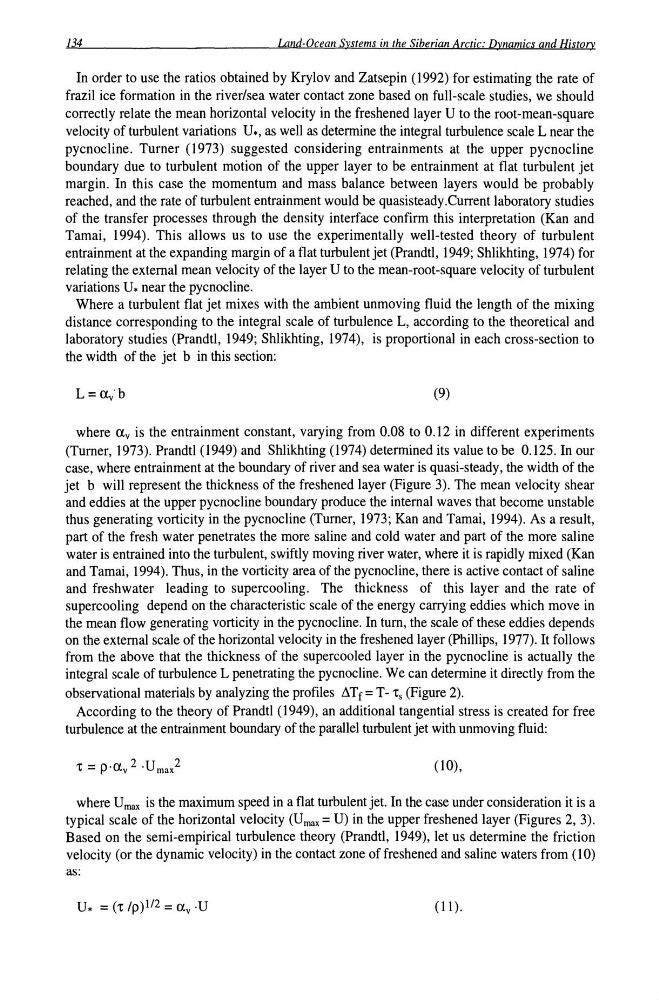
(9)
where Uv is the entrainment constant, varying from 0.08 to 0.12 in different experiments
(Turner, 1973). Prandtl (1949) and Shlikhting (1974) determined its value to be 0.125. In our
case, where entrainment at the boundary of river and sea water is quasi-steady, the width of the
jet b will represent the thickness of the freshened layer (Figure 3). The mean velocity shear
and eddies at the upper pycnocline boundary produce the internal waves that become unstable
thus generating vorticity in the pycnocline (Turner, 1973; Kan and Tarnai, 1994). As a result,
part of the fresh water penetrates the more saline and cold water and part of the more saline
water is entrained into the turbulent, swiftly moving river water, where it is rapidly mixed (Kan
and Tarnai, 1994). Thus, in the vorticity area of the pycnocline, there is active contact of saline
and freshwater leading to supercooling. The thickness of this layer and the rate of
supercooling depend on the characteristic scale of the energy carrying eddies which move in
the mean flow generating vorticity in the pycnocline. In turn, the scale of these eddies depends
on the external scale of the horizontal velocity in the freshened layer (Phillips, 1977). It follows
from the above that the thickness of the supercooled layer in the pycnocline is actually the
integral scale of turbulence L penetrating the pycnocline. We can determine it directly from the
observational materials by analyzing the profiles ilT f = T - 'ts (Figure 2).
According to the theory of Prandtl (1949), an additional tangential stress is created for free
turbulence at the entrainment boundary of the parallel turbulent jet with unmoving fluid:
(10),
where Dmax is the maximum speed in a flat turbulent jet. In the case under consideration it is a
typical scale of the horizontal velocity (Dmax = D) in the upper freshened layer (Figures 2, 3).
Based on the semi-empirical turbulence theory (Prandtl, 1949), let us determine the friction
velocity (or the dynamic velocity) in the contact zone of freshened and saline waters from (10)
as:
u. = ('t /p)1I2 = uv,U
(11).
Land-Ocean Systems in the Siberian Arctic: Dynamics and History
In order to use the ratios obtained by Krylov and Zatsepin (1992) for estimating the rate of
frazil ice formation in the river/sea water contact zone based on full-scale studies, we should
correctly relate the mean horizontal velocity in the freshened layer D to the root-mean-square
velocity of turbulent variations D., as well as determine the integral turbulence scale L near the
pycnocline. Turner (1973) suggested considering entrainments at the upper pycnocline
boundary due to turbulent motion of the upper layer to be entrainment at flat turbulent jet
margin. In this case the momentum and mass balance between layers would be probably
reached, and the rate of turbulent entrainment would be quasisteady.Current laboratory studies
of the transfer processes through the density interface confirm this interpretation (Kan and
Tarnai, 1994). This allows us to use the experimentally well-tested theory of turbulent
entrainment at the expanding margin of a flat turbulent jet (Prandtl, 1949; Shlikhting, 1974) for
relating the external mean velocity of the layer D to the mean-root-square velocity of turbulent
variations D. near the pycnocline.
Where a turbulent flat jet mixes with the ambient unmoving fluid the length of the mixing
distance corresponding to the integral scale of turbulence L, according to the theoretical and
laboratory studies (Prandtl, 1949; Shlikhting, 1974), is proportional in each cross-section to
the width of the jet b in this section:
(9)
where Uv is the entrainment constant, varying from 0.08 to 0.12 in different experiments
(Turner, 1973). Prandtl (1949) and Shlikhting (1974) determined its value to be 0.125. In our
case, where entrainment at the boundary of river and sea water is quasi-steady, the width of the
jet b will represent the thickness of the freshened layer (Figure 3). The mean velocity shear
and eddies at the upper pycnocline boundary produce the internal waves that become unstable
thus generating vorticity in the pycnocline (Turner, 1973; Kan and Tarnai, 1994). As a result,
part of the fresh water penetrates the more saline and cold water and part of the more saline
water is entrained into the turbulent, swiftly moving river water, where it is rapidly mixed (Kan
and Tarnai, 1994). Thus, in the vorticity area of the pycnocline, there is active contact of saline
and freshwater leading to supercooling. The thickness of this layer and the rate of
supercooling depend on the characteristic scale of the energy carrying eddies which move in
the mean flow generating vorticity in the pycnocline. In turn, the scale of these eddies depends
on the external scale of the horizontal velocity in the freshened layer (Phillips, 1977). It follows
from the above that the thickness of the supercooled layer in the pycnocline is actually the
integral scale of turbulence L penetrating the pycnocline. We can determine it directly from the
observational materials by analyzing the profiles ilT f = T - 'ts (Figure 2).
According to the theory of Prandtl (1949), an additional tangential stress is created for free
turbulence at the entrainment boundary of the parallel turbulent jet with unmoving fluid:
(10),
where Dmax is the maximum speed in a flat turbulent jet. In the case under consideration it is a
typical scale of the horizontal velocity (Dmax = D) in the upper freshened layer (Figures 2, 3).
Based on the semi-empirical turbulence theory (Prandtl, 1949), let us determine the friction
velocity (or the dynamic velocity) in the contact zone of freshened and saline waters from (10)
as:
u. = ('t /p)1I2 = uv,U
(11).