

132
Land-Ocean Systems in the Siberian Arctic: Dynamics and History
coefficients through the density interface. Two important conditions for supercooling and frazil
ice formation were obtained from (4) (Golovin et a!., 1996):
Rp > ~/( ex . a) - 200
1\
(5)
KtiKs >·t
(6).
Here Rp = ~LlS/
with molecular-turbulent heat and salt exchange through the pycnocline (Krylov and Zatsepin,
1992). With purely turbulent exchange when KtlKs '" 1, the effect of buoyancy is negligible.
This occurs either when the pycnocline is weak or external turbulenc is very strong. This
lowers the rate of frazil ice formation (Krylov and Zatsepin, 1992; Voropayev et a!., 1995).
Under conditions of a purely molecular exchange through the pycnocline when the "molecular
core" through which turbulence does not penetrate is preserved (Krylov and Zatsepin, 1992),
the following condition should be fulfilled (Golovin et a!., 1996) for supercooling and frazil ice
formation to be possible:
(7).
Here ex Ftm and ~Fsm are buoyancy flux associated with the molecular heat and salt fluxes
through the pycnocline, and Ktm and KSm are the molecular coefficients of temperature
conductivity and salt diffusion respectively. The condition (7) can be presented in the form:
(8).
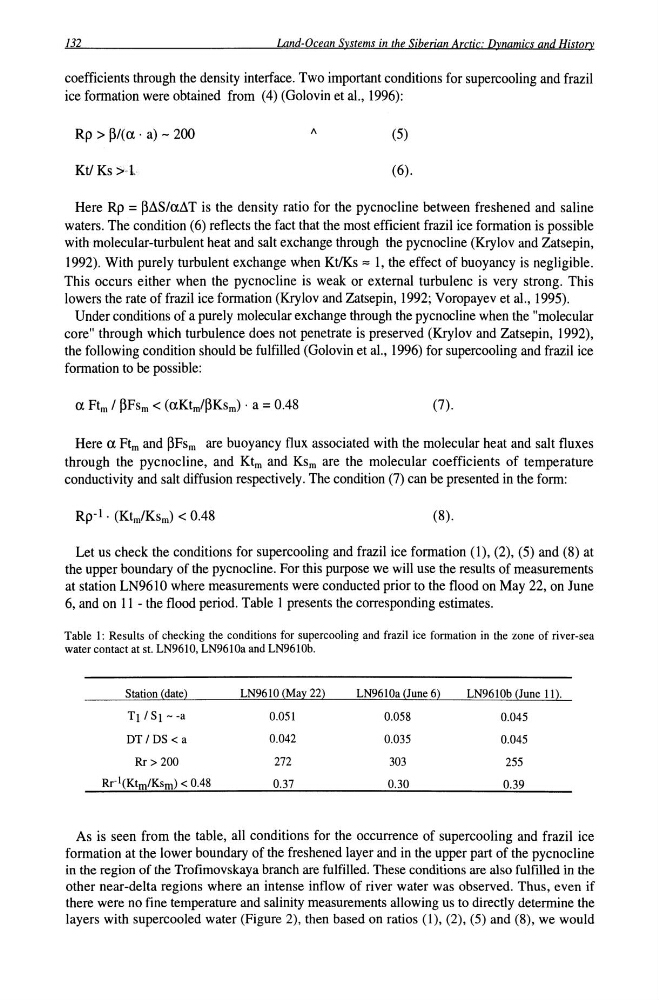
Let us check the conditions for supercooling and frazil ice formation (1), (2), (5) and (8) at
the upper boundary of the pycnocline. For this purpose we will use the results of measurements
at station LN961 0 where measurements were conducted prior to the flood on May 22, on June
6, and on 11 - the flood period. Table 1 presents the corresponding estimates.
Table 1: Results of checking the conditions for supercooling and frazil ice formation in the zone of river-sea
water contact at st. LN961O, LN9610a and LN9610b.
Station (date)
LN9610 (May 22)
LN9610a (June 6)
LN9610b (June 11).
TI/SI--a
0.051
0.058
0.045
DT IDS < a
0.042
0.035
0.045
Rr> 200
272
303
255
Rr-i(Ktm/Ksm ) < 0.48
0.37
0.30
0.39
As is seen from the table, all conditions for the occurrence of supercooling and frazil ice
formation at the lower boundary of the freshened layer and in the upper part of the pycnocline
in the region of the Trofimovskaya branch are fulfilled. These conditions are also fulfilled in the
other near-delta regions where an intense inflow of river water was observed. Thus, even if
there were no fine temperature and salinity measurements allowing us to directly determine the
layers with supercooled water (Figure 2), then based on ratios (1), (2), (5) and (8), we would
Land-Ocean Systems in the Siberian Arctic: Dynamics and History
coefficients through the density interface. Two important conditions for supercooling and frazil
ice formation were obtained from (4) (Golovin et a!., 1996):
Rp > ~/( ex . a) - 200
1\
(5)
KtiKs >·t
(6).
Here Rp = ~LlS/
with molecular-turbulent heat and salt exchange through the pycnocline (Krylov and Zatsepin,
1992). With purely turbulent exchange when KtlKs '" 1, the effect of buoyancy is negligible.
This occurs either when the pycnocline is weak or external turbulenc is very strong. This
lowers the rate of frazil ice formation (Krylov and Zatsepin, 1992; Voropayev et a!., 1995).
Under conditions of a purely molecular exchange through the pycnocline when the "molecular
core" through which turbulence does not penetrate is preserved (Krylov and Zatsepin, 1992),
the following condition should be fulfilled (Golovin et a!., 1996) for supercooling and frazil ice
formation to be possible:
(7).
Here ex Ftm and ~Fsm are buoyancy flux associated with the molecular heat and salt fluxes
through the pycnocline, and Ktm and KSm are the molecular coefficients of temperature
conductivity and salt diffusion respectively. The condition (7) can be presented in the form:
(8).
Let us check the conditions for supercooling and frazil ice formation (1), (2), (5) and (8) at
the upper boundary of the pycnocline. For this purpose we will use the results of measurements
at station LN961 0 where measurements were conducted prior to the flood on May 22, on June
6, and on 11 - the flood period. Table 1 presents the corresponding estimates.
Table 1: Results of checking the conditions for supercooling and frazil ice formation in the zone of river-sea
water contact at st. LN961O, LN9610a and LN9610b.
Station (date)
LN9610 (May 22)
LN9610a (June 6)
LN9610b (June 11).
TI/SI--a
0.051
0.058
0.045
DT IDS < a
0.042
0.035
0.045
Rr> 200
272
303
255
Rr-i(Ktm/Ksm ) < 0.48
0.37
0.30
0.39
As is seen from the table, all conditions for the occurrence of supercooling and frazil ice
formation at the lower boundary of the freshened layer and in the upper part of the pycnocline
in the region of the Trofimovskaya branch are fulfilled. These conditions are also fulfilled in the
other near-delta regions where an intense inflow of river water was observed. Thus, even if
there were no fine temperature and salinity measurements allowing us to directly determine the
layers with supercooled water (Figure 2), then based on ratios (1), (2), (5) and (8), we would