

Golovin et al.: Frazillce Formation during the Spring Flood
131
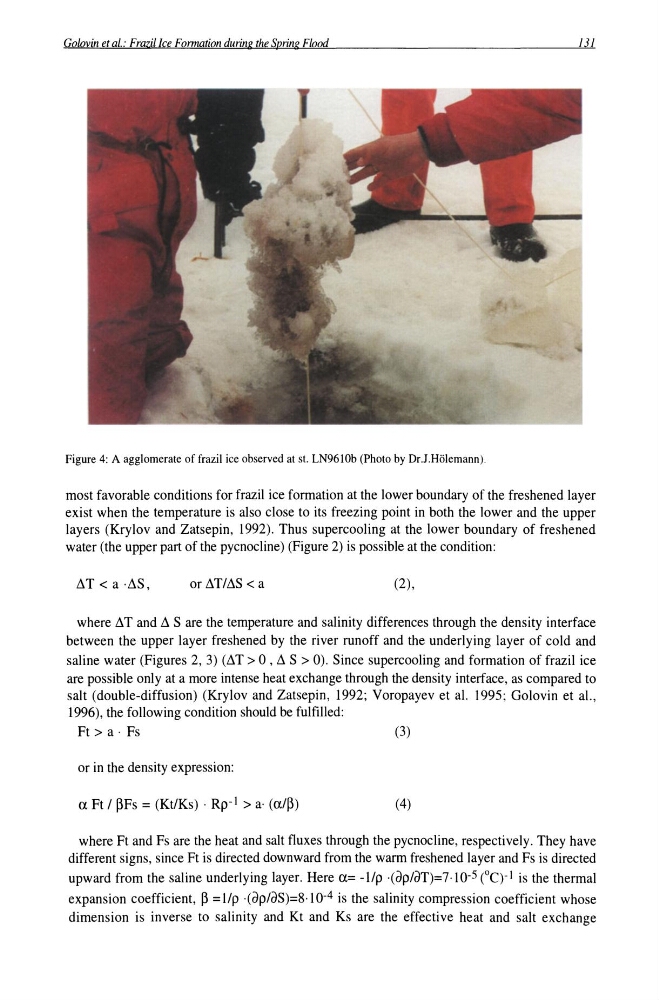
Figure 4: A agglomerate offrazil ice observed at st. LN9610b (Photo by DrJ.Holemann).
most favorable conditions for frazil ice formation at the lower boundary of the freshened layer
exist when the temperature is also close to its freezing point in both the lower and the upper
layers (Krylov and Zatsepin, 1992). Thus supercooling at the lower boundary of freshened
water (the upper part of the pycnocline) (Figure 2) is possible at the condition:
~T < a ·~S,
or ~T/~S < a
(2),
where ~T and ~ S are the temperature and salinity differences through the density interface
between the upper layer freshened by the river runoff and the underlying layer of cold and
saline water (Figures 2, 3) (~T > 0 , ~ S > 0). Since supercooling and formation of frazil ice
are possible only at a more intense heat exchange through the density interface, as compared to
salt (double-diffusion) (Krylov and Zatsepin, 1992; Voropayev et a!. 1995; Golovin et a!.,
1996), the following condition should be fulfilled:
Ft> a· Fs
(3)
or in the density expression:
a Ft I ~Fs = (KtlKs) . Rp-l > a· (a/~)
(4)
where Ft and Fs are the heat and salt fluxes through the pycnocline, respectively. They have
different signs, since Ft is directed downward from the warm freshened layer and Fs is directed
upward from the saline underlying layer. Here a= -lip ·(dp/dT)=7·1O- 5 ("C)-l is the thermal
expansion coefficient, ~ =lIp ·(dp/dS)=S·10-4 is the salinity compression coefficient whose
dimension is inverse to salinity and Kt and Ks are the effective heat and salt exchange
131
Figure 4: A agglomerate offrazil ice observed at st. LN9610b (Photo by DrJ.Holemann).
most favorable conditions for frazil ice formation at the lower boundary of the freshened layer
exist when the temperature is also close to its freezing point in both the lower and the upper
layers (Krylov and Zatsepin, 1992). Thus supercooling at the lower boundary of freshened
water (the upper part of the pycnocline) (Figure 2) is possible at the condition:
~T < a ·~S,
or ~T/~S < a
(2),
where ~T and ~ S are the temperature and salinity differences through the density interface
between the upper layer freshened by the river runoff and the underlying layer of cold and
saline water (Figures 2, 3) (~T > 0 , ~ S > 0). Since supercooling and formation of frazil ice
are possible only at a more intense heat exchange through the density interface, as compared to
salt (double-diffusion) (Krylov and Zatsepin, 1992; Voropayev et a!. 1995; Golovin et a!.,
1996), the following condition should be fulfilled:
Ft> a· Fs
(3)
or in the density expression:
a Ft I ~Fs = (KtlKs) . Rp-l > a· (a/~)
(4)
where Ft and Fs are the heat and salt fluxes through the pycnocline, respectively. They have
different signs, since Ft is directed downward from the warm freshened layer and Fs is directed
upward from the saline underlying layer. Here a= -lip ·(dp/dT)=7·1O- 5 ("C)-l is the thermal
expansion coefficient, ~ =lIp ·(dp/dS)=S·10-4 is the salinity compression coefficient whose
dimension is inverse to salinity and Kt and Ks are the effective heat and salt exchange