

120
Land-Ocean Svstems in the Siberian Arctic: Dynamics and History
was found that some degree of flexural rigidity of the ice to vertical motion is required for
sediment enrichment by waves into the ice cover. Such conditions would exist within a
continuous ice sheet or single floes with dimensions equal to or greater than the length of
passing waves (Ackermann et aI., 1994). Hence, wave fields propagating into a rigid,
congealed ice cover provide a possible and effective mechanism for particle entrainment into sea
ice.
300
250
:J"
~ 200
c
.9
'§
i 150
8
C
~
' 2 100
if>
50
I
River water
n=3
Sea water
n=11
t
Sea ice
n=10
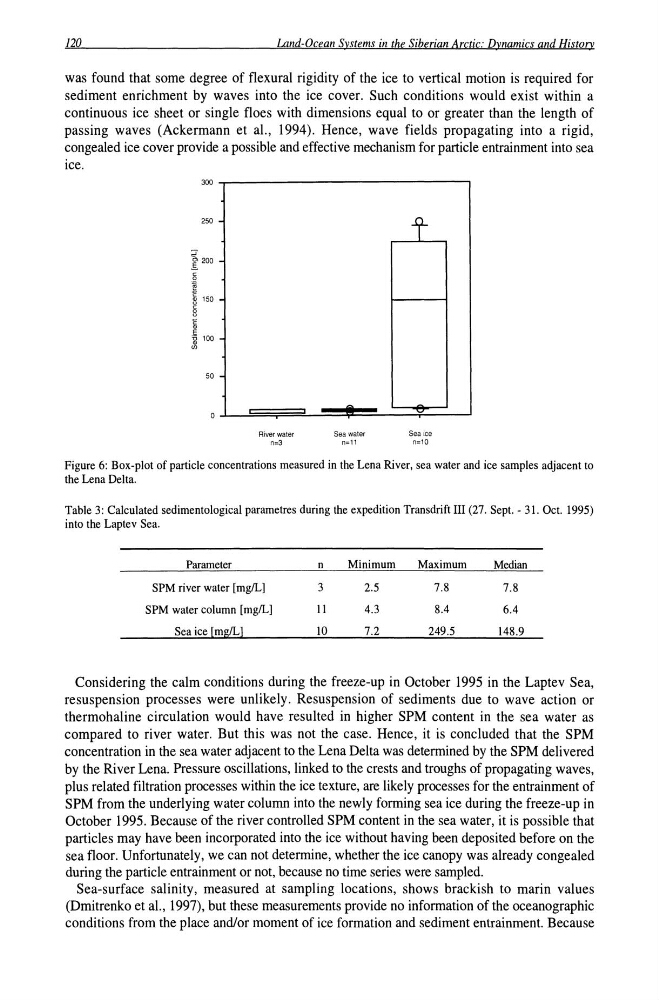
Figure 6: Box-plot of particle concentrations measured in the Lena River, sea water and ice samples adjacent to
the Lena Delta.
Table 3: Calculated sedimentological parametres during the expedition Transdrift III (27. Sept. - 31. Oct. 1995)
into the Laptev Sea.
Parameter
SPM river water [mg/L]
SPM water column [mgIL]
Sea ice [mg/LJ
n
Minimum
3
2.5
11
4.3
10
7.2
Maximum
7.8
8.4
249.5
Median
7.8
6.4
148.9
Considering the calm conditions during the freeze-up in October 1995 in the Laptev Sea,
resuspension processes were unlikely. Resuspension of sediments due to wave action or
thermohaline circulation would have resulted in higher SPM content in the sea water as
compared to river water. But this was not the case. Hence, it is concluded that the SPM
concentration in the sea water adjacent to the Lena Delta was determined by the SPM delivered
by the River Lena. Pressure oscillations, linked to the crests and troughs of propagating waves,
plus related filtration processes within the ice texture, are likely processes for the entrainment of
SPM from the underlying water column into the newly forming sea ice during the freeze-up in
October 1995. Because of the river controlled SPM content in the sea water, it is possible that
particles may have been incorporated into the ice without having been deposited before on the
sea floor. Unfortunately, we can not determine, whether the ice canopy was already congealed
during the particle entrainment or not, because no time series were sampled.
Sea-surface salinity, measured at sampling locations, shows brackish to marin values
(Dmitrenko et aI., 1997), but these measurements provide no information of the oceanographic
conditions from the place and/or moment of ice formation and sediment entrainment. Because
Land-Ocean Svstems in the Siberian Arctic: Dynamics and History
was found that some degree of flexural rigidity of the ice to vertical motion is required for
sediment enrichment by waves into the ice cover. Such conditions would exist within a
continuous ice sheet or single floes with dimensions equal to or greater than the length of
passing waves (Ackermann et aI., 1994). Hence, wave fields propagating into a rigid,
congealed ice cover provide a possible and effective mechanism for particle entrainment into sea
ice.
300
250
:J"
~ 200
c
.9
'§
i 150
8
C
~
' 2 100
if>
50
I
River water
n=3
Sea water
n=11
t
Sea ice
n=10
Figure 6: Box-plot of particle concentrations measured in the Lena River, sea water and ice samples adjacent to
the Lena Delta.
Table 3: Calculated sedimentological parametres during the expedition Transdrift III (27. Sept. - 31. Oct. 1995)
into the Laptev Sea.
Parameter
SPM river water [mg/L]
SPM water column [mgIL]
Sea ice [mg/LJ
n
Minimum
3
2.5
11
4.3
10
7.2
Maximum
7.8
8.4
249.5
Median
7.8
6.4
148.9
Considering the calm conditions during the freeze-up in October 1995 in the Laptev Sea,
resuspension processes were unlikely. Resuspension of sediments due to wave action or
thermohaline circulation would have resulted in higher SPM content in the sea water as
compared to river water. But this was not the case. Hence, it is concluded that the SPM
concentration in the sea water adjacent to the Lena Delta was determined by the SPM delivered
by the River Lena. Pressure oscillations, linked to the crests and troughs of propagating waves,
plus related filtration processes within the ice texture, are likely processes for the entrainment of
SPM from the underlying water column into the newly forming sea ice during the freeze-up in
October 1995. Because of the river controlled SPM content in the sea water, it is possible that
particles may have been incorporated into the ice without having been deposited before on the
sea floor. Unfortunately, we can not determine, whether the ice canopy was already congealed
during the particle entrainment or not, because no time series were sampled.
Sea-surface salinity, measured at sampling locations, shows brackish to marin values
(Dmitrenko et aI., 1997), but these measurements provide no information of the oceanographic
conditions from the place and/or moment of ice formation and sediment entrainment. Because