

Lindemnnn et al.: Particle Entrainment into Newly Forming Sea Ice
119
subfreezing air temperatures (Reimnitz et aI., 1992). After ceasing of the storm, frazil and
anchor ice with entrapped sediment rise to the water surface, forming a layer of grease ice with
turbid interstitial water. After congelation, this ice cover develops into turbid ice. Concerning
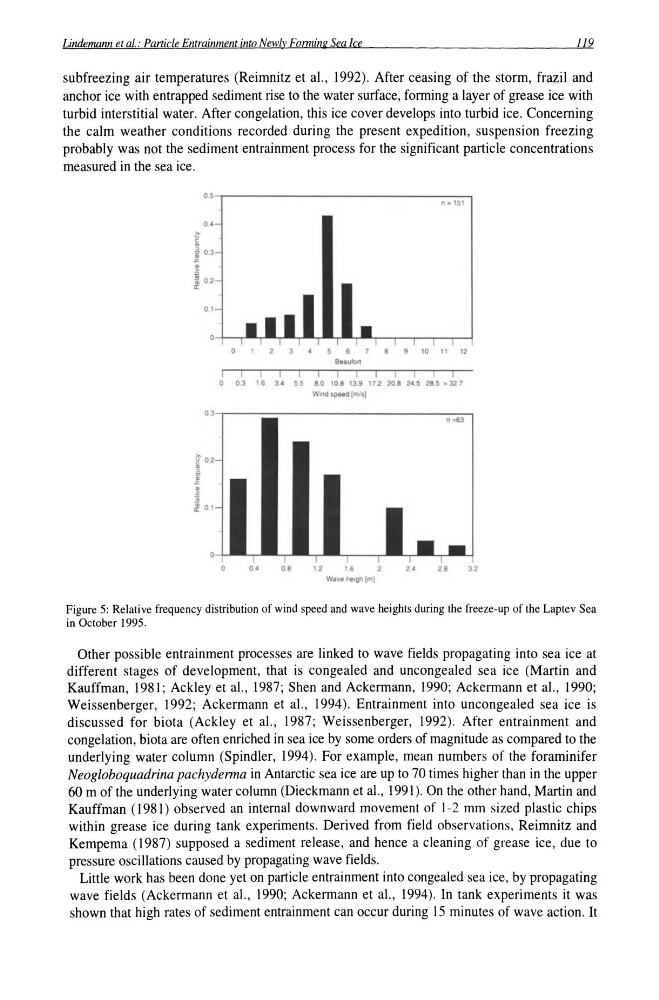
the calm weather conditions recorded during the present expedition, suspension freezing
probably was not the sediment entrainment process for the significant particle concentrations
measured in the sea ice.
05,--------------------------------. on.15\
o.
01
o
9
10
I'
12
etauiorl
I
I
I
I I i i
I
I
I I
I
03 16 3" 55 80 10813.9 172 208 245285,,321
WInCl SPHd Imlll
03 .------------------------------ n- .6 ~ 3~
~ 02i
~
004
08
12
I
16
I
2
-I
I
2"
28
32
Figure 5: Relative frequency distribution of wind speed and wave heights during the freeze-up of the Laptev Sea
in October 1995.
Other possible entrainment processes are linked to wave fields propagating into sea ice at
different stages of development, that is congealed and uncongealed sea ice (Martin and
Kauffman, 1981; Ackley et aI., 1987; Shen and Ackermann, 1990; Ackermann et aI., 1990;
Weissenberger, 1992; Ackermann et aI., 1994). Entrainment into uncongealed sea ice is
discussed for biota (Ackley et aI., 1987; Weissenberger, 1992). After entrainment and
congelation, biota are often enriched in sea ice by some orders of magnitude as compared to the
underlying water column (Spindler, 1994). For example, mean numbers of the foraminifer
Neogloboquadrina pachyderma in Antarctic sea ice are up to 70 times higher than in the upper
60 m of the underlying water column (Dieckmann et aI., 1991). On the other hand, Martin and
Kauffman (1981) observed an internal downward movement of 1-2 mm sized plastic chips
within grease ice during tank experiments. Derived from field observations, Reimnitz and
Kempema (1987) supposed a sediment release, and hence a cleaning of grease ice, due to
pressure oscillations caused by propagating wave fields.
Little work has been done yet on particle entrainment into congealed sea ice, by propagating
wave fields (Ackermann et aI., 1990; Ackermann et aI., 1994). In tank experiments it was
shown that high rates of sediment entrainment can occur during 15 minutes of wave action. It
119
subfreezing air temperatures (Reimnitz et aI., 1992). After ceasing of the storm, frazil and
anchor ice with entrapped sediment rise to the water surface, forming a layer of grease ice with
turbid interstitial water. After congelation, this ice cover develops into turbid ice. Concerning
the calm weather conditions recorded during the present expedition, suspension freezing
probably was not the sediment entrainment process for the significant particle concentrations
measured in the sea ice.
05,--------------------------------. on.15\
o.
01
o
9
10
I'
12
etauiorl
I
I
I
I I i i
I
I
I I
I
03 16 3" 55 80 10813.9 172 208 245285,,321
WInCl SPHd Imlll
03 .------------------------------ n- .6 ~ 3~
~ 02i
~
004
08
12
I
16
I
2
-I
I
2"
28
32
Figure 5: Relative frequency distribution of wind speed and wave heights during the freeze-up of the Laptev Sea
in October 1995.
Other possible entrainment processes are linked to wave fields propagating into sea ice at
different stages of development, that is congealed and uncongealed sea ice (Martin and
Kauffman, 1981; Ackley et aI., 1987; Shen and Ackermann, 1990; Ackermann et aI., 1990;
Weissenberger, 1992; Ackermann et aI., 1994). Entrainment into uncongealed sea ice is
discussed for biota (Ackley et aI., 1987; Weissenberger, 1992). After entrainment and
congelation, biota are often enriched in sea ice by some orders of magnitude as compared to the
underlying water column (Spindler, 1994). For example, mean numbers of the foraminifer
Neogloboquadrina pachyderma in Antarctic sea ice are up to 70 times higher than in the upper
60 m of the underlying water column (Dieckmann et aI., 1991). On the other hand, Martin and
Kauffman (1981) observed an internal downward movement of 1-2 mm sized plastic chips
within grease ice during tank experiments. Derived from field observations, Reimnitz and
Kempema (1987) supposed a sediment release, and hence a cleaning of grease ice, due to
pressure oscillations caused by propagating wave fields.
Little work has been done yet on particle entrainment into congealed sea ice, by propagating
wave fields (Ackermann et aI., 1990; Ackermann et aI., 1994). In tank experiments it was
shown that high rates of sediment entrainment can occur during 15 minutes of wave action. It