

Lindemann et al.: Particle Entrainment into Newly Forming Sea Ice
ll5
and direction as well as air temperature were recorded by a meteorological device M-49
(Factory of Meteorological Devices, Russia). While the vessel operated in open water, the wave
height was estimated visually from the ship's bridge. While the vessel was anchored, the flow
metre of the ship was used to measure surface-current speeds. Ice drift velocities were
estimated visually.
The equality of the data sets was tested, computing a Mann-Whitney U-test (Sachs, 1984).
Results
Ice conditions
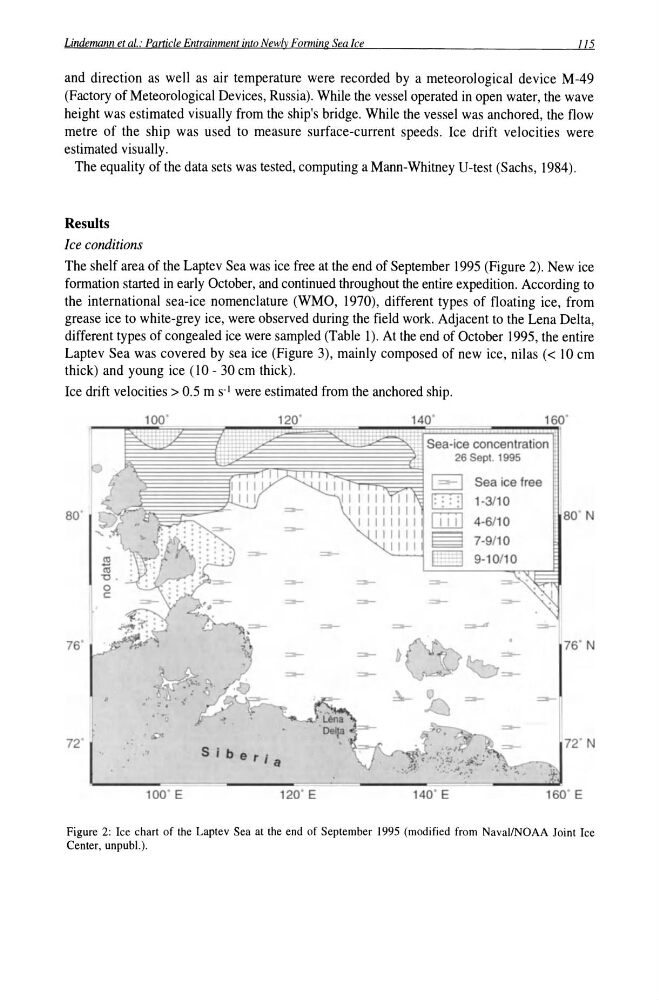
The shelf area of the Laptev Sea was ice free at the end of September 1995 (Figure 2). New ice
formation started in early October, and continued throughout the entire expedition. According to
the international sea-ice nomenclature (WMO, 1970), different types of floating ice, from
grease ice to white-grey ice, were observed during the field work. Adjacent to the Lena Delta,
different types of congealed ice were sampled (Table 1). At the end of October 1995, the entire
Laptev Sea was covered by sea ice (Figure 3), mainly composed of new ice, nilas « 10 cm
thick) and young ice (10 - 30 cm thick).
Ice drift velocities> 0.5 m S·I were estimated from the anchored ship.
120'
140'
lS0'
<
Sea-ice concentration
26 Sept. 1995
Sea ice free
1-3/10
80'
4-S/ 10
80' N
=-7·9/10
=-9-10/10
C1l
a;
'0 .
=>to
c:
~
=>t~
=-=:::.--d
b
7S' N
=--7S'
=-=-11
, ' 0
72'
Siberia
72' N
100' E
120' E
140' E
Figure 2: Ice chart of the Laptev Sea at the end of September 1995 (modified from NavalINOAA Joint Ice
Center, unpubl.).
ll5
and direction as well as air temperature were recorded by a meteorological device M-49
(Factory of Meteorological Devices, Russia). While the vessel operated in open water, the wave
height was estimated visually from the ship's bridge. While the vessel was anchored, the flow
metre of the ship was used to measure surface-current speeds. Ice drift velocities were
estimated visually.
The equality of the data sets was tested, computing a Mann-Whitney U-test (Sachs, 1984).
Results
Ice conditions
The shelf area of the Laptev Sea was ice free at the end of September 1995 (Figure 2). New ice
formation started in early October, and continued throughout the entire expedition. According to
the international sea-ice nomenclature (WMO, 1970), different types of floating ice, from
grease ice to white-grey ice, were observed during the field work. Adjacent to the Lena Delta,
different types of congealed ice were sampled (Table 1). At the end of October 1995, the entire
Laptev Sea was covered by sea ice (Figure 3), mainly composed of new ice, nilas « 10 cm
thick) and young ice (10 - 30 cm thick).
Ice drift velocities> 0.5 m S·I were estimated from the anchored ship.
120'
140'
lS0'
<
Sea-ice concentration
26 Sept. 1995
Sea ice free
1-3/10
80'
4-S/ 10
80' N
=-7·9/10
=-9-10/10
C1l
a;
'0 .
=>to
c:
~
=>t~
=-=:::.--d
b
7S' N
=--7S'
=-=-11
, ' 0
72'
Siberia
72' N
100' E
120' E
140' E
Figure 2: Ice chart of the Laptev Sea at the end of September 1995 (modified from NavalINOAA Joint Ice
Center, unpubl.).