

98
Land-Ocean Systems in the Siberian Arctic: Dynamics and History
keeping out, is the existence of molecular diffusivity. Due to it the layers may be mixed to the
quasi-homogeneous state. Moreover, the quasi-equilibrium state of the whole layered structure
is apparently achieved due to molecular diffusivity, that controls the minimal thickness of the
density interface and have influence on the mass and admixture fluxes between the mixed layers
(Krylov and Zatsepin, 1992).
,
x
2
,0
x
x
0
x
x x X
0
X
0'
0
x x
x X
,
X QXx x x +
,0
0
x
x
x
x xQxX
DO
0
x
)i(
0'
+
x
x
x
+ +
, 0
0
0
+
+ ++
+ +
0.2
+
+ + +
b
0
x
++
0
+
+ +
+
+
0
+
+
+
0
0
0
p
0.1
+
100
200
300
1000
Re
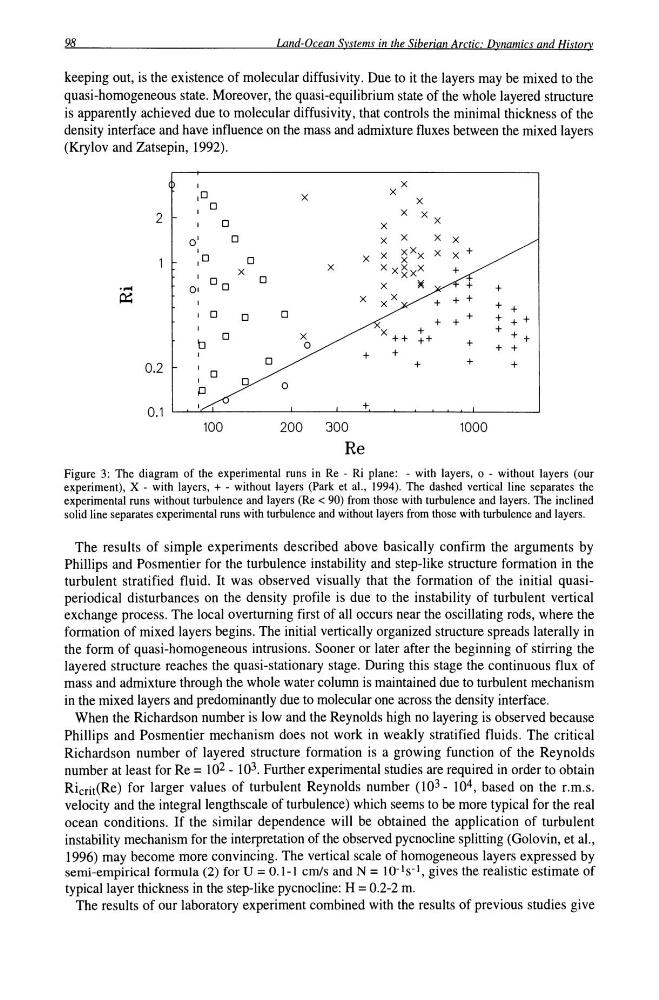
Figure 3: The diagram of the experimental runs in Re - Ri plane: - with layers, 0 - without layers (our
experiment), X - with layers, + - without layers (Park et aI., 1994). The dashed vertical line separates the
experimental runs without turbulence and layers (Re < 90) from those with turbulence and layers. The inclined
solid line separates experimental runs with turbulence and without layers from those with turbulence and layers.
The results of simple experiments described above basically confirm the arguments by
Phillips and Posmentier for the turbulence instability and step-like structure formation in the
turbulent stratified fluid. It was observed visually that the formation of the initial quasiperiodical disturbances on the density profile is due to the instability of turbulent vertical
exchange process. The local overturning first of all occurs near the oscillating rods, where the
formation of mixed layers begins. The initial vertically organized structure spreads laterally in
the form of quasi-homogeneous intrusions. Sooner or later after the beginning of stirring the
layered structure reaches the quasi-stationary stage. During this stage the continuous flux of
mass and admixture through the whole water column is maintained due to turbulent mechanism
in the mixed layers and predominantly due to molecular one across the density interface.
When the Richardson number is low and the Reynolds high no layering is observed because
Phillips and Posmentier mechanism does not work in weakly stratified fluids. The critical
Richardson number of layered structure formation is a growing function of the Reynolds
number at least for Re = 10 2 - 10 3 . Further experimental studies are required in order to obtain
Ricrit(Re) for larger values of turbulent Reynolds number (l0 3 - 10 4 , based on the r.m.s.
velocity and the integrallengthscale of turbulence) which seems to be more typical for the real
ocean conditions. If the similar dependence will be obtained the application of turbulent
instability mechanism for the interpretation of the observed pycnocline splitting (Golovin, et aI.,
1996) may become more convincing. The vertical scale of homogeneous layers expressed by
semi-empirical formula (2) for U = 0.1-\ cmls and N = 1O- 1 s- 1 , gives the realistic estimate of
typicaIlayer thickness in the step-like pycnocline: H = 0.2-2 m.
The results of our laboratory experiment combined with the results of previous studies give
Land-Ocean Systems in the Siberian Arctic: Dynamics and History
keeping out, is the existence of molecular diffusivity. Due to it the layers may be mixed to the
quasi-homogeneous state. Moreover, the quasi-equilibrium state of the whole layered structure
is apparently achieved due to molecular diffusivity, that controls the minimal thickness of the
density interface and have influence on the mass and admixture fluxes between the mixed layers
(Krylov and Zatsepin, 1992).
,
x
2
,0
x
x
0
x
x x X
0
X
0'
0
x x
x X
,
X QXx x x +
,0
0
x
x
x
x xQxX
DO
0
x
)i(
0'
+
x
x
x
+ +
, 0
0
0
+
+ ++
+ +
0.2
+
+ + +
b
0
x
++
0
+
+ +
+
+
0
+
+
+
0
0
0
p
0.1
+
100
200
300
1000
Re
Figure 3: The diagram of the experimental runs in Re - Ri plane: - with layers, 0 - without layers (our
experiment), X - with layers, + - without layers (Park et aI., 1994). The dashed vertical line separates the
experimental runs without turbulence and layers (Re < 90) from those with turbulence and layers. The inclined
solid line separates experimental runs with turbulence and without layers from those with turbulence and layers.
The results of simple experiments described above basically confirm the arguments by
Phillips and Posmentier for the turbulence instability and step-like structure formation in the
turbulent stratified fluid. It was observed visually that the formation of the initial quasiperiodical disturbances on the density profile is due to the instability of turbulent vertical
exchange process. The local overturning first of all occurs near the oscillating rods, where the
formation of mixed layers begins. The initial vertically organized structure spreads laterally in
the form of quasi-homogeneous intrusions. Sooner or later after the beginning of stirring the
layered structure reaches the quasi-stationary stage. During this stage the continuous flux of
mass and admixture through the whole water column is maintained due to turbulent mechanism
in the mixed layers and predominantly due to molecular one across the density interface.
When the Richardson number is low and the Reynolds high no layering is observed because
Phillips and Posmentier mechanism does not work in weakly stratified fluids. The critical
Richardson number of layered structure formation is a growing function of the Reynolds
number at least for Re = 10 2 - 10 3 . Further experimental studies are required in order to obtain
Ricrit(Re) for larger values of turbulent Reynolds number (l0 3 - 10 4 , based on the r.m.s.
velocity and the integrallengthscale of turbulence) which seems to be more typical for the real
ocean conditions. If the similar dependence will be obtained the application of turbulent
instability mechanism for the interpretation of the observed pycnocline splitting (Golovin, et aI.,
1996) may become more convincing. The vertical scale of homogeneous layers expressed by
semi-empirical formula (2) for U = 0.1-\ cmls and N = 1O- 1 s- 1 , gives the realistic estimate of
typicaIlayer thickness in the step-like pycnocline: H = 0.2-2 m.
The results of our laboratory experiment combined with the results of previous studies give