

gradient (Figure 2). As these parameters are largely controlled by water depth from the shelf to the deep sea, the
methane hydrate BSR shows two pinch-out zones, one at
the shallow water depth where pressure becomes too low
for hydrates to be stable and one toward the mid-ocean
ridge where heat flow becomes too high. Thus, if one
describes these two end members, one may still use the
terminology BSR but should be clear that the BSR does
not parallel the seafloor.
Seismic character of BSRs
BSRs related to hydrate/free gas phase transitions can be
distinguished from opal-A/opal-CT phase transitions
based on their phase polarity. While diagenetic BSRs have
the same positive phase as the seafloor reflection
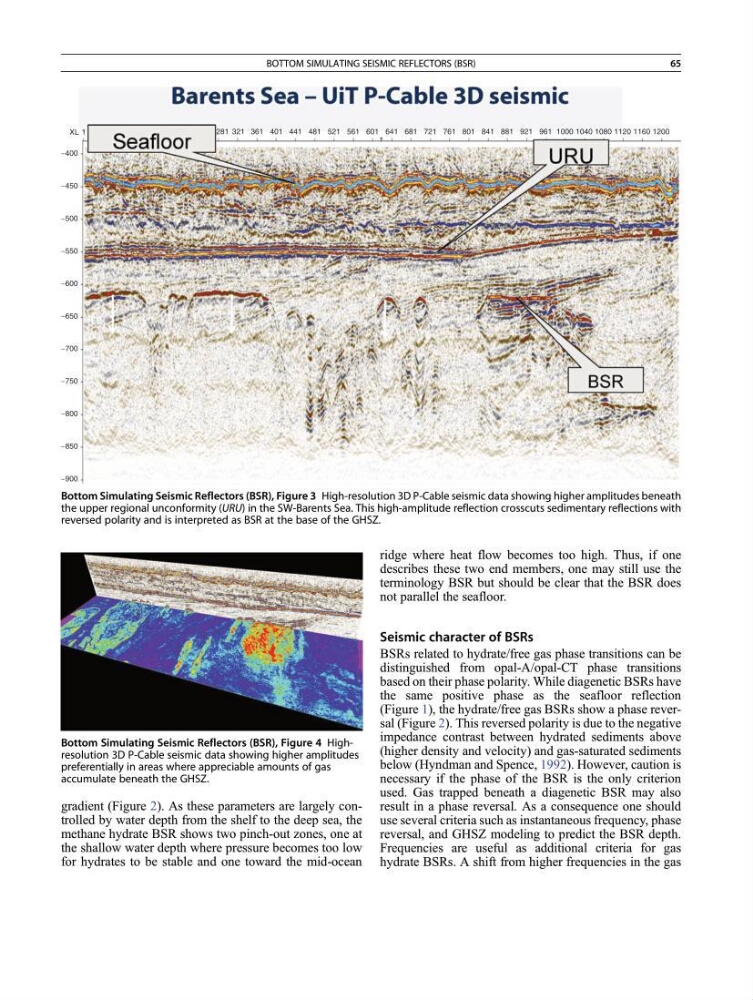
(Figure 1), the hydrate/free gas BSRs show a phase reversal (Figure 2). This reversed polarity is due to the negative
impedance contrast between hydrated sediments above
(higher density and velocity) and gas-saturated sediments
below (Hyndman and Spence, 1992). However, caution is
necessary if the phase of the BSR is the only criterion
used. Gas trapped beneath a diagenetic BSR may also
result in a phase reversal. As a consequence one should
use several criteria such as instantaneous frequency, phase
reversal, and GHSZ modeling to predict the BSR depth.
Frequencies are useful as additional criteria for gas
hydrate BSRs. A shift from higher frequencies in the gas
281
XL
−400
−450
−500
−550
−600
−650
−700
−750
−800
−850
−900
1
321 361 401 441 481 521 561 601 641 681 721 761 801 841 881 921 961 1000 1040 1080 1120 1160 1200
Bottom Simulating Seismic Reflectors (BSR), Figure 3 High-resolution 3D P-Cable seismic data showing higher amplitudes beneath
the upper regional unconformity (URU) in the SW-Barents Sea. This high-amplitude reflection crosscuts sedimentary reflections with
reversed polarity and is interpreted as BSR at the base of the GHSZ.
Bottom Simulating Seismic Reflectors (BSR), Figure 4 Highresolution 3D P-Cable seismic data showing higher amplitudes
preferentially in areas where appreciable amounts of gas
accumulate beneath the GHSZ.
BOTTOM SIMULATING SEISMIC REFLECTORS (BSR)
65
methane hydrate BSR shows two pinch-out zones, one at
the shallow water depth where pressure becomes too low
for hydrates to be stable and one toward the mid-ocean
ridge where heat flow becomes too high. Thus, if one
describes these two end members, one may still use the
terminology BSR but should be clear that the BSR does
not parallel the seafloor.
Seismic character of BSRs
BSRs related to hydrate/free gas phase transitions can be
distinguished from opal-A/opal-CT phase transitions
based on their phase polarity. While diagenetic BSRs have
the same positive phase as the seafloor reflection
(Figure 1), the hydrate/free gas BSRs show a phase reversal (Figure 2). This reversed polarity is due to the negative
impedance contrast between hydrated sediments above
(higher density and velocity) and gas-saturated sediments
below (Hyndman and Spence, 1992). However, caution is
necessary if the phase of the BSR is the only criterion
used. Gas trapped beneath a diagenetic BSR may also
result in a phase reversal. As a consequence one should
use several criteria such as instantaneous frequency, phase
reversal, and GHSZ modeling to predict the BSR depth.
Frequencies are useful as additional criteria for gas
hydrate BSRs. A shift from higher frequencies in the gas
281
XL
−400
−450
−500
−550
−600
−650
−700
−750
−800
−850
−900
1
321 361 401 441 481 521 561 601 641 681 721 761 801 841 881 921 961 1000 1040 1080 1120 1160 1200
Bottom Simulating Seismic Reflectors (BSR), Figure 3 High-resolution 3D P-Cable seismic data showing higher amplitudes beneath
the upper regional unconformity (URU) in the SW-Barents Sea. This high-amplitude reflection crosscuts sedimentary reflections with
reversed polarity and is interpreted as BSR at the base of the GHSZ.
Bottom Simulating Seismic Reflectors (BSR), Figure 4 Highresolution 3D P-Cable seismic data showing higher amplitudes
preferentially in areas where appreciable amounts of gas
accumulate beneath the GHSZ.
BOTTOM SIMULATING SEISMIC REFLECTORS (BSR)
65