

long), India’s Cox’s Bazar (about 240 km long), Texas’
Padre Island (about 210 km long), Australia’s Coorong
Beach (194 km), New Zealand’s Ninety Mile Beach
(each about 145 km long), Mexico’s Playa Novillero
(about 80 km long), and America’s Virginia Beach
(about 55 km long).
Grain size, shape, chemical composition, and color
Beaches are the product of wave-deposited sediment, but
the materials comprising the beach have an almost unlimited range in size, shape, and composition. In practice,
however, each beach area has a particular texture and composition with great variation occurring from place to place.
Most beaches are sandy (composed predominantly of
sand-sized grains, according to the Udden-Wentworth
scale), but the term also includes shingle, gravel (pebbles
and cobbles), and boulders that are deposited between
the upper swash limit and wave base (e.g., Hardisty,
1990; Short and Woodroffe, 2009). Coarse-grained
(cobble, boulder) beaches are prevalent in high latitudes
and typify many coastal segments in Canada and the
southern Baltic Sea coastline, for example, where glacial
materials and bedrock are eroded by coastal processes.
Coarse-grained beaches and barriers may also occur along
many high-energy coasts, as seen along the west coast of
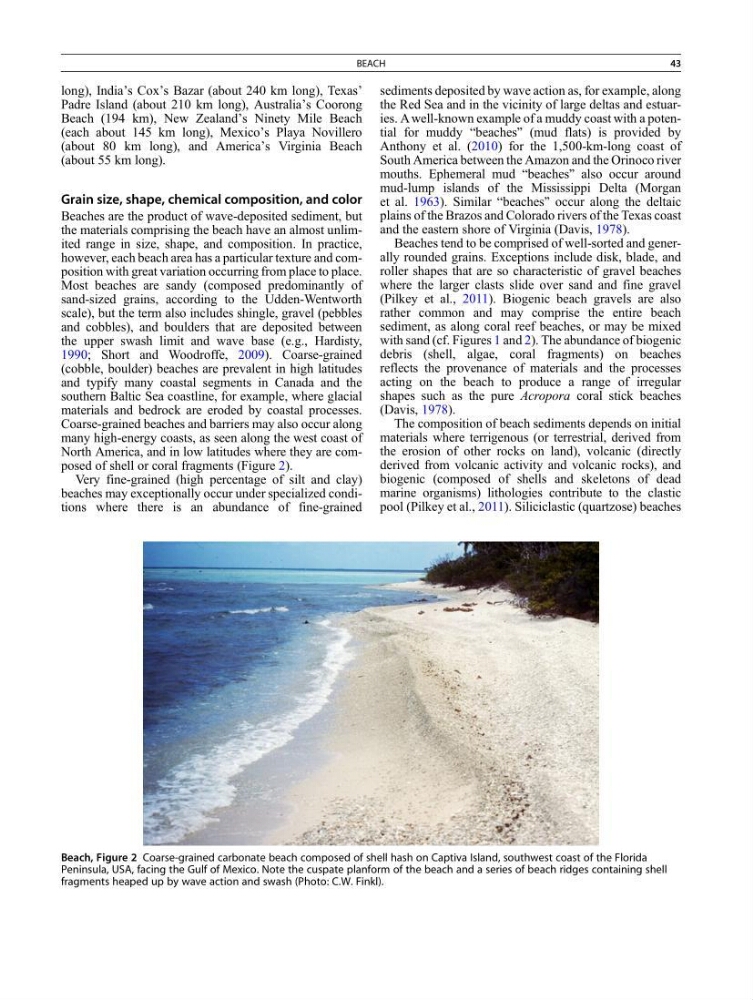
North America, and in low latitudes where they are composed of shell or coral fragments (Figure 2).
Very fine-grained (high percentage of silt and clay)
beaches may exceptionally occur under specialized conditions where there is an abundance of fine-grained
sediments deposited by wave action as, for example, along
the Red Sea and in the vicinity of large deltas and estuaries. A well-known example of a muddy coast with a potential for muddy “beaches” (mud flats) is provided by
Anthony et al. (2010) for the 1,500-km-long coast of
South America between the Amazon and the Orinoco river
mouths. Ephemeral mud “beaches” also occur around
mud-lump islands of the Mississippi Delta (Morgan
et al. 1963). Similar “beaches” occur along the deltaic
plains of the Brazos and Colorado rivers of the Texas coast
and the eastern shore of Virginia (Davis, 1978).
Beaches tend to be comprised of well-sorted and generally rounded grains. Exceptions include disk, blade, and
roller shapes that are so characteristic of gravel beaches
where the larger clasts slide over sand and fine gravel
(Pilkey et al., 2011). Biogenic beach gravels are also
rather common and may comprise the entire beach
sediment, as along coral reef beaches, or may be mixed
with sand (cf. Figures 1 and 2). The abundance of biogenic
debris (shell, algae, coral fragments) on beaches
reflects the provenance of materials and the processes
acting on the beach to produce a range of irregular
shapes such as the pure Acropora coral stick beaches
(Davis, 1978).
The composition of beach sediments depends on initial
materials where terrigenous (or terrestrial, derived from
the erosion of other rocks on land), volcanic (directly
derived from volcanic activity and volcanic rocks), and
biogenic (composed of shells and skeletons of dead
marine organisms) lithologies contribute to the clastic
pool (Pilkey et al., 2011). Siliciclastic (quartzose) beaches
Beach, Figure 2 Coarse-grained carbonate beach composed of shell hash on Captiva Island, southwest coast of the Florida
Peninsula, USA, facing the Gulf of Mexico. Note the cuspate planform of the beach and a series of beach ridges containing shell
fragments heaped up by wave action and swash (Photo: C.W. Finkl).
BEACH
43
Padre Island (about 210 km long), Australia’s Coorong
Beach (194 km), New Zealand’s Ninety Mile Beach
(each about 145 km long), Mexico’s Playa Novillero
(about 80 km long), and America’s Virginia Beach
(about 55 km long).
Grain size, shape, chemical composition, and color
Beaches are the product of wave-deposited sediment, but
the materials comprising the beach have an almost unlimited range in size, shape, and composition. In practice,
however, each beach area has a particular texture and composition with great variation occurring from place to place.
Most beaches are sandy (composed predominantly of
sand-sized grains, according to the Udden-Wentworth
scale), but the term also includes shingle, gravel (pebbles
and cobbles), and boulders that are deposited between
the upper swash limit and wave base (e.g., Hardisty,
1990; Short and Woodroffe, 2009). Coarse-grained
(cobble, boulder) beaches are prevalent in high latitudes
and typify many coastal segments in Canada and the
southern Baltic Sea coastline, for example, where glacial
materials and bedrock are eroded by coastal processes.
Coarse-grained beaches and barriers may also occur along
many high-energy coasts, as seen along the west coast of
North America, and in low latitudes where they are composed of shell or coral fragments (Figure 2).
Very fine-grained (high percentage of silt and clay)
beaches may exceptionally occur under specialized conditions where there is an abundance of fine-grained
sediments deposited by wave action as, for example, along
the Red Sea and in the vicinity of large deltas and estuaries. A well-known example of a muddy coast with a potential for muddy “beaches” (mud flats) is provided by
Anthony et al. (2010) for the 1,500-km-long coast of
South America between the Amazon and the Orinoco river
mouths. Ephemeral mud “beaches” also occur around
mud-lump islands of the Mississippi Delta (Morgan
et al. 1963). Similar “beaches” occur along the deltaic
plains of the Brazos and Colorado rivers of the Texas coast
and the eastern shore of Virginia (Davis, 1978).
Beaches tend to be comprised of well-sorted and generally rounded grains. Exceptions include disk, blade, and
roller shapes that are so characteristic of gravel beaches
where the larger clasts slide over sand and fine gravel
(Pilkey et al., 2011). Biogenic beach gravels are also
rather common and may comprise the entire beach
sediment, as along coral reef beaches, or may be mixed
with sand (cf. Figures 1 and 2). The abundance of biogenic
debris (shell, algae, coral fragments) on beaches
reflects the provenance of materials and the processes
acting on the beach to produce a range of irregular
shapes such as the pure Acropora coral stick beaches
(Davis, 1978).
The composition of beach sediments depends on initial
materials where terrigenous (or terrestrial, derived from
the erosion of other rocks on land), volcanic (directly
derived from volcanic activity and volcanic rocks), and
biogenic (composed of shells and skeletons of dead
marine organisms) lithologies contribute to the clastic
pool (Pilkey et al., 2011). Siliciclastic (quartzose) beaches
Beach, Figure 2 Coarse-grained carbonate beach composed of shell hash on Captiva Island, southwest coast of the Florida
Peninsula, USA, facing the Gulf of Mexico. Note the cuspate planform of the beach and a series of beach ridges containing shell
fragments heaped up by wave action and swash (Photo: C.W. Finkl).
BEACH
43