

Etymology and usage
According to Merriam-Webster (1994), the first known
use of the term beach was perhaps in 1535. The term beach
was used to describe “loose, water-worn pebbles of the
seashore,” probably from Old English bæce, bece
“stream,” from Proto-Germanic *bakiz. Extended to
loose, pebbly shores (1590s), and in dialect around Sussex
and Kent, beach still has the meaning “pebbles worn by
the waves.” French grève shows the same evolution
(http://www.etymonline.com/index.php?term¼beach).
Thus, early on the term beach did not refer to the expanse
of sand normally thought of today. Expansion of term to
cover the whole shore in the late sixteenth century may
have been related to a popular misunderstanding of the
“pebbles” connotation of “beach” in phrases such as “walk
on the beach” (http://www.word-detective.com/2007/12/
strand-beach/).
Geographic occurrence
Beaches are characteristic of almost all coasts where sediments accumulate alongshore. Sandy beaches occur in all
latitudes where there are waves, appropriate types of sediments that are available for accumulation, and a favorable
littoral geomorphology (e.g., Davies, 1980; Swift et al.,
1985; Pilkey, 2003). Long straight beaches tend to occur
along gently seaward-sloping continental shelves with
abundant sediment supply, whereas curved beaches in
coastal embayments are typically associated with steep
continental shelves and a limited sediment supply
(Masselink et al., 2011). Although most commonly associated with sedimentary coasts such as occur on barrier
islands, for example, beach–dune systems may be quite
extensive as major coastal features. It is estimated by various researchers that beaches occur along about a third of
the world’s coastline (Bird, 1984; Bird and Schwartz,
1985; van der Maarel, 1993), depending on the definitions
used for compound coasts. Some coasts, for example, may
be dominantly cliffy or rocky, but at the same time they
contain beaches in front of the cliffs or between rocky
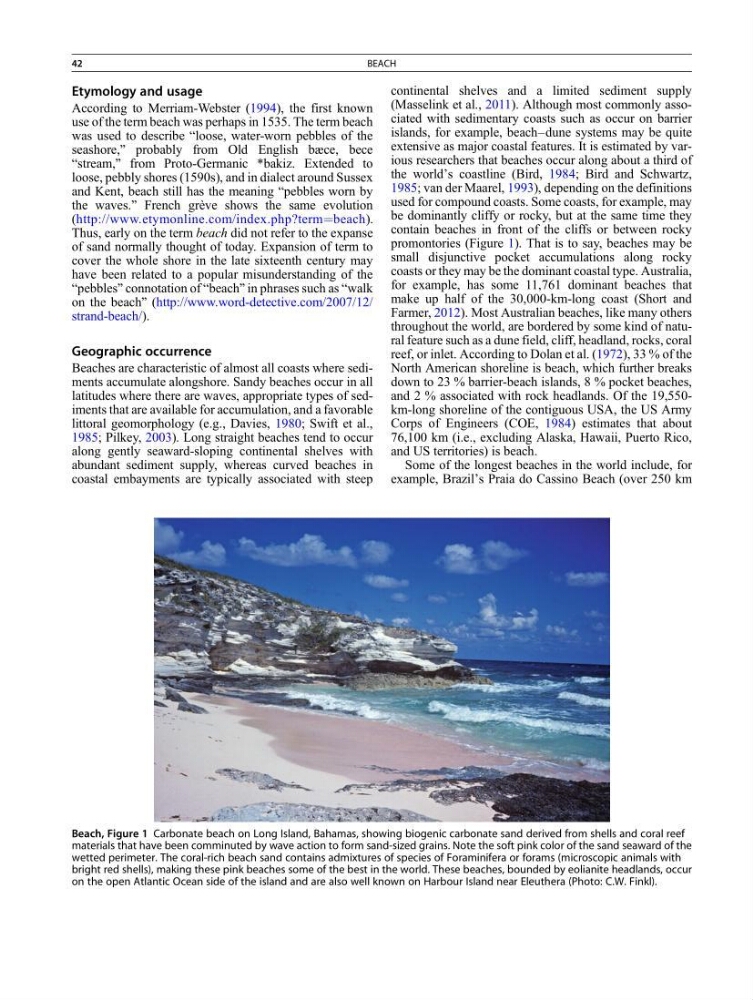
promontories (Figure 1). That is to say, beaches may be
small disjunctive pocket accumulations along rocky
coasts or they may be the dominant coastal type. Australia,
for example, has some 11,761 dominant beaches that
make up half of the 30,000-km-long coast (Short and
Farmer, 2012). Most Australian beaches, like many others
throughout the world, are bordered by some kind of natural feature such as a dune field, cliff, headland, rocks, coral
reef, or inlet. According to Dolan et al. (1972), 33 % of the
North American shoreline is beach, which further breaks
down to 23 % barrier-beach islands, 8 % pocket beaches,
and 2 % associated with rock headlands. Of the 19,550km-long shoreline of the contiguous USA, the US Army
Corps of Engineers (COE, 1984) estimates that about
76,100 km (i.e., excluding Alaska, Hawaii, Puerto Rico,
and US territories) is beach.
Some of the longest beaches in the world include, for
example, Brazil’s Praia do Cassino Beach (over 250 km
Beach, Figure 1 Carbonate beach on Long Island, Bahamas, showing biogenic carbonate sand derived from shells and coral reef
materials that have been comminuted by wave action to form sand-sized grains. Note the soft pink color of the sand seaward of the
wetted perimeter. The coral-rich beach sand contains admixtures of species of Foraminifera or forams (microscopic animals with
bright red shells), making these pink beaches some of the best in the world. These beaches, bounded by eolianite headlands, occur
on the open Atlantic Ocean side of the island and are also well known on Harbour Island near Eleuthera (Photo: C.W. Finkl).
42
BEACH
According to Merriam-Webster (1994), the first known
use of the term beach was perhaps in 1535. The term beach
was used to describe “loose, water-worn pebbles of the
seashore,” probably from Old English bæce, bece
“stream,” from Proto-Germanic *bakiz. Extended to
loose, pebbly shores (1590s), and in dialect around Sussex
and Kent, beach still has the meaning “pebbles worn by
the waves.” French grève shows the same evolution
(http://www.etymonline.com/index.php?term¼beach).
Thus, early on the term beach did not refer to the expanse
of sand normally thought of today. Expansion of term to
cover the whole shore in the late sixteenth century may
have been related to a popular misunderstanding of the
“pebbles” connotation of “beach” in phrases such as “walk
on the beach” (http://www.word-detective.com/2007/12/
strand-beach/).
Geographic occurrence
Beaches are characteristic of almost all coasts where sediments accumulate alongshore. Sandy beaches occur in all
latitudes where there are waves, appropriate types of sediments that are available for accumulation, and a favorable
littoral geomorphology (e.g., Davies, 1980; Swift et al.,
1985; Pilkey, 2003). Long straight beaches tend to occur
along gently seaward-sloping continental shelves with
abundant sediment supply, whereas curved beaches in
coastal embayments are typically associated with steep
continental shelves and a limited sediment supply
(Masselink et al., 2011). Although most commonly associated with sedimentary coasts such as occur on barrier
islands, for example, beach–dune systems may be quite
extensive as major coastal features. It is estimated by various researchers that beaches occur along about a third of
the world’s coastline (Bird, 1984; Bird and Schwartz,
1985; van der Maarel, 1993), depending on the definitions
used for compound coasts. Some coasts, for example, may
be dominantly cliffy or rocky, but at the same time they
contain beaches in front of the cliffs or between rocky
promontories (Figure 1). That is to say, beaches may be
small disjunctive pocket accumulations along rocky
coasts or they may be the dominant coastal type. Australia,
for example, has some 11,761 dominant beaches that
make up half of the 30,000-km-long coast (Short and
Farmer, 2012). Most Australian beaches, like many others
throughout the world, are bordered by some kind of natural feature such as a dune field, cliff, headland, rocks, coral
reef, or inlet. According to Dolan et al. (1972), 33 % of the
North American shoreline is beach, which further breaks
down to 23 % barrier-beach islands, 8 % pocket beaches,
and 2 % associated with rock headlands. Of the 19,550km-long shoreline of the contiguous USA, the US Army
Corps of Engineers (COE, 1984) estimates that about
76,100 km (i.e., excluding Alaska, Hawaii, Puerto Rico,
and US territories) is beach.
Some of the longest beaches in the world include, for
example, Brazil’s Praia do Cassino Beach (over 250 km
Beach, Figure 1 Carbonate beach on Long Island, Bahamas, showing biogenic carbonate sand derived from shells and coral reef
materials that have been comminuted by wave action to form sand-sized grains. Note the soft pink color of the sand seaward of the
wetted perimeter. The coral-rich beach sand contains admixtures of species of Foraminifera or forams (microscopic animals with
bright red shells), making these pink beaches some of the best in the world. These beaches, bounded by eolianite headlands, occur
on the open Atlantic Ocean side of the island and are also well known on Harbour Island near Eleuthera (Photo: C.W. Finkl).
42
BEACH