

referred to as the Cimmerian terrane. The detailed configuration of the Cimmerian terrane is unknown. In addition,
there is evidence for the existence of the Mongol–Okhotsk
Basin in central Asia (Figure 3a) from a series of remnant
island arc volcanics and ophiolites adjacent to the suture
zone as well as a large volume of seismically fast material
in the lower mantle underlying Siberia, imaged in seismic
tomography, and representing subducted Mongol–
Okhotsk Ocean slabs (Van der Voo et al., 1999). The initiation of breakup of Pangaea is focused in the central North
Atlantic, where seafloor spreading may have initiated as
early as 200 Ma (Labails et al., 2010).
180 Ma
At 180 Ma the configuration of the global oceans becomes
simplified as they are nearly entirely dominated by
Panthalassa and the meso-Tethys, with all smaller ocean
basins reduced to narrow remnant strips of deep ocean
crust. The closure of the Cache Creek Ocean is tightly
constrained to around 172–174 Ma (Colpron et al.,
2007) and references therein. The closure of the paleoTethys and accretion of the Cimmerian terrane occurred
along the southern Laurasian margin at 170 Ma in this
model (Figure 3b, c). This time also sees the birth of the
Pacific plate, visible as a triangular area in Figure 3b in
the center of Panthalassa. The “Pacific triangle” is an area
of the western Pacific where three Mesozoic magnetic
lineation sets (Japanese, Hawaiian, and Phoenix lineations) intersect, recording the birth of the Pacific plate at
a triple junction from three parent plates: the Farallon,
Izanagi, and Phoenix plates. The northwestern
(Japanese) lineations represent spreading between the
Pacific and Izanagi plates and young toward the west–
northwest, the easternmost (Hawaiian) lineations represent spreading between the Pacific and Farallon plates
and young toward the east, and the southernmost
(Phoenix) lineations represent spreading between the
Pacific and Phoenix plates and young toward the south
(Atwater, 1970; Nakanishi et al., 1992b). These three
plates existed prior to the establishment of the Pacific plate
in a simple ridge–ridge–ridge configuration (Figure 3a).
160 Ma
Rapid growth of the Pacific plate is recorded during this
time with a gradual increase in the spreading rate. Seafloor
spreading is well underway in the central North Atlantic,
signifying the breakup of Pangaea into Laurasia and
Gondwanaland (Figure 3c). The earliest onset of breakup
between North America and Africa has recently been
redated at around 200 Ma (Labails et al., 2010) coincident
with ultraslow seafloor spreading but with an increase in
spreading rate from 170 Ma. Further south, the deformation within South America associated with the breakup
of the South Atlantic is believed to have initiated at around
A
g e
[ m
. y . a g o ]
1 0 0
1 2 0
4
0
5
0
0
2 0 4 0 6 0 8 0
1 4 0
1 6 0
1 8 0
2 0 0
0
1
0
2
0
3
0
6
0
7
0
8
0
9
0
L a ti tu d e [d e g ]
0
150
450
750
1050
1350
1650
1950
2250
Age and latitude dependence of sediment thickness [m]
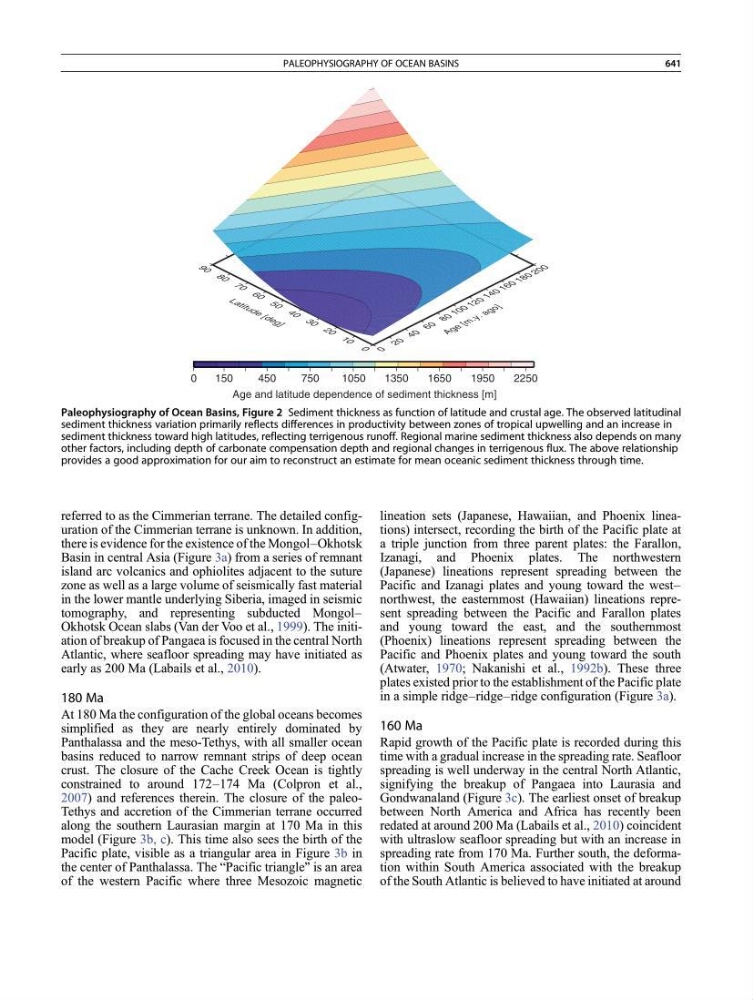
Paleophysiography of Ocean Basins, Figure 2 Sediment thickness as function of latitude and crustal age. The observed latitudinal
sediment thickness variation primarily reflects differences in productivity between zones of tropical upwelling and an increase in
sediment thickness toward high latitudes, reflecting terrigenous runoff. Regional marine sediment thickness also depends on many
other factors, including depth of carbonate compensation depth and regional changes in terrigenous flux. The above relationship
provides a good approximation for our aim to reconstruct an estimate for mean oceanic sediment thickness through time.
PALEOPHYSIOGRAPHY OF OCEAN BASINS
641