

information. The knowledge of the age of the water at the
time of the incorporation of
14
C into the carbonate shells
of planktonic and benthic organisms is important
(reservoir effect). In the analysis of organic matter, a possible admixture of older material (without
14 C) must be
considered. When dating young sediments, the influence
of industrialization and the atomic bomb effect has to be
taken into account. The combustion of fossil fuels releases
14
C-free carbon into the atmosphere (Suess effect), and
with the atomic bomb tests (1945–1993), additional
14
C
was released.
For older deposits, different methods of stratigraphy are
used, e.g., biostratigraphy. The first appearances and
extinctions of fossils provide time markers. Also widely
used is magnetostratigraphy, which can divide the younger geological history on the basis of magnetic field
reversals.
The backbone of paleoceanography is oxygen-isotope
stratigraphy. The ratio of the stable oxygen isotopes
16
O and
18 O, which is incorporated into the calcite shells,
depends on the isotope ratio of the water and the temperature, documenting climate development, and in particular
the growth and dismantling of ice sheets. Since they are
related to the Earth’s orbital parameters, time intervals
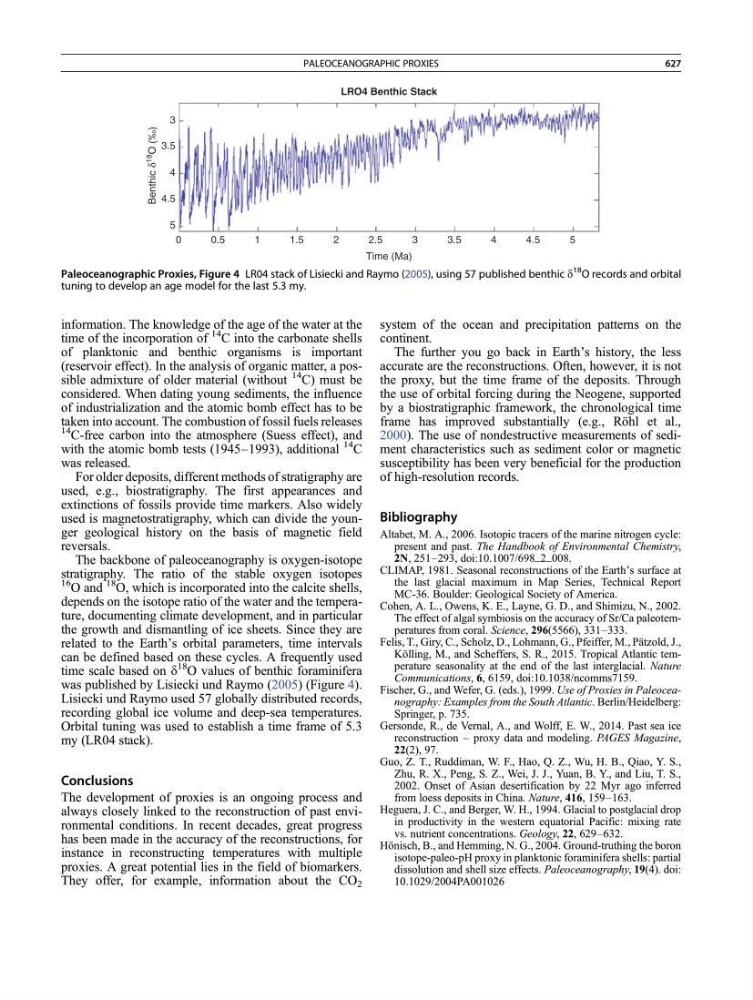
can be defined based on these cycles. A frequently used
time scale based on d
18
O values of benthic foraminifera
was published by Lisiecki und Raymo (2005) (Figure 4).
Lisiecki und Raymo used 57 globally distributed records,
recording global ice volume and deep-sea temperatures.
Orbital tuning was used to establish a time frame of 5.3
my (LR04 stack).
Conclusions
The development of proxies is an ongoing process and
always closely linked to the reconstruction of past environmental conditions. In recent decades, great progress
has been made in the accuracy of the reconstructions, for
instance in reconstructing temperatures with multiple
proxies. A great potential lies in the field of biomarkers.
They offer, for example, information about the CO 2
system of the ocean and precipitation patterns on the
continent.
The further you go back in Earth’s history, the less
accurate are the reconstructions. Often, however, it is not
the proxy, but the time frame of the deposits. Through
the use of orbital forcing during the Neogene, supported
by a biostratigraphic framework, the chronological time
frame has improved substantially (e.g., Röhl et al.,
2000). The use of nondestructive measurements of sediment characteristics such as sediment color or magnetic
susceptibility has been very beneficial for the production
of high-resolution records.
Bibliography
Altabet, M. A., 2006. Isotopic tracers of the marine nitrogen cycle:
present and past. The Handbook of Environmental Chemistry,
2N, 251–293, doi:10.1007/698_2_008.
CLIMAP, 1981. Seasonal reconstructions of the Earth’s surface at
the last glacial maximum in Map Series, Technical Report
MC-36. Boulder: Geological Society of America.
Cohen, A. L., Owens, K. E., Layne, G. D., and Shimizu, N., 2002.
The effect of algal symbiosis on the accuracy of Sr/Ca paleotemperatures from coral. Science, 296(5566), 331–333.
Felis, T., Giry, C., Scholz, D., Lohmann, G., Pfeiffer, M., Pätzold, J.,
Kölling, M., and Scheffers, S. R., 2015. Tropical Atlantic temperature seasonality at the end of the last interglacial. Nature
Communications, 6, 6159, doi:10.1038/ncomms7159.
Fischer, G., and Wefer, G. (eds.), 1999. Use of Proxies in Paleoceanography: Examples from the South Atlantic. Berlin/Heidelberg:
Springer, p. 735.
Gersonde, R., de Vernal, A., and Wolff, E. W., 2014. Past sea ice
reconstruction – proxy data and modeling. PAGES Magazine,
22(2), 97.
Guo, Z. T., Ruddiman, W. F., Hao, Q. Z., Wu, H. B., Qiao, Y. S.,
Zhu, R. X., Peng, S. Z., Wei, J. J., Yuan, B. Y., and Liu, T. S.,
2002. Onset of Asian desertification by 22 Myr ago inferred
from loess deposits in China. Nature, 416, 159–163.
Heguera, J. C., and Berger, W. H., 1994. Glacial to postglacial drop
in productivity in the western equatorial Pacific: mixing rate
vs. nutrient concentrations. Geology, 22, 629–632.
Hönisch, B., and Hemming, N. G., 2004. Ground-truthing the boron
isotope-paleo-pH proxy in planktonic foraminifera shells: partial
dissolution and shell size effects. Paleoceanography, 19(4). doi:
10.1029/2004PA001026
0
5
4.5
Benthic
δ 18
O (‰)
3.5
3
4
0.5
1
1.5
2
2.5
LRO4 Benthic Stack
Time (Ma)
3
3.5
4
4.5
5
Paleoceanographic Proxies, Figure 4 LR04 stack of Lisiecki and Raymo (2005), using 57 published benthic d
18 O records and orbital
tuning to develop an age model for the last 5.3 my.
PALEOCEANOGRAPHIC PROXIES
627