

the course of 1 year. The obliquity, which defines our tropical latitudes and polar circles, is presently 23
27
0 . The longitude of the perihelion is 102
, which confirms that the
Northern Hemisphere winter occurs when the Earth is about
the closest to the Sun.
The long-term variations of obliquity are given by Eq. 3
e ¼ e
Ã
þ
X
i
A i cos g i t þ B i
ð
Þ
For eccentricity, its analytical development can be calculated from
e ¼
ffiffiffiffiffiffiffiffiffiffiffiffiffiffiffiffiffiffiffiffiffiffiffiffiffiffiffiffiffiffiffiffiffiffiffiffiffiffiffiffiffiffiffiffi
e sin e
o
ð
Þ
2 þ e cos e
o
ð
Þ
2
q
or from
ffiffiffiffiffiffiffiffiffiffiffiffiffiffiffiffiffiffiffiffiffiffiffiffiffiffiffiffiffiffiffiffiffiffiffiffiffiffiffiffiffiffi
e sin p
ð
Þ
2 þ e cos p
ð
Þ
2
q
which leads to
e ¼ e
Ã
þ
X
i
E i cos l i t þ f i
ð
Þ
ð 5Þ
with e* ¼ 0.0287069.
From the definition of e
o ¼ p þ c and using Eqs. 1, 4,
and 5, the climatic precession parameter e sin e
o can be
expressed into the following trigonometrical expansion
as a quasiperiodic function of time:
e sin e
o ¼
X
i
P i sin a i t þ i
ð
Þ
ð6Þ
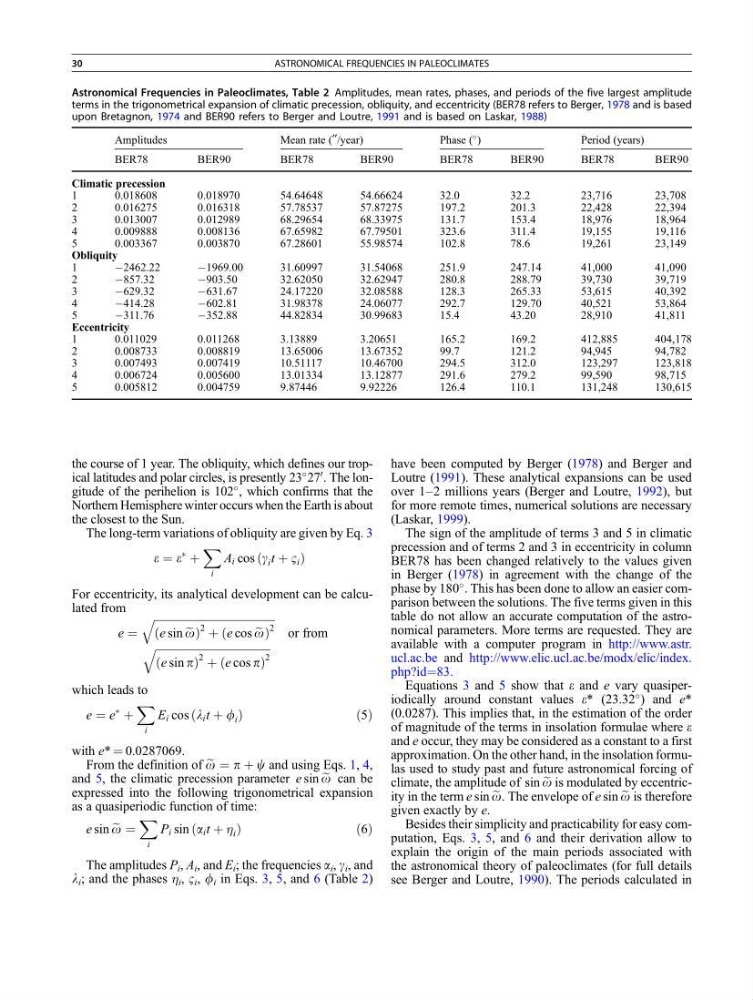
The amplitudes P i , A i , and E i ; the frequencies a i , g i , and
l i ; and the phases i , B i , f i in Eqs. 3, 5, and 6 (Table 2)
have been computed by Berger (1978) and Berger and
Loutre (1991). These analytical expansions can be used
over 1–2 millions years (Berger and Loutre, 1992), but
for more remote times, numerical solutions are necessary
(Laskar, 1999).
The sign of the amplitude of terms 3 and 5 in climatic
precession and of terms 2 and 3 in eccentricity in column
BER78 has been changed relatively to the values given
in Berger (1978) in agreement with the change of the
phase by 180
. This has been done to allow an easier comparison between the solutions. The five terms given in this
table do not allow an accurate computation of the astronomical parameters. More terms are requested. They are
available with a computer program in http://www.astr.
ucl.ac.be and http://www.elic.ucl.ac.be/modx/elic/index.
php?id¼83.
Equations 3 and 5 show that e and e vary quasiperiodically around constant values e* (23.32
) and e*
(0.0287). This implies that, in the estimation of the order
of magnitude of the terms in insolation formulae where e
and e occur, they may be considered as a constant to a first
approximation. On the other hand, in the insolation formulas used to study past and future astronomical forcing of
climate, the amplitude of sin e
o is modulated by eccentricity in the term e sin e
o. The envelope of e sin e
o is therefore
given exactly by e.
Besides their simplicity and practicability for easy computation, Eqs. 3, 5, and 6 and their derivation allow to
explain the origin of the main periods associated with
the astronomical theory of paleoclimates (for full details
see Berger and Loutre, 1990). The periods calculated in
Astronomical Frequencies in Paleoclimates, Table 2 Amplitudes, mean rates, phases, and periods of the five largest amplitude
terms in the trigonometrical expansion of climatic precession, obliquity, and eccentricity (BER78 refers to Berger, 1978 and is based
upon Bretagnon, 1974 and BER90 refers to Berger and Loutre, 1991 and is based on Laskar, 1988)
Amplitudes
Mean rate (ʺ/year)
Phase (
)
Period (years)
BER78
BER90
BER78
BER90
BER78
BER90
BER78
BER90
Climatic precession
1
0.018608
0.018970
54.64648
54.66624
32.0
32.2
23,716
23,708
2
0.016275
0.016318
57.78537
57.87275
197.2
201.3
22,428
22,394
3
0.013007
0.012989
68.29654
68.33975
131.7
153.4
18,976
18,964
4
0.009888
0.008136
67.65982
67.79501
323.6
311.4
19,155
19,116
5
0.003367
0.003870
67.28601
55.98574
102.8
78.6
19,261
23,149
Obliquity
1
À2462.22
À1969.00
31.60997
31.54068
251.9
247.14
41,000
41,090
2
À857.32
À903.50
32.62050
32.62947
280.8
288.79
39,730
39,719
3
À629.32
À631.67
24.17220
32.08588
128.3
265.33
53,615
40,392
4
À414.28
À602.81
31.98378
24.06077
292.7
129.70
40,521
53,864
5
À311.76
À352.88
44.82834
30.99683
15.4
43.20
28,910
41,811
Eccentricity
1
0.011029
0.011268
3.13889
3.20651
165.2
169.2
412,885
404,178
2
0.008733
0.008819
13.65006
13.67352
99.7
121.2
94,945
94,782
3
0.007493
0.007419
10.51117
10.46700
294.5
312.0
123,297
123,818
4
0.006724
0.005600
13.01334
13.12877
291.6
279.2
99,590
98,715
5
0.005812
0.004759
9.87446
9.92226
126.4
110.1
131,248
130,615
30
ASTRONOMICAL FREQUENCIES IN PALEOCLIMATES
27
0 . The longitude of the perihelion is 102
, which confirms that the
Northern Hemisphere winter occurs when the Earth is about
the closest to the Sun.
The long-term variations of obliquity are given by Eq. 3
e ¼ e
Ã
þ
X
i
A i cos g i t þ B i
ð
Þ
For eccentricity, its analytical development can be calculated from
e ¼
ffiffiffiffiffiffiffiffiffiffiffiffiffiffiffiffiffiffiffiffiffiffiffiffiffiffiffiffiffiffiffiffiffiffiffiffiffiffiffiffiffiffiffiffi
e sin e
o
ð
Þ
2 þ e cos e
o
ð
Þ
2
q
or from
ffiffiffiffiffiffiffiffiffiffiffiffiffiffiffiffiffiffiffiffiffiffiffiffiffiffiffiffiffiffiffiffiffiffiffiffiffiffiffiffiffiffi
e sin p
ð
Þ
2 þ e cos p
ð
Þ
2
q
which leads to
e ¼ e
Ã
þ
X
i
E i cos l i t þ f i
ð
Þ
ð 5Þ
with e* ¼ 0.0287069.
From the definition of e
o ¼ p þ c and using Eqs. 1, 4,
and 5, the climatic precession parameter e sin e
o can be
expressed into the following trigonometrical expansion
as a quasiperiodic function of time:
e sin e
o ¼
X
i
P i sin a i t þ i
ð
Þ
ð6Þ
The amplitudes P i , A i , and E i ; the frequencies a i , g i , and
l i ; and the phases i , B i , f i in Eqs. 3, 5, and 6 (Table 2)
have been computed by Berger (1978) and Berger and
Loutre (1991). These analytical expansions can be used
over 1–2 millions years (Berger and Loutre, 1992), but
for more remote times, numerical solutions are necessary
(Laskar, 1999).
The sign of the amplitude of terms 3 and 5 in climatic
precession and of terms 2 and 3 in eccentricity in column
BER78 has been changed relatively to the values given
in Berger (1978) in agreement with the change of the
phase by 180
. This has been done to allow an easier comparison between the solutions. The five terms given in this
table do not allow an accurate computation of the astronomical parameters. More terms are requested. They are
available with a computer program in http://www.astr.
ucl.ac.be and http://www.elic.ucl.ac.be/modx/elic/index.
php?id¼83.
Equations 3 and 5 show that e and e vary quasiperiodically around constant values e* (23.32
) and e*
(0.0287). This implies that, in the estimation of the order
of magnitude of the terms in insolation formulae where e
and e occur, they may be considered as a constant to a first
approximation. On the other hand, in the insolation formulas used to study past and future astronomical forcing of
climate, the amplitude of sin e
o is modulated by eccentricity in the term e sin e
o. The envelope of e sin e
o is therefore
given exactly by e.
Besides their simplicity and practicability for easy computation, Eqs. 3, 5, and 6 and their derivation allow to
explain the origin of the main periods associated with
the astronomical theory of paleoclimates (for full details
see Berger and Loutre, 1990). The periods calculated in
Astronomical Frequencies in Paleoclimates, Table 2 Amplitudes, mean rates, phases, and periods of the five largest amplitude
terms in the trigonometrical expansion of climatic precession, obliquity, and eccentricity (BER78 refers to Berger, 1978 and is based
upon Bretagnon, 1974 and BER90 refers to Berger and Loutre, 1991 and is based on Laskar, 1988)
Amplitudes
Mean rate (ʺ/year)
Phase (
)
Period (years)
BER78
BER90
BER78
BER90
BER78
BER90
BER78
BER90
Climatic precession
1
0.018608
0.018970
54.64648
54.66624
32.0
32.2
23,716
23,708
2
0.016275
0.016318
57.78537
57.87275
197.2
201.3
22,428
22,394
3
0.013007
0.012989
68.29654
68.33975
131.7
153.4
18,976
18,964
4
0.009888
0.008136
67.65982
67.79501
323.6
311.4
19,155
19,116
5
0.003367
0.003870
67.28601
55.98574
102.8
78.6
19,261
23,149
Obliquity
1
À2462.22
À1969.00
31.60997
31.54068
251.9
247.14
41,000
41,090
2
À857.32
À903.50
32.62050
32.62947
280.8
288.79
39,730
39,719
3
À629.32
À631.67
24.17220
32.08588
128.3
265.33
53,615
40,392
4
À414.28
À602.81
31.98378
24.06077
292.7
129.70
40,521
53,864
5
À311.76
À352.88
44.82834
30.99683
15.4
43.20
28,910
41,811
Eccentricity
1
0.011029
0.011268
3.13889
3.20651
165.2
169.2
412,885
404,178
2
0.008733
0.008819
13.65006
13.67352
99.7
121.2
94,945
94,782
3
0.007493
0.007419
10.51117
10.46700
294.5
312.0
123,297
123,818
4
0.006724
0.005600
13.01334
13.12877
291.6
279.2
99,590
98,715
5
0.005812
0.004759
9.87446
9.92226
126.4
110.1
131,248
130,615
30
ASTRONOMICAL FREQUENCIES IN PALEOCLIMATES