

Long-term variations of obliquity and precession
After having calculated the motion of the planetary point
masses around the Sun, the Poisson equations for the
Earth-Moon system were used to compute the long-term
variations of two astronomical parameters which, with
the eccentricity, play a fundamental role in the long-term
seasonal and latitudinal variations of insolation. These
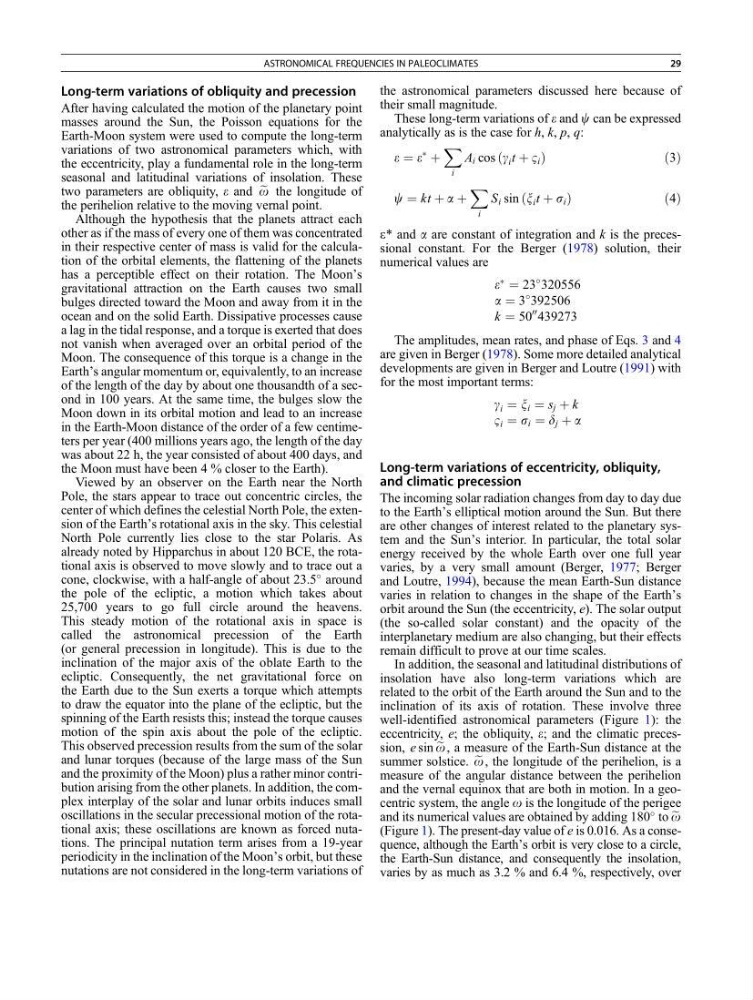
two parameters are obliquity, e and e
o the longitude of
the perihelion relative to the moving vernal point.
Although the hypothesis that the planets attract each
other as if the mass of every one of them was concentrated
in their respective center of mass is valid for the calculation of the orbital elements, the flattening of the planets
has a perceptible effect on their rotation. The Moon’s
gravitational attraction on the Earth causes two small
bulges directed toward the Moon and away from it in the
ocean and on the solid Earth. Dissipative processes cause
a lag in the tidal response, and a torque is exerted that does
not vanish when averaged over an orbital period of the
Moon. The consequence of this torque is a change in the
Earth’s angular momentum or, equivalently, to an increase
of the length of the day by about one thousandth of a second in 100 years. At the same time, the bulges slow the
Moon down in its orbital motion and lead to an increase
in the Earth-Moon distance of the order of a few centimeters per year (400 millions years ago, the length of the day
was about 22 h, the year consisted of about 400 days, and
the Moon must have been 4 % closer to the Earth).
Viewed by an observer on the Earth near the North
Pole, the stars appear to trace out concentric circles, the
center of which defines the celestial North Pole, the extension of the Earth’s rotational axis in the sky. This celestial
North Pole currently lies close to the star Polaris. As
already noted by Hipparchus in about 120 BCE, the rotational axis is observed to move slowly and to trace out a
cone, clockwise, with a half-angle of about 23.5
around
the pole of the ecliptic, a motion which takes about
25,700 years to go full circle around the heavens.
This steady motion of the rotational axis in space is
called the astronomical precession of the Earth
(or general precession in longitude). This is due to the
inclination of the major axis of the oblate Earth to the
ecliptic. Consequently, the net gravitational force on
the Earth due to the Sun exerts a torque which attempts
to draw the equator into the plane of the ecliptic, but the
spinning of the Earth resists this; instead the torque causes
motion of the spin axis about the pole of the ecliptic.
This observed precession results from the sum of the solar
and lunar torques (because of the large mass of the Sun
and the proximity of the Moon) plus a rather minor contribution arising from the other planets. In addition, the complex interplay of the solar and lunar orbits induces small
oscillations in the secular precessional motion of the rotational axis; these oscillations are known as forced nutations. The principal nutation term arises from a 19-year
periodicity in the inclination of the Moon’s orbit, but these
nutations are not considered in the long-term variations of
the astronomical parameters discussed here because of
their small magnitude.
These long-term variations of e and c can be expressed
analytically as is the case for h, k, p, q:
e ¼ e
Ã
þ
X
i
A i cos g i t þ B i
ð
Þ
ð3Þ
c ¼ kt þ a þ
X
i
S i sin x i t þ s i
ð
Þ
ð4Þ
e* and a are constant of integration and k is the precessional constant. For the Berger (1978) solution, their
numerical values are
e
Ã
¼ 23
320556
a ¼ 3
392506
k ¼ 50
00 439273
The amplitudes, mean rates, and phase of Eqs. 3 and 4
are given in Berger (1978). Some more detailed analytical
developments are given in Berger and Loutre (1991) with
for the most important terms:
g i ¼ x i ¼ s j þ k
B i ¼ s i ¼ d j þ a
Long-term variations of eccentricity, obliquity,
and climatic precession
The incoming solar radiation changes from day to day due
to the Earth’s elliptical motion around the Sun. But there
are other changes of interest related to the planetary system and the Sun’s interior. In particular, the total solar
energy received by the whole Earth over one full year
varies, by a very small amount (Berger, 1977; Berger
and Loutre, 1994), because the mean Earth-Sun distance
varies in relation to changes in the shape of the Earth’s
orbit around the Sun (the eccentricity, e). The solar output
(the so-called solar constant) and the opacity of the
interplanetary medium are also changing, but their effects
remain difficult to prove at our time scales.
In addition, the seasonal and latitudinal distributions of
insolation have also long-term variations which are
related to the orbit of the Earth around the Sun and to the
inclination of its axis of rotation. These involve three
well-identified astronomical parameters (Figure 1): the
eccentricity, e; the obliquity, e; and the climatic precession, e sin e
o , a measure of the Earth-Sun distance at the
summer solstice. e
o , the longitude of the perihelion, is a
measure of the angular distance between the perihelion
and the vernal equinox that are both in motion. In a geocentric system, the angle o is the longitude of the perigee
and its numerical values are obtained by adding 180
to e
o
(Figure 1). The present-day value of e is 0.016. As a consequence, although the Earth’s orbit is very close to a circle,
the Earth-Sun distance, and consequently the insolation,
varies by as much as 3.2 % and 6.4 %, respectively, over
ASTRONOMICAL FREQUENCIES IN PALEOCLIMATES
29
After having calculated the motion of the planetary point
masses around the Sun, the Poisson equations for the
Earth-Moon system were used to compute the long-term
variations of two astronomical parameters which, with
the eccentricity, play a fundamental role in the long-term
seasonal and latitudinal variations of insolation. These
two parameters are obliquity, e and e
o the longitude of
the perihelion relative to the moving vernal point.
Although the hypothesis that the planets attract each
other as if the mass of every one of them was concentrated
in their respective center of mass is valid for the calculation of the orbital elements, the flattening of the planets
has a perceptible effect on their rotation. The Moon’s
gravitational attraction on the Earth causes two small
bulges directed toward the Moon and away from it in the
ocean and on the solid Earth. Dissipative processes cause
a lag in the tidal response, and a torque is exerted that does
not vanish when averaged over an orbital period of the
Moon. The consequence of this torque is a change in the
Earth’s angular momentum or, equivalently, to an increase
of the length of the day by about one thousandth of a second in 100 years. At the same time, the bulges slow the
Moon down in its orbital motion and lead to an increase
in the Earth-Moon distance of the order of a few centimeters per year (400 millions years ago, the length of the day
was about 22 h, the year consisted of about 400 days, and
the Moon must have been 4 % closer to the Earth).
Viewed by an observer on the Earth near the North
Pole, the stars appear to trace out concentric circles, the
center of which defines the celestial North Pole, the extension of the Earth’s rotational axis in the sky. This celestial
North Pole currently lies close to the star Polaris. As
already noted by Hipparchus in about 120 BCE, the rotational axis is observed to move slowly and to trace out a
cone, clockwise, with a half-angle of about 23.5
around
the pole of the ecliptic, a motion which takes about
25,700 years to go full circle around the heavens.
This steady motion of the rotational axis in space is
called the astronomical precession of the Earth
(or general precession in longitude). This is due to the
inclination of the major axis of the oblate Earth to the
ecliptic. Consequently, the net gravitational force on
the Earth due to the Sun exerts a torque which attempts
to draw the equator into the plane of the ecliptic, but the
spinning of the Earth resists this; instead the torque causes
motion of the spin axis about the pole of the ecliptic.
This observed precession results from the sum of the solar
and lunar torques (because of the large mass of the Sun
and the proximity of the Moon) plus a rather minor contribution arising from the other planets. In addition, the complex interplay of the solar and lunar orbits induces small
oscillations in the secular precessional motion of the rotational axis; these oscillations are known as forced nutations. The principal nutation term arises from a 19-year
periodicity in the inclination of the Moon’s orbit, but these
nutations are not considered in the long-term variations of
the astronomical parameters discussed here because of
their small magnitude.
These long-term variations of e and c can be expressed
analytically as is the case for h, k, p, q:
e ¼ e
Ã
þ
X
i
A i cos g i t þ B i
ð
Þ
ð3Þ
c ¼ kt þ a þ
X
i
S i sin x i t þ s i
ð
Þ
ð4Þ
e* and a are constant of integration and k is the precessional constant. For the Berger (1978) solution, their
numerical values are
e
Ã
¼ 23
320556
a ¼ 3
392506
k ¼ 50
00 439273
The amplitudes, mean rates, and phase of Eqs. 3 and 4
are given in Berger (1978). Some more detailed analytical
developments are given in Berger and Loutre (1991) with
for the most important terms:
g i ¼ x i ¼ s j þ k
B i ¼ s i ¼ d j þ a
Long-term variations of eccentricity, obliquity,
and climatic precession
The incoming solar radiation changes from day to day due
to the Earth’s elliptical motion around the Sun. But there
are other changes of interest related to the planetary system and the Sun’s interior. In particular, the total solar
energy received by the whole Earth over one full year
varies, by a very small amount (Berger, 1977; Berger
and Loutre, 1994), because the mean Earth-Sun distance
varies in relation to changes in the shape of the Earth’s
orbit around the Sun (the eccentricity, e). The solar output
(the so-called solar constant) and the opacity of the
interplanetary medium are also changing, but their effects
remain difficult to prove at our time scales.
In addition, the seasonal and latitudinal distributions of
insolation have also long-term variations which are
related to the orbit of the Earth around the Sun and to the
inclination of its axis of rotation. These involve three
well-identified astronomical parameters (Figure 1): the
eccentricity, e; the obliquity, e; and the climatic precession, e sin e
o , a measure of the Earth-Sun distance at the
summer solstice. e
o , the longitude of the perihelion, is a
measure of the angular distance between the perihelion
and the vernal equinox that are both in motion. In a geocentric system, the angle o is the longitude of the perigee
and its numerical values are obtained by adding 180
to e
o
(Figure 1). The present-day value of e is 0.016. As a consequence, although the Earth’s orbit is very close to a circle,
the Earth-Sun distance, and consequently the insolation,
varies by as much as 3.2 % and 6.4 %, respectively, over
ASTRONOMICAL FREQUENCIES IN PALEOCLIMATES
29